


Insurgents targeted Iraqi government buildings and a military convoy in two near-simultaneous bomb attacks yesterday in the northern city of Mosul, killing three people, officials said.
A car bomb exploded inside the government compound in Mosul, the provincial capital of Nineveh, and early reports indicated it was a suicide attack, the military said in a statement. A mortar round destroyed a gas station across the street.
Three people inside the compound were killed and another one was injured in the morning blast, said provincial government spokesman Hazem Jalawi.
Also around 11am, a suicide car bomber attacked a convoy carrying an Iraqi general, slightly injuring him, the military said.
In other news, rebels and US forces battled yesterday in the central Iraqi town of Ramadi, and hospital officials reported three Iraqis were killed during the fighting.
Insurgents bombed one US security patrol and ambushed a separate convoy with small arms, rocket-propelled grenades and an improvised explosive, said 1st Lieutenant Lyle Gilbert. No Americans were injured, he said.
Witnesses said rebels also fired mortar rounds at US forces, whose return volleys included sniper fire.
Meanwhile, the US' top enemy in Iraq claimed the killing of nearly 50 unarmed army recruits in a cold-blooded assault on fledgling security forces slated to take part in a crackdown on rebels before elections due in January.
Insurgents blew up a roadside bomb near a US patrol in central Baghdad on Monday, wounding three Iraqi civilians, the Interior Ministry said. The US military had no immediate word on the blast that went off not far from the Australian embassy.
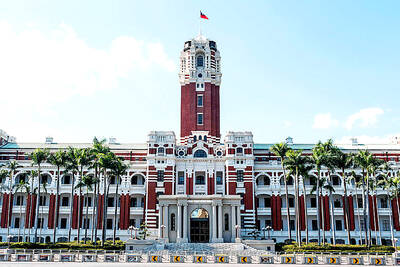
SECURITY: Taipei presses the US for arms supplies, saying the arms sales are not only a reflection of the US security commitment to Taiwan but also serve as a mutual deterrent against regional threats Taiwan is committed to preserving the cross-strait “status quo” and contributing to regional peace and stability, the Presidential Office said yesterday. “It is an undeniable fact that the Republic of China is a sovereign and independent democratic nation,” Presidential Office spokeswoman Karen Kuo (郭雅慧) reiterated, adding that Beijing has no right to claim sovereignty over Taiwan. The statements came after US President Donald Trump warned against Taiwanese independence. Trump wrapped up a state visit to Beijing on Friday, during which Chinese President Xi Jinping (習近平) had pressed him not to support Taiwan. Taiwan depends heavily on US security backing to deter China from carrying
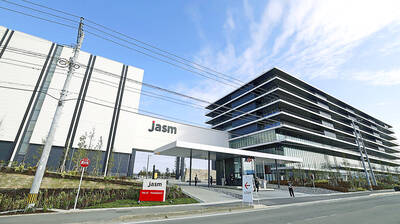
The subsidiary of Taiwan Semiconductor Manufacturing Co (TSMC, 台積電) in Kumamoto, Japan, turned a profit in the first quarter of this year, marking the first time the first fab of the unit has become profitable since mass production started at the end of 2024. According to the contract chipmaker’s financial statement released on Friday, Japan Advanced Semiconductor Manufacturing Inc (JASM), a joint venture running the fab in Kumamoto, posted NT$951 million (US$30.19 million) in profit in the January-to-March period, compared with a loss of NT$1.39 billion in the previous quarter, and a loss of NT$3.25 billion in the first quarter of
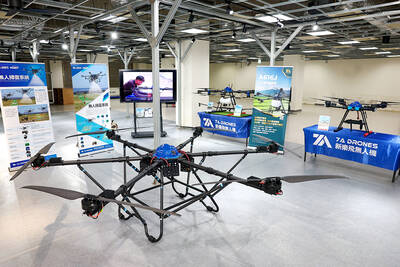
DRONE CENTRAL: Taiwan aims to become Asia’s democratic hub for drones, with most exports focused on high-quality military-grade models, an official said Taiwan’s drone industry is expected to expand significantly by 2030, producing 100,000 units per month and exporting half of them, the Ministry of Economic Affairs said yesterday. Current drone production capacity is about 15,000 units per month, but the industry can quickly scale up as demand increases, Industrial Development Administration Director-General Chiou Chyou-huey (邱求慧) told a news conference in Taipei. Taiwan’s drone output grew 2.5-fold last year to NT$12.9 billion (US$408.3 million) under a government program to develop the uncrewed vehicle sector, he said. The Executive Yuan in October last year approved plans to invest NT$44.2 billion into domestic production of uncrewed aerial
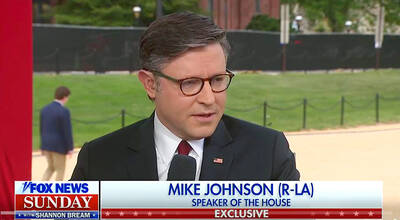
RESOLUTE BACKING: Two Republican senators are planning to introduce legislation that would impose immediate sanctions on China if it attempts to invade Taiwan US House of Representatives Speaker Mike Johnson on Sunday reaffirmed US congressional support for Taiwan, saying the US and “all freedom-loving people” have a stake in preventing China from seizing Taiwan by force. Johnson made the remarks in an interview with Fox News Sunday on US President Donald Trump’s summit with Chinese President Xi Jinping (習近平) last week. In an interview that aired on Friday on Fox News, just as Trump wrapped up a high-stakes visit to China, he said he has yet to green-light a new US$14 billion arms package to Taiwan and that it “depends on China.” “It’s a very good


 RSS
RSS