


Gunmen killed a Sunni Muslim cleric who was entering a mosque in Baghdad to perform noon prayers yesterday -- the second attack on a cleric belonging to the influential Association of Muslim Scholars in as many days -- the group said.
The attack came as relatives pleaded for the release of a British and two American hostages as a deadline loomed for the trio's beheading.
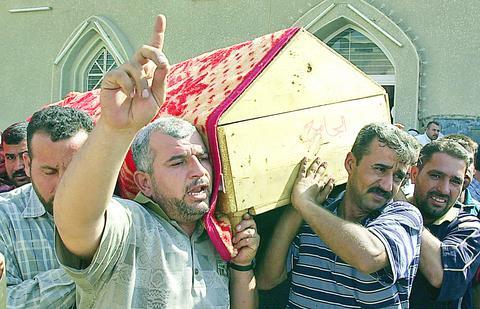
PHOTO: AP
The cleric, Sheik Mohammed Jadoa al-Janabi, was killed in Baghdad's predominantly Shiite al-Baya neighborhood. He was unarmed and had no security guards, said one official who spoke on condition of anonymity.
Late Sunday, gunmen attacked the car of another cleric, Sheik Hazem al-Zeidi, after he left a mosque in Baghdad's mostly Shiite eastern slum of Sadr City, said Sheik Abdul-Sattar Abdul-Jabbar, a senior member of the group.
Al-Zeidi was killed and his two bodyguards were taken hostage, though they were released unharmed early yesterday, he said.
There have been tit-for-tat killings of Shiite and Sunni clerics across the country the past year. They are widely believed to be motivated by sectarian sentiments, but the embattled police never thoroughly investigate such cases.
The Association of Muslim Scholars is a conservative group that strongly opposes the US presence in Iraq but has worked for the release of foreign hostages.
Insurgents have used kidnappings and spectacular bombings as their weapons of choice in a 17-month campaign to undermine the interim government of Prime Minister Ayad Allawi and force the US and its allies out of Iraq.
The Tawhid and Jihad group, led by Jordanian terror mastermind Abu Musab al-Zarqawi, was threatening to behead Americans Jack Hensley and Eugene Armstrong and Briton Kenneth Bigley yesterday. The three construction contractors were seized from their Baghdad house last week.
The British government and Bigley's brother, Philip, appealed for their release in statements broadcast repeatedly yesterday on pan-Arab satellite TV station Al-Arabiya.
"Ken has enjoyed working in the Arab world for the last 10 years in civil engineering and has many Arabic friends and is understanding and appreciative of the Islamic culture. He wanted to help the ordinary Iraqi people and is just doing his job," Philip Bigley said. "At the end of the day, we just want him home safe and well."
Hensley's wife, Patty, told Al-Jazeera that she learned of her husband's abduction through media reports. She said he, like all Americans in Iraq, was there to help the Iraqi people.
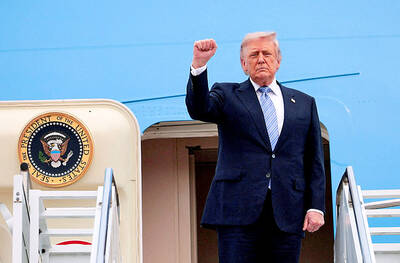
US-CHINA SUMMIT: MOFA welcomed US reassurance of no change in its Taiwan policy; Trump said he did not comment when Xi talked of opposing independence US President Donald Trump yesterday said he has not made a decision on whether to move forward with a major arms package for Taiwan after hearing concerns about it from Chinese President Xi Jinping (習近平). Trump’s comments on Taiwan came as he flew back to Washington after wrapping up critical talks in which both leaders said important progress was made in stabilizing US-China relations even as deep differences persist between the world’s two biggest powers on Iran and Taiwan. “I will make a determination,” Trump said, adding: “I’ll be making decisions. But, you know, I think the last thing we need right
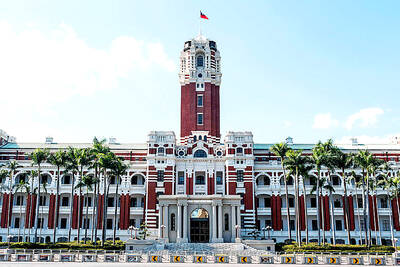
SECURITY: Taipei presses the US for arms supplies, saying the arms sales are not only a reflection of the US security commitment to Taiwan but also serve as a mutual deterrent against regional threats Taiwan is committed to preserving the cross-strait “status quo” and contributing to regional peace and stability, the Presidential Office said yesterday. “It is an undeniable fact that the Republic of China is a sovereign and independent democratic nation,” Presidential Office spokeswoman Karen Kuo (郭雅慧) reiterated, adding that Beijing has no right to claim sovereignty over Taiwan. The statements came after US President Donald Trump warned against Taiwanese independence. Trump wrapped up a state visit to Beijing on Friday, during which Chinese President Xi Jinping (習近平) had pressed him not to support Taiwan. Taiwan depends heavily on US security backing to deter China from carrying
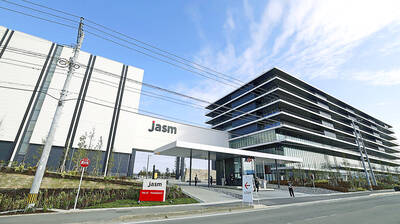
The subsidiary of Taiwan Semiconductor Manufacturing Co (TSMC, 台積電) in Kumamoto, Japan, turned a profit in the first quarter of this year, marking the first time the first fab of the unit has become profitable since mass production started at the end of 2024. According to the contract chipmaker’s financial statement released on Friday, Japan Advanced Semiconductor Manufacturing Inc (JASM), a joint venture running the fab in Kumamoto, posted NT$951 million (US$30.19 million) in profit in the January-to-March period, compared with a loss of NT$1.39 billion in the previous quarter, and a loss of NT$3.25 billion in the first quarter of
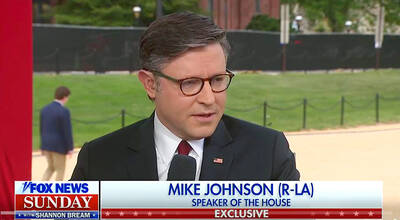
RESOLUTE BACKING: Two Republican senators are planning to introduce legislation that would impose immediate sanctions on China if it attempts to invade Taiwan US House of Representatives Speaker Mike Johnson on Sunday reaffirmed US congressional support for Taiwan, saying the US and “all freedom-loving people” have a stake in preventing China from seizing Taiwan by force. Johnson made the remarks in an interview with Fox News Sunday on US President Donald Trump’s summit with Chinese President Xi Jinping (習近平) last week. In an interview that aired on Friday on Fox News, just as Trump wrapped up a high-stakes visit to China, he said he has yet to green-light a new US$14 billion arms package to Taiwan and that it “depends on China.” “It’s a very good


 RSS
RSS