


President Vladimir Putin said that Russia is preparing for pre-emptive strikes against terrorists, as Chechen warlord Shamil Basayev claimed responsibility for a school hostage-taking and other terror attacks in Russia that have claimed more than 430 lives.
Speaking to a meeting of world mayors in Moscow on Friday, Putin also made a veiled attack on the West, saying that double standards in dealing with terrorism are "disastrous for global security."
Putin didn't name specific countries, but his comments appeared to be aimed against European and US officials who have urged Moscow to conduct peace talks with Chechen rebels.
"There continue to be attempts to divide terrorists into `ours and others,' into `moderates and radicals,'" Putin said in televised remarks. "All this is a condescending, justifying attitude to murders, which amounts to being an accomplice to terrorism."
Putin firmly ruled out any "bargaining" with terrorists. "Every concession leads to aggression, a widening of their demands and multiplies the losses," Putin said.
He said that "now in Russia, we are seriously preparing to act preventively against terrorists," adding that such action would be "in strict accordance with the law and norms of the constitution, norms of international law."
Putin didn't elaborate, and it wasn't immediately clear whether he was referring to action against terrorists only at home or abroad as well. Lower-level officials, including Defense Minister Sergei Ivanov, have said that Russia could conduct pre-emptive strikes against terrorists abroad, saying such action could involve any weapons except nuclear.
Putin's statement came as the main Chechen rebel Web site, Kavkaz-Center, posted what it said was an e-mail from Basayev, saying that his "Riyadus Salikhin Martyrs' Brigade" was responsible for the near-simultaneous bombings of two passenger jets last month, a suicide bombing outside a Moscow subway station and the school hostage-taking in Beslan that ended in a hail of gunfire.
More than 430 people were killed in the attacks, with some 338 of those deaths coming during the seizure of the school.
The lengthy e-mail, signed with Basayev's nom de guerre, Abdallakh Shamil, defended the attacks as part of the Chechen war for independence against Russia. At the same time, Basayev sought to shift blame for the bloodshed at the school, saying the deaths were caused by a Russian attempt to storm the school.
Putin and other officials said repeatedly that they had not planned to storm the school, where the attackers had rigged bombs surrounding the approximately 1,200 hostages. According to Russian officials and witnesses, after explosions rocked the school and armed volunteers started shooting, the special forces opened fire, too.
Basayev's e-mail disputed that. and alleged that Emergency Situations Ministry workers who entered the school to purportedly collect bodies of hostages who had been killed early in the crisis were in fact security officers, and that the explosions rang out only after those workers had yelled "Run out!" to the hostages.
Car bomb defused
Meanwhile, Russian security officials said police stopped a man driving a car wired with land mines and explosives in downtown Moscow early yesterday.
A duty officer at the Federal Security Service said the man was stopped by Moscow police around 1am. Police questioned him and found two land mines in the car, along with 200 grams of TNT under the driver's seat. The mines were connected with wires and had an antenna attached to them.
The man, who appeared to be intoxicated, told police he had been paid US$1,000 to park two cars with explosives in them along a Moscow street frequently used by top government officials, said the duty officer, who refused to give his name.
The ITAR-Tass news agency identified the man as 38-year-old Alexander Pumane.
Police later located a second car in a residential neighborhood in central Moscow and used a water cannon to open it. No explosives were found but residents of nearby buildings were evacuated as a precaution, the officer said.
The duty officer confirmed that the man later suffered a heart attack and died while in police custody, but the officer refused to elaborate.
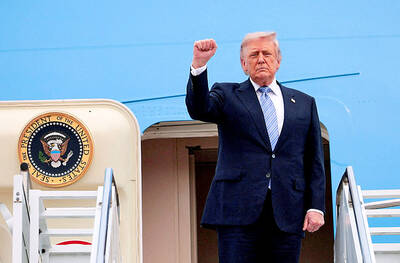
US-CHINA SUMMIT: MOFA welcomed US reassurance of no change in its Taiwan policy; Trump said he did not comment when Xi talked of opposing independence US President Donald Trump yesterday said he has not made a decision on whether to move forward with a major arms package for Taiwan after hearing concerns about it from Chinese President Xi Jinping (習近平). Trump’s comments on Taiwan came as he flew back to Washington after wrapping up critical talks in which both leaders said important progress was made in stabilizing US-China relations even as deep differences persist between the world’s two biggest powers on Iran and Taiwan. “I will make a determination,” Trump said, adding: “I’ll be making decisions. But, you know, I think the last thing we need right
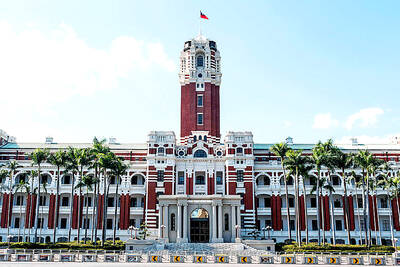
SECURITY: Taipei presses the US for arms supplies, saying the arms sales are not only a reflection of the US security commitment to Taiwan but also serve as a mutual deterrent against regional threats Taiwan is committed to preserving the cross-strait “status quo” and contributing to regional peace and stability, the Presidential Office said yesterday. “It is an undeniable fact that the Republic of China is a sovereign and independent democratic nation,” Presidential Office spokeswoman Karen Kuo (郭雅慧) reiterated, adding that Beijing has no right to claim sovereignty over Taiwan. The statements came after US President Donald Trump warned against Taiwanese independence. Trump wrapped up a state visit to Beijing on Friday, during which Chinese President Xi Jinping (習近平) had pressed him not to support Taiwan. Taiwan depends heavily on US security backing to deter China from carrying
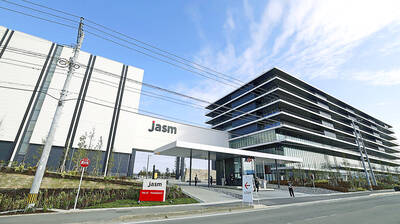
The subsidiary of Taiwan Semiconductor Manufacturing Co (TSMC, 台積電) in Kumamoto, Japan, turned a profit in the first quarter of this year, marking the first time the first fab of the unit has become profitable since mass production started at the end of 2024. According to the contract chipmaker’s financial statement released on Friday, Japan Advanced Semiconductor Manufacturing Inc (JASM), a joint venture running the fab in Kumamoto, posted NT$951 million (US$30.19 million) in profit in the January-to-March period, compared with a loss of NT$1.39 billion in the previous quarter, and a loss of NT$3.25 billion in the first quarter of
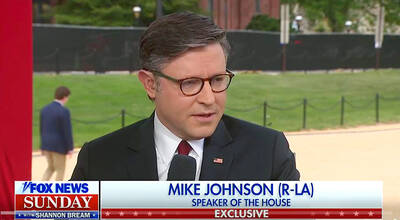
RESOLUTE BACKING: Two Republican senators are planning to introduce legislation that would impose immediate sanctions on China if it attempts to invade Taiwan US House of Representatives Speaker Mike Johnson on Sunday reaffirmed US congressional support for Taiwan, saying the US and “all freedom-loving people” have a stake in preventing China from seizing Taiwan by force. Johnson made the remarks in an interview with Fox News Sunday on US President Donald Trump’s summit with Chinese President Xi Jinping (習近平) last week. In an interview that aired on Friday on Fox News, just as Trump wrapped up a high-stakes visit to China, he said he has yet to green-light a new US$14 billion arms package to Taiwan and that it “depends on China.” “It’s a very good


 RSS
RSS