


At least 12 people were killed yesterday as US troops battled insurgents who fired a salvo of mortars into Iraq's government compound, orchestrated two failed car bombings and assassinated a security official.
Militants loyal to alleged al-Qaeda operative and Iraq's most wanted man, Abu Mussab al-Zarqawi, claimed attacks on the heavily-fortified Green Zone housing the government and the US embassy and on the notorious Abu Ghraib prison.
The battles raged hours after US-led troops across the country commemorated the third anniversary of the Sept. 11 attacks on the US, blamed on al-Qaeda, which led to the US-led invasions of Afghanistan and Iraq.
At least 12 people were killed, including two children, and 41 wounded during intense fighting around Haifa Street, considered a bastion of Saddam Hussein loyalists, according to doctors at two local hospitals.
Mazen al-Tomaisi, a Palestinian working for Saudi and al-Arabiya television, died and two photographers were wounded in a US helicopter attack during the clashes, media sources said.
The fighting erupted after a suspected car bomb exploded two hours before dawn in Haifa Street where insurgents and US troops clash regularly.
Heavy machine-gun and assault rifle fire reverberated across the street for three hours and a tank was mobilized to support US troops.
As the sun rose at 6:30am, a car bomb struck the tank, wounding four people, a military spokeswoman said.
A pair of US helicopters then swooped down over the neighborhood and fired missiles into the mob, scattering at least five corpses across the ground.
The US military said the tank was destroyed from the air "to prevent looting and harm to the Iraqi people."
Simultaneously, two drivers were shot dead while trying to ram cars rigged with explosives into the high-security Green Zone and the notorious Abu Ghraib prison, Iraqi and US sources said.
Another man was killed trying to smash his car through the compound of the Abu Ghraib prison west of Baghdad, the US military said.
An Iraqi police colonel also died in a car bombing on his way to work, a ministry spokesman said.
Gunmen attacked security forces guarding the Dibis and Kirkuk oilfields in two separate attacks yesterday, injuring five officers, a security official said.
He said the assailants fled the scene in the two attacks. No other details were available.
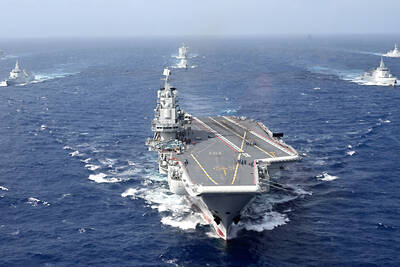
PROVOCATIVE: Chinese Deputy Ambassador to the UN Sun Lei accused Japan of sending military vessels to deliberately provoke tensions in the Taiwan Strait China denounced remarks by Japan and the EU about the South China Sea at a UN Security Council meeting on Monday, and accused Tokyo of provocative behavior in the Taiwan Strait and planning military expansion. Ayano Kunimitsu, a Japanese vice foreign minister, told the Council meeting on maritime security that Tokyo was seriously concerned about the situation in the East China and South China seas, and reiterated Japan’s opposition to any attempt to change the “status quo” by force, and obstruction of freedom of navigation and overflight. Stavros Lambrinidis, head of the EU delegation to the UN, also highlighted South China Sea
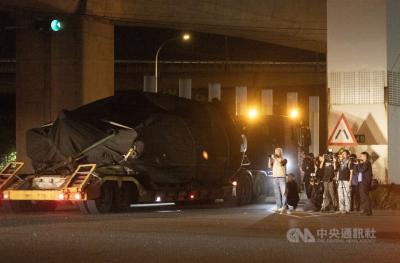
The final batch of 28 M1A2T Abrams tanks purchased from the US arrived at Taipei Port last night and were transported to the Armor Training Command in Hsinchu County’s Hukou Township (湖口), completing the military’s multi-year procurement of 108 of the tanks. Starting at 12:10am today, reporters observed more than a dozen civilian flatbed trailers departing from Taipei Port, each carrying an M1A2T tank covered with black waterproof tarps. Escorted by military vehicles, the convoy traveled via the West Coast Expressway to the Armor Training Command, with police implementing traffic control. The army operates about 1,000 tanks, including CM-11 Brave Tiger
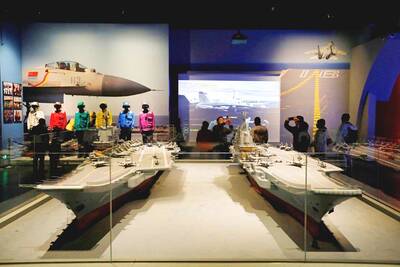
China on Wednesday teased in a video an aircraft carrier that could be its fourth, and the first using nuclear power, while making an allusion to Taiwan and vowing to further build up its islands, as it looks to boost maritime power, secure resources and bolster territorial claims. The video, issued on the eve of the 77th founding anniversary of the Chinese People’s Liberation Army Navy, featured fictional officers with names that are homophones of three commissioned aircraft carriers, the Liaoning (遼寧), Shandong (山東) and Fujian (福建). Titled Into the Deep, it showed a 19-year-old named “Hejian” (何劍) joining the group, sparking
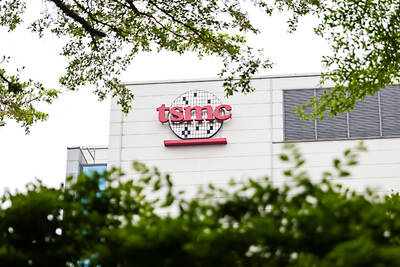
Taiwan Semiconductor Manufacturing Co (TSMC, 台積電), the world’s largest contract chipmaker, said it expects its 2-nanometer (2nm) chip capacity to grow at a compound annual rate of 70 percent from this year to 2028. The projection comes as five fabs begin volume production of 2-nanometer chips this year — two in Hsinchu and three in Kaohsiung — TSMC senior vice president and deputy cochief operating officer Cliff Hou (侯永清) said at the company’s annual technology symposium in Silicon Valley, California, last week. Output in the first year of 2-nanometer production, which began in the fourth quarter of last year, is expected to


 RSS
RSS