


Shortly after boarding a chartered flight on the first leg of his seven-day visit to the nation's two diplomatic allies in Central America, President Chen Shui-bian (
Chen's announcement at an altitude of 9,000m follows in the wake of media reports that China had apparently cancelled its military exercise on Dongshan Island after withdrawing some 3,000 troops.
The Han Kuang drill was slated to take place on Sept. 9.
"Some said that it was a goodwill gesture from China," Chen told reporters. "Regardless of what China's intention is, Taiwan definitely fosters goodwill and is sincere in pursuing cross-strait cooperation based on the principle of peace."
"I hope the two sides of the Taiwan Strait can move toward better cooperation and create a win-win situation," the president said, adding that the decision was made after consulting with Minister of Defense Lee Jye (
Saying that the US and Japan were foes 50 years ago, but have since become good partners, Chen expressed the hope that China and Taiwan would "strive toward persistent peace and goodwill."
At a banquet held in his honor by a Taiwanese expatriate in Honolulu, Chen on Monday stressed that the existence of the Republic of China "is crystal clear."
After a ten-hour flight, Chen and his entourage arrived in Honolulu yesterday for a refueling stop. The president and his entourage were welcomed by hundreds of flag-waving expatriates and a number of political figures, including Hawaiian Attorney General Mark Bennett and Taiwan's representative to the US David Lee (
Hawaiian Governor Linda Lingle was not available to meet with Chen during the stopover, as she was attending the Republican Party's national convention in New York.
During the stopover of less than seven hours, Chen made a quick visit to Pearl Harbor's Arizona Memorial.
According to a source, Chen also met William Brown, chairman of the American Institute in Taiwan, and Democratic Representative Daniel Inouye.
According to the source, Brown said that the decision to cancel the Han Kuang drill "was a gesture of great goodwill" and that "the US welcomes the decision."
Chen and his delegation yesterday departed for Panama to attend the inauguration of Panamanian president-elect Martin Torrijos on Sept. 1.
Chen is slated to travel to Belize on Sept. 2 for an official visit.
Also See Stories:
MOFA denies US intervention
Cancelation intended as olive branch, Lee Jye says
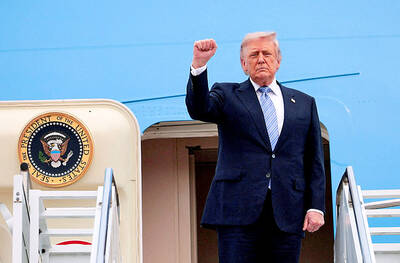
US-CHINA SUMMIT: MOFA welcomed US reassurance of no change in its Taiwan policy; Trump said he did not comment when Xi talked of opposing independence US President Donald Trump yesterday said he has not made a decision on whether to move forward with a major arms package for Taiwan after hearing concerns about it from Chinese President Xi Jinping (習近平). Trump’s comments on Taiwan came as he flew back to Washington after wrapping up critical talks in which both leaders said important progress was made in stabilizing US-China relations even as deep differences persist between the world’s two biggest powers on Iran and Taiwan. “I will make a determination,” Trump said, adding: “I’ll be making decisions. But, you know, I think the last thing we need right
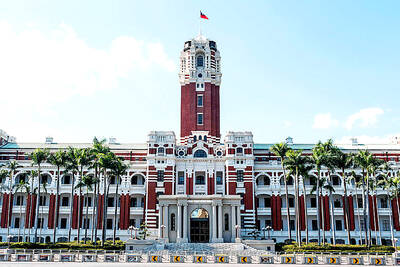
SECURITY: Taipei presses the US for arms supplies, saying the arms sales are not only a reflection of the US security commitment to Taiwan but also serve as a mutual deterrent against regional threats Taiwan is committed to preserving the cross-strait “status quo” and contributing to regional peace and stability, the Presidential Office said yesterday. “It is an undeniable fact that the Republic of China is a sovereign and independent democratic nation,” Presidential Office spokeswoman Karen Kuo (郭雅慧) reiterated, adding that Beijing has no right to claim sovereignty over Taiwan. The statements came after US President Donald Trump warned against Taiwanese independence. Trump wrapped up a state visit to Beijing on Friday, during which Chinese President Xi Jinping (習近平) had pressed him not to support Taiwan. Taiwan depends heavily on US security backing to deter China from carrying
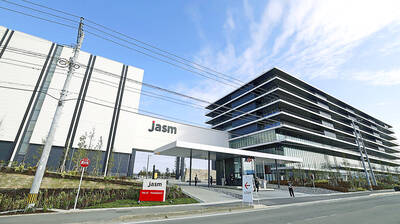
The subsidiary of Taiwan Semiconductor Manufacturing Co (TSMC, 台積電) in Kumamoto, Japan, turned a profit in the first quarter of this year, marking the first time the first fab of the unit has become profitable since mass production started at the end of 2024. According to the contract chipmaker’s financial statement released on Friday, Japan Advanced Semiconductor Manufacturing Inc (JASM), a joint venture running the fab in Kumamoto, posted NT$951 million (US$30.19 million) in profit in the January-to-March period, compared with a loss of NT$1.39 billion in the previous quarter, and a loss of NT$3.25 billion in the first quarter of
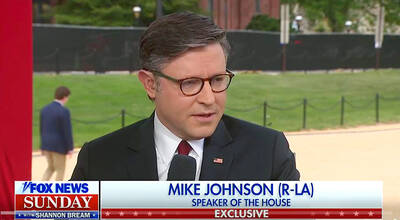
RESOLUTE BACKING: Two Republican senators are planning to introduce legislation that would impose immediate sanctions on China if it attempts to invade Taiwan US House of Representatives Speaker Mike Johnson on Sunday reaffirmed US congressional support for Taiwan, saying the US and “all freedom-loving people” have a stake in preventing China from seizing Taiwan by force. Johnson made the remarks in an interview with Fox News Sunday on US President Donald Trump’s summit with Chinese President Xi Jinping (習近平) last week. In an interview that aired on Friday on Fox News, just as Trump wrapped up a high-stakes visit to China, he said he has yet to green-light a new US$14 billion arms package to Taiwan and that it “depends on China.” “It’s a very good


 RSS
RSS