

Venezuelan authorities will conduct a random audit of the recall referendum, former US president Jimmy Carter announced on Tuesday, adding that he had no reason to doubt the vote won by President Hugo Chavez.
Carter said he and the Organization of American States (OAS) had suggested the move in order to ease concerns voiced by the opposition.
Carter, a Nobel Peace Prize laureate, said the electoral authorities agreed to conduct the random audit of 150 voting desks yesterday, monitored by officials of the government, the opposition and international observers.
"The results of this second audit should be sufficient to address the remaining concerns that have been expressed by the opposition," Carter said.
Opposition leaders have denounced as a "massive fraud" the official outcome of the referendum which has Chavez garnering 58 percent of the ballots. The opposition had pushed for the vote hoping it could revoke the president's mandate.
But Carter, who had already endorsed the outcome, reiterated on Tuesday he had "no reason to doubt the integrity of the electoral process or the accuracy of the referendum itself."
Carter and other international election monitors pledged to go the extra mile to dispel opposition claims that the referendum was rigged, and to prevent further political upheaval.
Carter and Cesar Gaviria, the head of the OAS, have been working for two years to find a solution to the often bloody political crisis that has gripped Venezuela, the world's fifth-largest oil exporting nation. Carter and Gaviria on Monday endorsed results of Sunday's referendum, in which voters by almost 58 percent voted to keep the leftist firebrand in office.
Leaders of an opposition coalition immediately cried fraud and called for mass demonstrations. Gunmen fired on an opposition demonstration later Monday, injuring six people and mortally wounding a woman who died in a hospital on Tuesday. Dozens died in a failed coup against Chavez in April 2002, and in political riots over several years.
Not willing to simply pack up and go home after giving their blessing to how the referendum was handled, Carter and Gaviria decided they needed to stick around.
Yesterday, they and members of the OAS and the Carter Center staff were to watch, along with representatives of the opposition, as national election officials compare electronic and paper ballots.
The referendum was carried out on touch-screen voting machines, which produced a paper receipt of each vote, much like an ATM. Voters then deposited the receipts into a ballot box.
Amid charges that the electronic machines were rigged, the monitors will be checking the results from the machines against the paper ballots to make sure there are no major discrepancies.
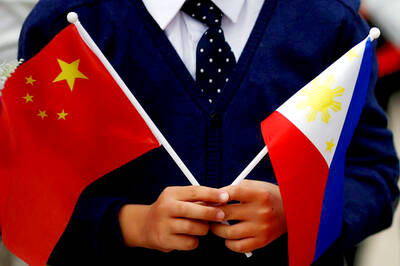
The Philippine Coast Guard yesterday said it has deployed its largest vessel and an aircraft to challenge a Chinese research ship operating off northern Batanes near Taiwan, adding that a Chinese coast guard vessel had also moved in. The Philippine operation “disrupted the vessel’s unauthorized marine scientific research and compelled it to leave its loitering position,” said Jay Tarriela, Philippine Coast Guard spokesperson on South China Sea issues. The Philippine Coast Guard said the BRP Teresa Magbanua and an aircraft were deployed to counter the Chinese vessel, which it said had remained about 37 nautical miles northwest of Itbayat Island since Monday. The
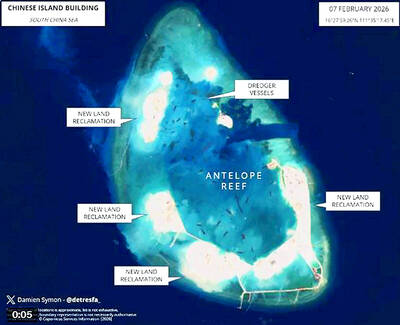
RUNWAY: Analysts said the first aircraft landing is expected by the middle of next year, while Chinese state media said it would serve civilian needs Chinese construction of a runway on Antelope Reef (Lingyang Reef, 羚羊礁) in the Paracel Islands (Xisha Islands, 西沙群島), is well under way with analysts estimating it could be completed by the middle of next year, strengthening Beijing’s military control over the disputed South China Sea. Satellite images reviewed by Reuters show grading work, piles of gravel and concrete, and compaction cranes in operation to build a full-scale runway that military attaches and security analysts say could be one of China’s most important offshore bases in the region. The images, taken on Friday last week by commercial satellite imagery provider Vantor, also show

SHIFTING COOPERATION: With the new arrangement, US representatives would be able to participate directly in defense discussions, including weapons procurement Taiwan-US military cooperation is deepening, with the Pentagon expected to station personnel at the Ministry of National Defense (MND), sources said. The NT$470 million (US$14.77 million) joint program is scheduled to run from this year through 2028, under which the Pentagon would dispatch representatives from the Office of the Under Secretary of Defense for Policy and the Institute for Defense Analyses, a senior military official said on condition of anonymity, adding that one representative from each organization would be stationed at the ministry’s headquarters. The Office of the Under Secretary of Defense for Policy is one of the US’ bodies responsible for

The Presidential Office today condemned China's transnational repression after an alleged Chinese foreign agent was arrested in California yesterday on suspicion of surveilling President William Lai's (賴清德) son, Lai Ting-yu (賴廷與), the FBI said. The 34-year-old woman, named Wanying Heather Zhang (張婉瑩), was arrested on suspicion of acting as an unregistered foreign agent, US news agency CBS reported. She was apprehended at Los Angeles International Airport yesterday attempting to fly to Shanghai, it said. This represents a “typical case” of China’s transnational repression, Presidential Office spokeswoman Karen Kuo (郭雅慧) said today. "Our country expresses the strongest condemnation of such barbaric conduct that


 RSS
RSS