


Afghan President Hamid Karzai appealed yesterday for NATO to speed up a planned expansion of its peacekeeping force in his country to protect against terrorists, private armies and narcotics gangs before September's key elections.
"Please hurry," Karzai urged a NATO summit.
"Come sooner than September and provide the Afghan men and women with a chance to vote freely without fear, without coercion," he said.
On Monday, the alliance decided to expand its peacekeeping forces in Afghanistan from 6,500 to 10,000 over the election period, although officials clarified yesterday that about 1,300 of those troops will be held in reserve outside the country for emergency use.
The expanded NATO forces should allow the separate, 20,000-strong US-led force to intensify its focus on pursuing insurgents from the old Taliban regime and its al-Qaeda allies in the troubled south and east, but it has been criticized as insufficient.
Karzai thanked the 26 NATO leaders for expanding the force, then made a forceful plea for an accelerated deployment, reminding the summit of recent deadly attacks on officials carrying out voter registration and on registered voters.
"The Afghan people have trust in the security that you are going to provide for us, but the Afghan people need that security today and not tomorrow," he said.
"The reason we need this is that we have three challenges still in our country. First the challenge of terrorism, as you are all aware, second is the challenge of private militias ... third is the challenge of narcotics," he said.
tear gas
Outside the summit, police fired tear gas into a group of 1,000 anti-NATO protesters after some of the demonstrators threw rocks at officers.
About 23,000 police and soldiers guarded the summit, closing several streets around the summit site and leaders' hotels.
Monday's summit agreement on Afghanistan allows the alliance forces to set up permanent peacekeeping teams in four more northern cities besides the temporary increase for the elections.
But the agreement was described as inadequate by human-rights campaigners.
"It's a disgrace," said Jon Sifton, a researcher at Human Rights Watch. "NATO officials should be ashamed ... If these elections fail to occur, or occur but are not free and fair, Afghans can blame NATO."
He said Afghanistan had been neglected while Western leaders were focused on Iraq. NATO leaders on Monday agreed to help train the armed forces of Iraq after the US surprised allies by handing over sovereignty to the Iraqi government two days ahead of schedule.
Under current NATO plans, British troops supported by contingents from Norway, Romania, Denmark, Sweden and Finland will set up a regional hub in the city of Mazar-e-Sharif.
Germany will run a team in Faizabad, the Netherlands in Baghlan and more British and Nordic troops will be based in Maimana. Officials said the teams should be up and running under NATO command within the next few weeks.
Besides those permanent bases, NATO will temporarily increase its presence by about 1,500 troops for up to eight weeks around the elections, with another 1,300 in reserve. The alliance is also seeking to muster more troops to expand into a western sector centered on the city of Herat.
EXPLOSION
Police were investigating a small explosion that injured three cleaners on a plane on the ground at Istanbul airport.
The booby-trapped package exploded yesterday aboard a Turkish Airlines plane after passengers had disembarked, an airline spokeswoman said.
She said the fingers of the cleaner who opened the package were torn off, while two other cleaners suffered minor injuries.
The airplane had arrived in Istanbul from the western Turkish city of Izmir, she said.
Police said the blast was caused by 2g of plastic explosive hidden inside a wallet.
The airport appeared to be operating normally after the blast.
PROVOCATIVE: Chinese Deputy Ambassador to the UN Sun Lei accused Japan of sending military vessels to deliberately provoke tensions in the Taiwan Strait China denounced remarks by Japan and the EU about the South China Sea at a UN Security Council meeting on Monday, and accused Tokyo of provocative behavior in the Taiwan Strait and planning military expansion. Ayano Kunimitsu, a Japanese vice foreign minister, told the Council meeting on maritime security that Tokyo was seriously concerned about the situation in the East China and South China seas, and reiterated Japan’s opposition to any attempt to change the “status quo” by force, and obstruction of freedom of navigation and overflight. Stavros Lambrinidis, head of the EU delegation to the UN, also highlighted South China Sea
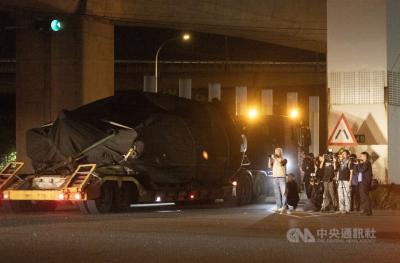
The final batch of 28 M1A2T Abrams tanks purchased from the US arrived at Taipei Port last night and were transported to the Armor Training Command in Hsinchu County’s Hukou Township (湖口), completing the military’s multi-year procurement of 108 of the tanks. Starting at 12:10am today, reporters observed more than a dozen civilian flatbed trailers departing from Taipei Port, each carrying an M1A2T tank covered with black waterproof tarps. Escorted by military vehicles, the convoy traveled via the West Coast Expressway to the Armor Training Command, with police implementing traffic control. The army operates about 1,000 tanks, including CM-11 Brave Tiger
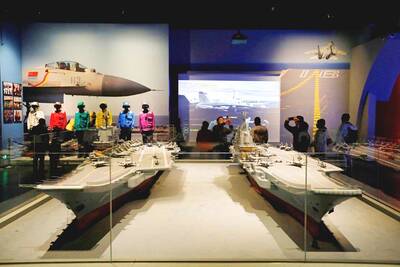
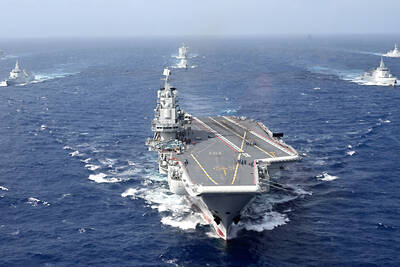
China on Wednesday teased in a video an aircraft carrier that could be its fourth, and the first using nuclear power, while making an allusion to Taiwan and vowing to further build up its islands, as it looks to boost maritime power, secure resources and bolster territorial claims. The video, issued on the eve of the 77th founding anniversary of the Chinese People’s Liberation Army Navy, featured fictional officers with names that are homophones of three commissioned aircraft carriers, the Liaoning (遼寧), Shandong (山東) and Fujian (福建). Titled Into the Deep, it showed a 19-year-old named “Hejian” (何劍) joining the group, sparking
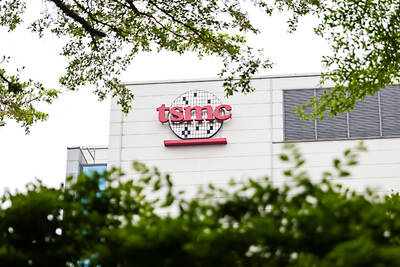
Taiwan Semiconductor Manufacturing Co (TSMC, 台積電), the world’s largest contract chipmaker, said it expects its 2-nanometer (2nm) chip capacity to grow at a compound annual rate of 70 percent from this year to 2028. The projection comes as five fabs begin volume production of 2-nanometer chips this year — two in Hsinchu and three in Kaohsiung — TSMC senior vice president and deputy cochief operating officer Cliff Hou (侯永清) said at the company’s annual technology symposium in Silicon Valley, California, last week. Output in the first year of 2-nanometer production, which began in the fourth quarter of last year, is expected to


 RSS
RSS