


US President George W. Bush tried to forge unity over Iraq yesterday in a lightning summit with European leaders who backed the training of Iraqi troops but offered little further concrete support.
Fenced off from his detractors by 2,000 soldiers and 4,000 police, Bush holed up in a western Irish castle with EU leaders ahead of a NATO summit in Turkey this week.
The US hopes a transatlantic agreement over training police in Iraq is proof that old enmities are over, but diplomats fear it may be simply the lowest common denominator the two sides can live with.
Big breakthroughs were scant at the summit as hundreds of demonstrators vilified Bush as a warmonger.
The protesters were kept well away from 16th-century Dromoland Castle as Bush met Irish Prime Minister Bertie Ahern.
Ahern stressed the need for transatlantic unity four days before Washington cedes control of Baghdad to an interim government.
After the bilateral Irish talks, Bush headed to the EU-US summit.
The leaders trumpeted a satellite navigation cooperation agreement as proof of strong ties even as Iraq and the Middle East continue to dog relations.
In the joint US-EU statement, the leaders said they "support the training and equipping of professional Iraqi security forces capable of assuming increasing responsibility for the country's security."
The EU said it would also look at helping the new government prepare for elections and "consider further support for the rule of law and civil administration in Iraq."
In a reference to the US abuse of prisoners at Abu Ghraib prison, the statement stressed "the need for full respect of the Geneva Conventions," mirroring European disquiet voiced by Ahern earlier over prisoner rights in both Iraq and Guantanamo Bay, Cuba.
NATO leaders, including Bush, meet tomorrow and on Tuesday and are expected to reach an agreement in principle to help train Iraqi security forces, far short of the original US goal of having NATO troops help with security.
Meanwhile, insurgents in Iraq launched attacks in the strife-ridden city of Baquba yesterday, killing nine people, six of them insurgents, US and Iraqi officials said. Attacks also occurred in other cities.
The attacks in Baquba, 55km northeast of Baghdad, occurred only two days after US tanks and jets routed insurgents who assaulted police stations and government offices there as part of a widespread offensive that killed about 100 people nationwide.
Yesterday's attacks targeted offices of two political parties -- one of them run by the Iraqi prime minister -- a police station and a government building in Baquba.
Also See Stories:
Ireland gives Bush rough treatment
US jets raid `al-Zarqawi safe house'
Anti-US message from mosques anti-US
Helping the occupation a deadly risk

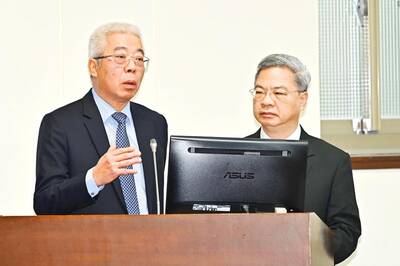
Taiwan has arranged for about 8 million barrels of crude oil, or about one-third of its monthly needs, to be shipped from the Red Sea this month to bypass the Strait of Hormuz and ease domestic supply pressures, CPC Corp, Taiwan (CPC, 台灣中油) said yesterday. The state-run oil company has worked with Middle Eastern suppliers to secure routes other than the Strait of Hormuz, through which about 20 percent of the world’s oil and liquefied natural gas typically passes, CPC chairman Fang Jeng-zen (方振仁) said at a meeting of the legislature’s Economics Committee in Taipei. Suppliers in Saudi Arabia have indicated they
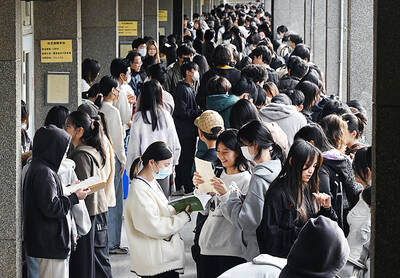
A global survey showed that 60 percent of Taiwanese had attained higher education, second only to Canada, the Ministry of the Interior said. Taiwan easily surpassed the global average of 43 percent and ranked ahead of major economies, including Japan, South Korea and the US, data from the Organisation for Economic Co-operation and Development (OECD) for 2024 showed. Taiwan has a high literacy rate, data released by the ministry showed. As of the end of last year, Taiwan had 20.617 million people aged 15 or older, accounting for 88.5 percent of the total population, with a literacy rate of 99.4 percent, the data

CCP ‘PAWN’? Beijing could use the KMT chairwoman’s visit to signal to the world that many people in Taiwan support the ‘one China’ principle, an academic said Chinese Nationalist Party (KMT) Chairwoman Cheng Li-wun (鄭麗文) yesterday arrived in China for a “peace” mission and potential meeting with Chinese President Xi Jinping (習近平), while a Taiwanese minister detailed the number of Chinese warships currently deployed around the nation. Cheng is visiting at a time of increased Chinese military pressure on Taiwan, as the opposition-dominated Legislative Yuan stalls a government plan for US$40 billion in extra defense spending. Speaking to reporters before going to the airport, Cheng said she was going on a “historic journey for peace,” but added that some people felt uneasy about her trip. “If you truly love Taiwan,

NEW LOW: The council in 2024 based predictions on a pessimistic estimate for the nation’s total fertility rate of 0.84, but last year that rate was 0.69, 17 percent lower An expected National Development Council (NDC) report expects the nation’s population to drop below 12 million by 2065, with the old-age dependency ratio to top 100 percent sooner than 2070, sources said yesterday. The council is slated to release its latest population projections in August, using an ultra-low fertility model, the sources said. The previous report projected that Taiwan’s population would fall to 14.37 million by 2070, but based on a new estimate of the total fertility rate (TFR) — the average number of children born to a woman over her lifetime — the population is expected to reach 12 million by


 RSS
RSS