


A suicide car bomber killed up to 12 Iraqis, including four policemen, near a US-Iraqi base in Baghdad yesterday and gunmen killed a senior Iraqi civil servant in the second such murder in as many days.
The US-led administration has said insurgents may step up attacks before and after the occupation formally ends on June 30 to disrupt the handover and discredit Iraq's new government.
While the new bloodshed seemed to bear out that prediction, two foreign hostages, a Turk and an Egyptian, were freed after what a mediator called talks with men close to their captors.
Police at the scene of the car bombing said their colleagues had tried to stop a suspicious vehicle hurtling toward an Iraqi military college in southeast Baghdad, where many US soldiers are also based.
Abdul Razzak Kadhem, a senior police officer, said two police cars had intercepted the vehicle, which then exploded, destroying one police car and badly damaging another.
The US military, condemning what it called a "random, senseless act of violence," said the blast had killed eight Iraqi civilians and four police, and wounded 13 people.
Kadhem said earlier four policemen and two civilians had died. Four policemen were wounded.
Two charred bodies could be seen in the burnt wreckage of one police car. All that remained of the bomber's car was a blackened engine in the road. Several civilian vehicles were damaged. Blood stained the driver's seat of a white pick-up.
"One car was blown across the street," said Abdel Hasan al-Jabbar, an off-duty civil-defense worker. "The man inside had blood pouring from the top of his head."
Guerrillas frequently target police and other Iraqis whom they accuse of collaborating with the US-led occupation.
The Iraqi civil servant, Kamal al-Jarrah, 63, who headed the education ministry's cultural relations department, was shot in his garden after stepping out of his house in the western Ghazaliya district of the capital to go to work.
The veteran bureaucrat died in hospital, Abdul Khaliq al-Amiri, secretary to the education minister, said. Jarrah's wife, who was with him in the garden, was unhurt.
In a similarly precise attack on Saturday, gunmen in a car killed Bassam Qubba, the foreign ministry's undersecretary for multinational affairs and international organizations.
Last month, a suicide bombing killed Izzedin Salim, the head of Iraq's now-dissolved Governing Council, and another council member survived an ambush south of the capital.
The Foreign Ministry said Qubba's killing bore "the hallmarks of leftover supporters of Saddam Hussein's evil regime." Foreign Minister Hoshiyar Zebari said the interim government "will not be scared or intimidated by Saddamists."

PROVOCATIVE: Chinese Deputy Ambassador to the UN Sun Lei accused Japan of sending military vessels to deliberately provoke tensions in the Taiwan Strait China denounced remarks by Japan and the EU about the South China Sea at a UN Security Council meeting on Monday, and accused Tokyo of provocative behavior in the Taiwan Strait and planning military expansion. Ayano Kunimitsu, a Japanese vice foreign minister, told the Council meeting on maritime security that Tokyo was seriously concerned about the situation in the East China and South China seas, and reiterated Japan’s opposition to any attempt to change the “status quo” by force, and obstruction of freedom of navigation and overflight. Stavros Lambrinidis, head of the EU delegation to the UN, also highlighted South China Sea
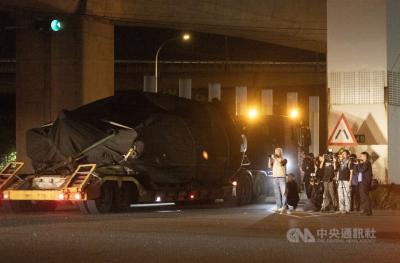
The final batch of 28 M1A2T Abrams tanks purchased from the US arrived at Taipei Port last night and were transported to the Armor Training Command in Hsinchu County’s Hukou Township (湖口), completing the military’s multi-year procurement of 108 of the tanks. Starting at 12:10am today, reporters observed more than a dozen civilian flatbed trailers departing from Taipei Port, each carrying an M1A2T tank covered with black waterproof tarps. Escorted by military vehicles, the convoy traveled via the West Coast Expressway to the Armor Training Command, with police implementing traffic control. The army operates about 1,000 tanks, including CM-11 Brave Tiger
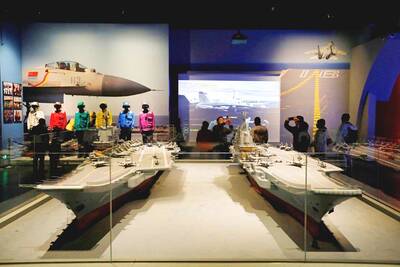
China on Wednesday teased in a video an aircraft carrier that could be its fourth, and the first using nuclear power, while making an allusion to Taiwan and vowing to further build up its islands, as it looks to boost maritime power, secure resources and bolster territorial claims. The video, issued on the eve of the 77th founding anniversary of the Chinese People’s Liberation Army Navy, featured fictional officers with names that are homophones of three commissioned aircraft carriers, the Liaoning (遼寧), Shandong (山東) and Fujian (福建). Titled Into the Deep, it showed a 19-year-old named “Hejian” (何劍) joining the group, sparking

Taiwan Semiconductor Manufacturing Co (TSMC, 台積電), the world’s largest contract chipmaker, said it expects its 2-nanometer (2nm) chip capacity to grow at a compound annual rate of 70 percent from this year to 2028. The projection comes as five fabs begin volume production of 2-nanometer chips this year — two in Hsinchu and three in Kaohsiung — TSMC senior vice president and deputy cochief operating officer Cliff Hou (侯永清) said at the company’s annual technology symposium in Silicon Valley, California, last week. Output in the first year of 2-nanometer production, which began in the fourth quarter of last year, is expected to


 RSS
RSS