


Taiwanese pop diva Chang Hui-mei (張惠妹), better known as A-mei, was forced to cancel a performance in China on Saturday night due to a protest by students from Zhejiang University (浙江大學) who accused her of being a supporter of Taiwan independence.
She was scheduled to promote the Master Kong brand of Wei Chuan Food Corp (

PHOTO: TONY YAO, TAIPEI TIMES
At a press conference held by Wei Chuan, Taiwan's second-largest food company, several hundred students raised banners reading "Safeguarding our motherland and unification" (
Faced with student anger, event organizers kept A-mei from the stage.
Days before the event, more than a thousand students from Zhejiang University signed an online boycott of A-mei, expressing discontent with the provincial government for allowing a pro-independence Taiwanese singer to make money in China.
This is not the first time China has blacklisted the Taiwanese singer. Four years ago, A-mei came under a Chinese media blackout for singing the national anthem at President Chen Shui-bian's (
Internet discussions on XinhuaNet and the People's Daily Online show that more Taiwanese entertainers have been blacklisted and become embroiled in political storms.
The users of China's two major Internet sources have identified more than 20 "green performers." They singled out pop singers Jay Chou (
Returning to Taiwan last night, A-mei said she respected the right of Chinese to express themselves on the Internet.
"But I hope the situation will not get complex. We entertainment artists are innocent," she said at CKS International Airport in Taoyuan last night.
A-mei said most Chinese fans were friendly and that she planned to continue with her scheduled activities in China.
Taiwanese businesspeople have faced similar problems across the Strait.
China's criticism of Taiwanese tycoon Hsu Wen-long (
A week after the statement came a diatribe on the front page of the People's Daily calling Chi Mei Optoelectronics (奇美) chairman Hsu, also a presidential adviser, an ardent supporter of independence.
"His Chi Mei Corporation prospered hugely in the mainland, yet he is recognized in Taiwan's business community as a key figure of the Taiwan independence faction," the article said.
Chi Mei Corp has plants in Guangdong and Jiangsu provinces and is eyeing operations in Shanghai.
According to Chen Yi-shen (
Chen said Chinese officials have demanded that all pro-independence businesspeople be excluded as candidates for re-election to the association.

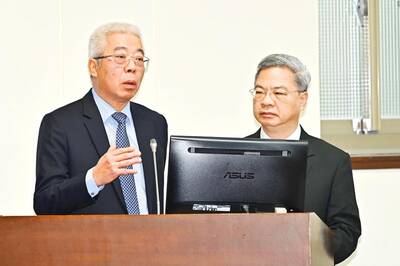
Taiwan has arranged for about 8 million barrels of crude oil, or about one-third of its monthly needs, to be shipped from the Red Sea this month to bypass the Strait of Hormuz and ease domestic supply pressures, CPC Corp, Taiwan (CPC, 台灣中油) said yesterday. The state-run oil company has worked with Middle Eastern suppliers to secure routes other than the Strait of Hormuz, through which about 20 percent of the world’s oil and liquefied natural gas typically passes, CPC chairman Fang Jeng-zen (方振仁) said at a meeting of the legislature’s Economics Committee in Taipei. Suppliers in Saudi Arabia have indicated they
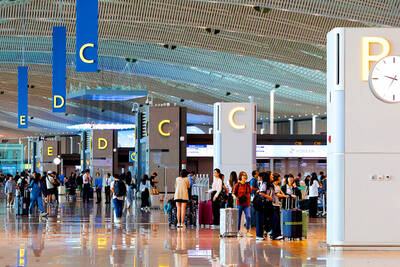
South Korea has adjusted its electronic arrival card system to no longer list Taiwan as a part of China, a move that the Ministry of Foreign Affairs said would help facilitate exchanges between the two sides. South Korea previously listed “Taiwan” as “Taiwan (China)” in the drop-down menus of its online arrival card system, where people had to fill out where they came from and their next destination. The ministry had requested South Korea make a revision and said it would change South Korea’s name on Taiwan’s online immigration system from “Republic of Korea” to “Korea (South),” should the issue not be

Tainan, Taipei and New Taipei City recorded the highest fines nationwide for illegal accommodations in the first quarter of this year, with fines issued in the three cities each exceeding NT$7 million (US$220,639), Tourism Administration data showed. Among them, Taipei had the highest number of illegal short-term rental units, with 410. There were 3,280 legally registered hotels nationwide in the first quarter, down by 14 properties, or 0.43 percent, from a year earlier, likely indicating operators exiting the market, the agency said. However, the number of unregistered properties rose to 1,174, including 314 illegal hotels and 860 illegal short-term rental

AIR ALERT: China’s reservation of airspace over the Yellow Sea and East China Sea could be an attempt to test the US’ response ahead of a Trump-Xi meeting, the NSB head said China’s attempts to infiltrate Taiwan are systematic, planned and targeted, with activity shifting from recruiting mid-level military officers to rank-and-file enlisted personnel, National Security Bureau (NSB) Director-General Tsai Ming-yen (蔡明彥) said yesterday. The Chinese Communist Party’s (CCP) integrates national security, intelligence operations and “united front” efforts into a dense network to conduct intelligence gathering and espionage in Taiwan, Tsai said at a meeting of the legislature’s Foreign Affairs and National Defense Committee. It uses specific networks to screen targets through exchange activities and recruiting local collaborators to establish intelligence-gathering organizations, he said. China is also shifting who it targets to lower-ranking military personnel,


 RSS
RSS