


Hong Kong's celebrated runaway crocodile has been captured alive, the government said yesterday, ending an eight-month saga that saw it elude even the world's most respected croc hunter.
The 1.5m reptile, which mysteriously appeared last November, is believed to have wandered into a net laid to catch the beast.
"The crocodile has been caught," a spokesman for the government's agriculture, fisheries and conservation department said.
The spokesman could not confirm how the animal had been caught, but reports on cable TV and radio said it had wandered into a trap.
RTHK public radio said it had been caught in a baited net.
"It had walked up onto the bank ... it was going back into the water and then it was trapped in one of our nets," an employee of the agriculture, fisheries and conservation department told the radio station.
TV images showed the writhing reptile being carried away from its watery home in a large net by two men before being thrown into the back of a waiting truck.
RTHK said the animal had been taken to a quarantine center. It is believed it will then be transferred to the nearby Kadoorie Farm nature reserve until a permanent home is found for it in a wetland nature park.
There was no indication of the condition of the crocodile, but Kadoorie Farm's Idy Wong (王麗賢) said she had been told it had struggled to free itself from the trap.
The crocodile hit the headlines when it was first sighted in a muddy, polluted ditch near the suburban town of Yuen Long in Hong Kong's northern New Territories.
It became a media celebrity almost overnight and attracted a daily phalanx of photographers awaiting its every move.
International fame was assured when it evaded the efforts of celebrated Australian crocodile hunter John Lever who had been brought in to catch the reptile last November.
Since then crocodile hunters from China have also come to capture it only to leave red-faced and empty handed.
Surviving on a diet of dead fish that fill the putrid waters, the beast has been frequently spotted on the banks of the filthy waterway.
Crocodiles are not native to Hong Kong and it is believed the Yuen Long creature either escaped from a farm in nearby China or was a pet that was discarded when it grew too large.
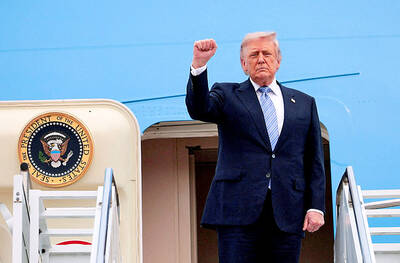
US-CHINA SUMMIT: MOFA welcomed US reassurance of no change in its Taiwan policy; Trump said he did not comment when Xi talked of opposing independence US President Donald Trump yesterday said he has not made a decision on whether to move forward with a major arms package for Taiwan after hearing concerns about it from Chinese President Xi Jinping (習近平). Trump’s comments on Taiwan came as he flew back to Washington after wrapping up critical talks in which both leaders said important progress was made in stabilizing US-China relations even as deep differences persist between the world’s two biggest powers on Iran and Taiwan. “I will make a determination,” Trump said, adding: “I’ll be making decisions. But, you know, I think the last thing we need right
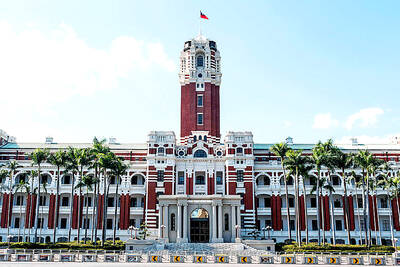
SECURITY: Taipei presses the US for arms supplies, saying the arms sales are not only a reflection of the US security commitment to Taiwan but also serve as a mutual deterrent against regional threats Taiwan is committed to preserving the cross-strait “status quo” and contributing to regional peace and stability, the Presidential Office said yesterday. “It is an undeniable fact that the Republic of China is a sovereign and independent democratic nation,” Presidential Office spokeswoman Karen Kuo (郭雅慧) reiterated, adding that Beijing has no right to claim sovereignty over Taiwan. The statements came after US President Donald Trump warned against Taiwanese independence. Trump wrapped up a state visit to Beijing on Friday, during which Chinese President Xi Jinping (習近平) had pressed him not to support Taiwan. Taiwan depends heavily on US security backing to deter China from carrying
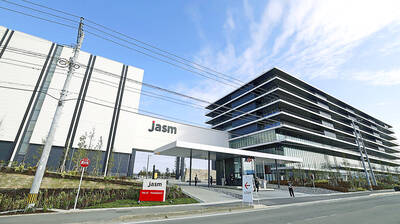
The subsidiary of Taiwan Semiconductor Manufacturing Co (TSMC, 台積電) in Kumamoto, Japan, turned a profit in the first quarter of this year, marking the first time the first fab of the unit has become profitable since mass production started at the end of 2024. According to the contract chipmaker’s financial statement released on Friday, Japan Advanced Semiconductor Manufacturing Inc (JASM), a joint venture running the fab in Kumamoto, posted NT$951 million (US$30.19 million) in profit in the January-to-March period, compared with a loss of NT$1.39 billion in the previous quarter, and a loss of NT$3.25 billion in the first quarter of
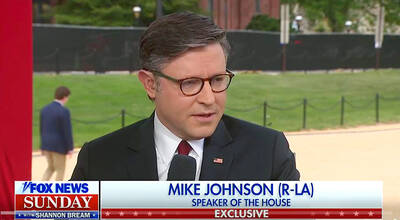
RESOLUTE BACKING: Two Republican senators are planning to introduce legislation that would impose immediate sanctions on China if it attempts to invade Taiwan US House of Representatives Speaker Mike Johnson on Sunday reaffirmed US congressional support for Taiwan, saying the US and “all freedom-loving people” have a stake in preventing China from seizing Taiwan by force. Johnson made the remarks in an interview with Fox News Sunday on US President Donald Trump’s summit with Chinese President Xi Jinping (習近平) last week. In an interview that aired on Friday on Fox News, just as Trump wrapped up a high-stakes visit to China, he said he has yet to green-light a new US$14 billion arms package to Taiwan and that it “depends on China.” “It’s a very good


 RSS
RSS