


South Korea's parliamentary speaker adjourned an unprecedented session called to try to impeach President Roh Moo-hyun yesterday because Roh supporters had blocked him from presiding over the opposition-inspired vote.
The two opposition parties trying to impeach Roh said earlier they had secured enough support among their own members of parliament to pass the bill if it was put to the vote.
Foreign investors closely watch political stability in South Korea, which already faces a crisis over North Korea's nuclear ambitions, a still-nascent recovery in Asia's fourth-largest economy and an investigation into illicit funds given to political parties by conglomerates known as chaebol.
"I don't think the session can continue in this situation today," speaker Park Kwan-yong told the chamber. "I will do what it takes if the speaker's seat is occupied again tomorrow."
A parliamentary announcer said today's session would start at 10am.
Park has the right to call guards to clear the chamber. Technically, he failed even to open yesterday's session because pro-Roh Uri Party members had occupied the speaker's area in the National Assembly, a domed building near the Han River in Seoul.
The opposition has until 6:30 pm today to hold the vote, which would come barely a year into Roh's single five-year term and just weeks before an April 15 election.
"By our count, we have a two-thirds majority," Park Jin of the main opposition Grand National Party told reporters.
Party officials said that 127 of the 145 Grand National Party parliamentarians were ready to vote for impeachment after Roh failed to apologize at a news conference yesterday over illegal electioneering.
They said 55 of the 62 members of the smaller Millennium Democratic Party would also back the impeachment bid.
Those figures would mean the opposition could tally just over the 181-vote, two-thirds majority needed. There was no way to confirm the figures independently ahead of the vote.

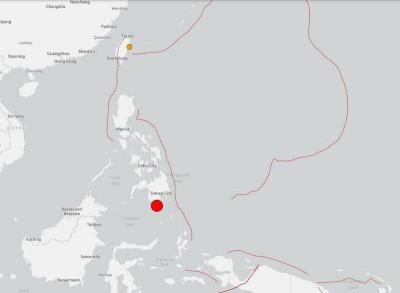
A magnitude 7.8 earthquake struck off the southern coast of Mindanao in the Philippines at 7:38am today, prompting the US Tsunami Warning System to issue an alert for neighboring countries, including Taiwan. The system issued a purple alert indicating a "tsunami threat." The potential threat zone includes Taiwan, the Philippines, Papua New Guinea, Yap and Palau. Philippine authorities were assessing the damage from the quake, with the office of civil defense seeking to verifying initial reports that 15 people had been killed and 129 injured in the region, mostly from falling debris. Arlene Hollero, disaster chief of Maasim town in the Philippines' Sarangani Province,

RESILIENCE: Taiwan plays a key role in semiconductors, energy, information infrastructure and advanced manufacturing, AIT Director Raymond Greene said Taiwan’s continued investment in deterrence and resilience remains vital, especially in uncrewed systems and other emerging technologies, American Institute in Taiwan (AIT) Director Raymond Greene said yesterday. Greene made the remarks at the annual National Strategic Summit on Supply Chain Resilience held by the Research Institute for Democracy, Society and Emerging Technology (DSET), a government-backed think tank. As Taiwan last year became the US’ fourth-largest trading partner and supply chain security is becoming more important, cooperation in emerging technologies continues to deepen between the two countries, he said. The US is committed to accelerating innovation, building key infrastructure, strengthening cooperation

The National Chungshan Institute of Science and Technology yesterday showcased its locally developed variants of the Vision 60 robotic patrol dog, which it plans to deploy on the nation’s outlying territories in the South China Sea. The variants were produced under the Joint Lab project — created by the institute and domestic companies — and assembled with domestically produced motors, lenses and artificial intelligence (AI) systems alongside licensed tech from the US, Missile and Rocket Systems Research Division deputy director Jen Kuo-kang (任國光) told the media event at a military base in Taipei’s Dazhi (大直) area. Taiwan has built up its strengths

RIGHT DIRECTION: Taiwan’s efforts to prevent forced labor include a proposal to ‘fully prohibit’ employers from withholding workers’ documents, an official said Taiwan is to establish a mechanism to restrict imports of goods linked to forced labor, the Executive Yuan said yesterday, after the US proposed imposing additional tariffs on Taiwanese goods over labor concerns. “The Ministry of Labor and the Ministry of Economic Affairs are to establish an interministerial review procedure,” Executive Yuan spokesperson Michelle Lee (李慧芝) said at a news briefing in Taipei. “The government is to use the Foreign Trade Act [貿易法] as the legal basis to restrict imports of goods produced with forced labor” and bring its supply chain governance more in line with international standards on human rights, resilience


 RSS
RSS