


The Executive Yuan reacted angrily yesterday after opposition lawmakers voted down the government's annual budget request on Tuesday, while moving forward with plans for its five-year, NT$500 billion public construction project.
Cabinet Spokesman Lin Chia-lung (
"It's unconstitutional, illegal and jeopardizes the relationship between the executive and legislative branches," Lin said.
Citing Article 70 of the Constitution, Lin said the legislature is not permitted to request the Cabinet increase spending while reviewing the annual budget.
In addition, it was in defiance of the law and encroached on the government's authority for the legislature to ask the executive branch to adjust budget items of the annual spending plan, according to interpretation No. 264 of the Council of Grand Justices, he said.
Lin also dismissed media speculation that the Cabinet is planning to request a constitutional interpretation on the quandary.
"Instead, we'll submit an explanatory note to the legislature and follow up with personal visits to opposition lawmakers in the hope that they'll change their mind and resume the committee budgetary review as soon as possible," he said.
While the Cabinet respects the authority of the legislative body, Lin said, it is impossible for the government to accept a resolution that is illegitimate.
"As the law stands, the legislative body is supposed to complete the review of the government's annual budget request by the end of November. However, it has failed to do so for the past three years," Lin said.
"The resolution not only is illegal but also seriously hampers the execution of government initiatives."
Cashing in on their numerical edge, opposition Chinese Nationalist Party (KMT), People First Party (PFP) and independent lawmakers voted on Tuesday in favor of a motion to shelve review of the government's annual budget.
The opposition bloc also requested the Cabinet submit an amended spending plan by Monday, claiming that certain outlays lack a legal foundation.
Opposition lawmakers argued that the Cabinet should not have requested funding to establish a human rights memorial hall because the legislature has not yet approved such a plan.
They also said the Judicial Yuan should not have proposed a budget for its reorganization as the legislative body has not yet decided whether to approve its restructuring.
Lin said the accusations were just another pretext for the opposition camp to boycott the spending plan.
Meanwhile, the Cabinet yesterday approved the special draft bill of the five-year, NT$500 billion public construction project.
The draft, should it be approved by the legislature, earmarks a special budget of NT$500 billion over the next five years. The fund, which would be exempt from the Budget Law (
The draft stipulates that the government may either borrow money or sell stakes in state-owned enterprises to obtain the funding.

SILENCING CRITICS: In addition to blocking Taiwan, China aimed to prevent rights activists from speaking out against authoritarian states, a Cabinet department said The Ministry of Foreign Affairs (MOFA) yesterday condemned transnational repression by Beijing after RightsCon, a major digital human rights conference scheduled to be held in Zambia this week, was abruptly canceled due to Chinese pressure over Taiwanese participation. This year’s RightsCon, the world’s largest conference discussing issues “at the intersection of human rights and technology,” was scheduled to take place from tomorrow to Friday in Lusaka, and expected to draw 2,600 in-person attendees from 150 countries, along with 1,100 online participants. However, organizers were forced to cancel the event due to behind-the-scenes pressure from China, the ministry said, expressing its “strongest condemnation”
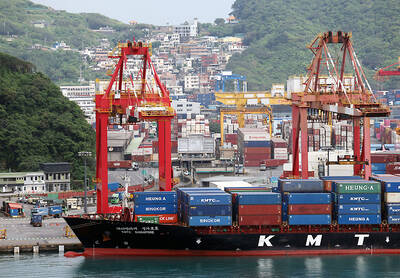
Taiwan’s economy grew far faster than expected in the first quarter, as booming demand for artificial intelligence (AI) applications drove a surge in exports, spilling over into investment and consumption, the Directorate-General of Budget, Accounting and Statistics (DGBAS) said yesterday. GDP growth was 13.69 percent year-on-year during the January-to-March period, beating the DGBAS’ February forecast by 2.23 percentage points and marking the most robust growth in nearly four decades, DGBAS senior official Chiang Hsin-yi (江心怡) told a news conference in Taipei. The result was powered by exports, which remain the backbone of Taiwan’s economy, Chiang said. Outbound shipments jumped 51.12 percent year-on-year to
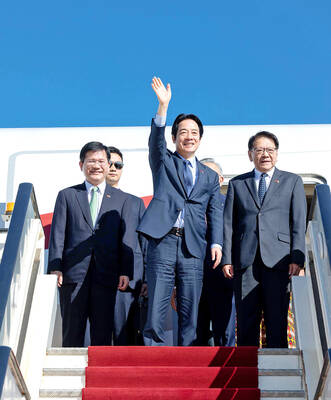
DELAYED BUT DETERMINED: The president’s visit highlights Taiwan’s right to international engagement amid regional pressure from China President Willaim Lai (賴清德) yesterday arrived in Eswatini, more than a week after his planned visit to Taiwan’s sole African ally was suspended because of revoked overflight permits. “The visit, originally scheduled for April 22, was postponed due to unforeseen external factors,” Lai wrote on social media. “After several days of careful arrangements by our diplomatic and national security teams, we successfully arrived today.” Lai said he looked forward to further deepening Taiwan-Eswatini relations through closer cooperation in the economy, agriculture, culture and education, as well as advancing the nation’s international partnerships. The president was initially scheduled to arrive in time to celebrate
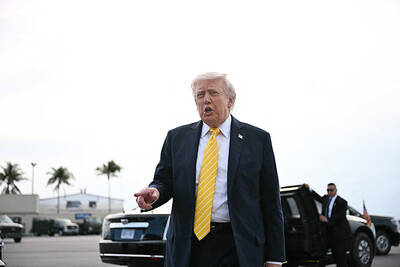
Iran’s Islamic Revolutionary Guard Corp (IRGC) yesterday said the US faced a choice between an “impossible” military operation or a “bad deal” with Tehran, after US President Donald Trump disparaged Iran’s latest peace proposal. Negotiations between the two countries have been deadlocked since a ceasefire came into effect on April 8, with only one round of direct peace talks held so far. Iran’s Tasnim and Fars news agencies reported that Tehran had submitted a 14-point proposal to mediator Pakistan, but Trump was quick to cast doubt on it. “I will soon be reviewing the plan that Iran has just sent to us, but


 RSS
RSS