


Fearing a humiliating lack of international support, Taiwanese authorities in May urged the US not to push for a vote on Taiwan's observer status in the World Health Assembly in Geneva, a State Department report obtained by the Taipei Times has revealed.
The report, required under a law passed unanimously by Congress and signed by US President George W. Bush on May 29, said the US delegation acceded to the request because "Taiwan clearly did not have sufficient support to win a vote or to lose by a respectable margin."
"Taiwan proposed, and we agreed, that we would carefully track support for Taiwan's bid and only support the holding of a vote if it would demonstrate a significantly increased level of support," the State Department report to Congress said.
The report appears to contradict repeated statements by Taiwanese officials that Taiwan wanted a vote and was pushing the US and other allies to advance such a vote. Taiwan has been seeking observer status since 1997, but no vote has been held since then, when, the State Department report points out, "Taiwan suffered an overwhelming defeat."
Last year, according to pro-Taiwan sources in Washington, the US urged Taiwan not to press for the vote in the 2002 WHA meeting, because the US feared a disastrous defeat. The latest State Department report, therefore, seems to represent a 180-degree shift in the strategies of both Washington and Taipei.
"It is clear that Taiwan has gained some support and sympathy for its cause, but it is still far short of having sufficient support," the State Department concludes.
The report says joint strategy planning between the US and Taiwan began in late April, the third year that the two sides had coordinated their efforts to advance Taiwan's bid for observer status. Washington, the report says, "firmly believes Taiwan should take the lead in building support" for its cause. Nevertheless, the report cites a number of actions the US took, including statements on the WHA floor and a letter to WHO director-general Dr. Gro Brundland.
The WHO legislation urged the State Department to devise a strategy to obtain Taiwan's participation as an observer at the WHA assembly, which took place between May 19 and May 28. While Bush's signature came only after the meeting was held, the law became a symbolic document of support for Taiwan's cause.
Even so, Bush indicated that the required State Department report itself would be limited in what it disclosed. In signing the law, he said the report would "withhold information the disclosure of which could impair foreign relations ... national security," or executive prerogatives.
As a result, the report contains virtually nothing about Washington's efforts to lobby other nations on behalf of Taiwan, or any interaction it might have had with China.
Despite the lack of a vote, the State Department said Washington is still committed to a "long-term strategy, as we continue to believe that observership would not be attainable in the near term."
The SARS epidemic did, however, have a positive impact on Taiwan's efforts to gain participation in the work of the WHO, the report said. On May 27, the WHA passed a resolution requesting the director general to "respond appropriately to all requests for WHO support" in dealing with SARS, which, the department said, "commits the WHO to respond to all requests for assistance, including those from Taiwan."
Washington and Taipei believe, "this resolution marks a significant advance that can be built upon." It also cites other actions during the recent SARS epidemic that included Taiwan in WHO actions.
The report, according to sources, was presented by the administration to the House International Relations Committee on June 19. But it has only been made public now.Also See Story:
China called WHA bluff
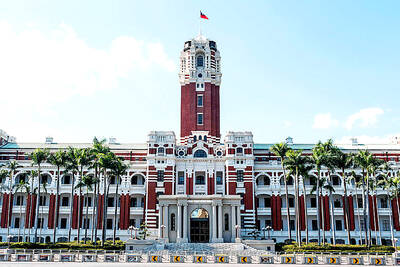
SECURITY: Taipei presses the US for arms supplies, saying the arms sales are not only a reflection of the US security commitment to Taiwan but also serve as a mutual deterrent against regional threats Taiwan is committed to preserving the cross-strait “status quo” and contributing to regional peace and stability, the Presidential Office said yesterday. “It is an undeniable fact that the Republic of China is a sovereign and independent democratic nation,” Presidential Office spokeswoman Karen Kuo (郭雅慧) reiterated, adding that Beijing has no right to claim sovereignty over Taiwan. The statements came after US President Donald Trump warned against Taiwanese independence. Trump wrapped up a state visit to Beijing on Friday, during which Chinese President Xi Jinping (習近平) had pressed him not to support Taiwan. Taiwan depends heavily on US security backing to deter China from carrying
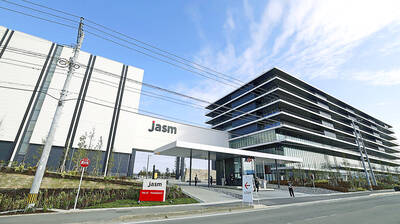
The subsidiary of Taiwan Semiconductor Manufacturing Co (TSMC, 台積電) in Kumamoto, Japan, turned a profit in the first quarter of this year, marking the first time the first fab of the unit has become profitable since mass production started at the end of 2024. According to the contract chipmaker’s financial statement released on Friday, Japan Advanced Semiconductor Manufacturing Inc (JASM), a joint venture running the fab in Kumamoto, posted NT$951 million (US$30.19 million) in profit in the January-to-March period, compared with a loss of NT$1.39 billion in the previous quarter, and a loss of NT$3.25 billion in the first quarter of
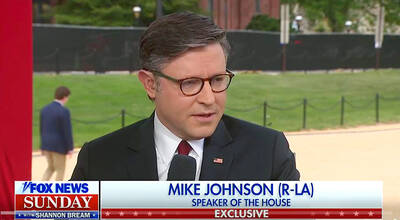
RESOLUTE BACKING: Two Republican senators are planning to introduce legislation that would impose immediate sanctions on China if it attempts to invade Taiwan US House of Representatives Speaker Mike Johnson on Sunday reaffirmed US congressional support for Taiwan, saying the US and “all freedom-loving people” have a stake in preventing China from seizing Taiwan by force. Johnson made the remarks in an interview with Fox News Sunday on US President Donald Trump’s summit with Chinese President Xi Jinping (習近平) last week. In an interview that aired on Friday on Fox News, just as Trump wrapped up a high-stakes visit to China, he said he has yet to green-light a new US$14 billion arms package to Taiwan and that it “depends on China.” “It’s a very good
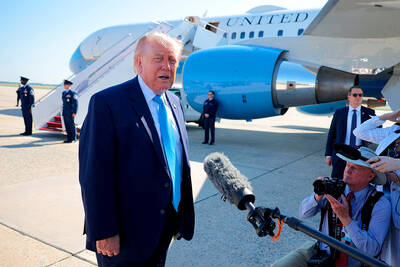
US President Donald Trump yesterday said he would speak to President William Lai (賴清德) as his administration considers whether to move ahead with a US$14 billion weapons sale to Taiwan — a potential arms deal that has drawn criticism from China. “Well, I’ll speak to him. I speak to everybody,” Trump told reporters yesterday when asked if he had any plans to call his counterpart, although he did not offer a time frame for when such a conversation could take place. Trump previously said he would speak to the person “that’s running Taiwan,” without specifying who he meant. “We have that situation very


 RSS
RSS