


SARS has crept its way into eastern Taiwan and the offshore islands as Hualien, Ilan and Penghu counties reported a total of three supected SARS deaths yesterday.
Yesterday also marked the nation's biggest jump in probable SARS cases reported in a single day -- with 34 more new cases. The increase brought the total number of SARS probable cases to 308, but no new deaths were reported.
Although the preliminary test of the death in Hualien came out negative yesterday, Lin Shinn-zong (
According to Lin, over 30 people, who were in contact with the dead, began their 10-day compulsory home quarantine yesterday. Nine more people, who were in close contact with the dead, were sent to the Chung-rong Nursery Home in Chian Township for quarantine.
To prevent further deterioration of the outbreak, a SARS command center located at Tzu Chi Buddhist General Hospital was launched yesterday.
Taking the helm of the command center is Wang Li-hsin (
As of yesterday afternoon, a cumulative total of 18 probable SARS cases were reported in Hualien, with three new cases. All of the new probable cases there are high school students.
In Ilan County, a 78-year-old man, surnamed Chao, died at the Po-ai Hospital at 2:25am yesterday. He was listed as a suspected SARS patient before his death.
Chao checked in to a local clinic on Thursday after he developed a high fever and began having problems breathing. His medical record showed that he visited the National Taiwan University Hospital on April 22.
In Penghu County, a 56-year-old man, surnamed Yeh, died on Friday morning at the Kaohsiung Chang Gung Memorial Hospital.
Yeh, who had been diagnosed with lung cancer, was rushed to the Armed Forces Penghu Hospital after developing a high fever and breathing problems on Tuesday afternoon.
He was listed as a suspected SARS patient before being air lifted to Kaohsiung Chang Gung Memorial Hospital on Friday.
Meanwhile, Premier Yu Shyi-kun yesterday said that the Cabinet has set aside NT$3.7 billion to subsidize local governments' SARS-related expenses before the legislature passes the NT$50 billion budget request.
The NT$50 billion budget is earmarked to subsidize the medical expenses and mitigate the economic impact on industries affected by the outbreak.
The Cabinet hopes the proposal will pass the legislature on Friday.
Inspecting the Kaohsiung County Government yesterday morning, Yu called on Kaohsiung residents to be cautious in the face of the SARS outbreak.
"It's dangerous to think that the SARS virus won't make inroads into the south," Yu said.
"Before an effective treatment or vaccine is found, we must do our best to curb the outbreak by isolating suspected patients and tracking down those in contact with them."
Yu yesterday also agreed to include Lin Yung-hsiang (
Lin, 28, a resident doctor at Kaohsiung Chang Gung Memorial Hospital, died of SARS on Friday. He was the nation's second medical doctor to succumb to the highly contagious disease.
Lin got married less than a year ago.
Making good on his promise of providing ample medical supplies to front-line health care workers, Yu yesterday donated 30,000 face masks and 3,000 protective outfits to Kaohsiung County and 3,000 protective outfits to Kaohsiung City.
The premier also promised the delivery of 1,000 sets of videoconferencing systems to the county and city today.

RESOLUTE BACKING: Two Republican senators are planning to introduce legislation that would impose immediate sanctions on China if it attempts to invade Taiwan US House of Representatives Speaker Mike Johnson on Sunday reaffirmed US congressional support for Taiwan, saying the US and “all freedom-loving people” have a stake in preventing China from seizing Taiwan by force. Johnson made the remarks in an interview with Fox News Sunday on US President Donald Trump’s summit with Chinese President Xi Jinping (習近平) last week. In an interview that aired on Friday on Fox News, just as Trump wrapped up a high-stakes visit to China, he said he has yet to green-light a new US$14 billion arms package to Taiwan and that it “depends on China.” “It’s a very good
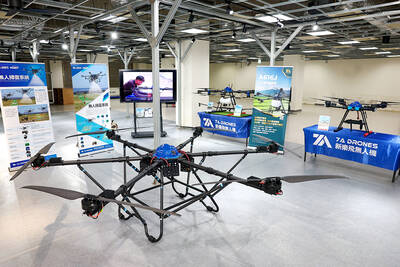
DRONE CENTRAL: Taiwan aims to become Asia’s democratic hub for drones, with most exports focused on high-quality military-grade models, an official said Taiwan’s drone industry is expected to expand significantly by 2030, producing 100,000 units per month and exporting half of them, the Ministry of Economic Affairs said yesterday. Current drone production capacity is about 15,000 units per month, but the industry can quickly scale up as demand increases, Industrial Development Administration Director-General Chiou Chyou-huey (邱求慧) told a news conference in Taipei. Taiwan’s drone output grew 2.5-fold last year to NT$12.9 billion (US$408.3 million) under a government program to develop the uncrewed vehicle sector, he said. The Executive Yuan in October last year approved plans to invest NT$44.2 billion into domestic production of uncrewed aerial
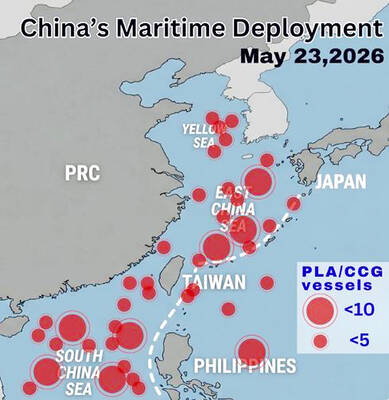
WARNING: China should stop engaging in actions that undermine regional peace and stability, as it would only build resentment among people across the Strait, the CGA said China has deployed more than 100 navy, coast guard and other vessels in waters from the Yellow Sea to the South China Sea and the western Pacific since US President Donald Trump and Chinese President Xi Jinping (習近平) met in Beijing, National Security Council Secretary-General Joseph Wu (吳釗燮) said yesterday. “In this part of the world, #China is the one & only PROBLEM wrecking the #StatusQuo & threatening regional peace & stability,” Wu wrote on X. In a separate post, he said Beijing was coercing Taiwan’s maritime domain, calling it illegal and provocative, after the Coast Guard Administration (CGA) expelled a
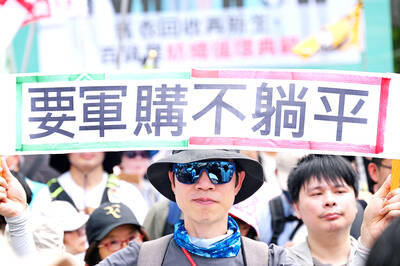
More than 8,000 people took part in a rally in Taipei yesterday to express support for more defense spending, after the opposition slashed the Cabinet’s proposed NT$1.25 trillion (US$39.6 billion) special defense budget and capped it at NT$780 billion. The demonstrators urged the Cabinet to propose another bill. Taiwan Economic Democracy Union convener Lai Chung-chiang (賴中強) said the main problem of the passed budget plan is the removal of funding for critical items, not just that the total amount is smaller. Critical budget items included purchasing or developing uncrewed vehicles, Strong Bow (強弓) missile systems, additional ammunition, artificial intelligence-powered combat systems and Taiwan-US


 RSS
RSS