


Days ahead of scheduled talks with North Korea, US President George W. Bush gave diplomatic pressure a "good chance" of succeeding in coaxing Pyongyang to end its tension-producing nuclear weapons programs.
Along with the US, regional neighbors China, Japan and South Korea are opposed to a nuclear-armed North Korea. Bush cited that unanimity of purpose -- if not of strategy -- as reason for optimism.
"I believe that all four of us working together have a good chance of convincing North Korea to abandon her ambitions to develop nuclear arsenals," Bush told reporters Sunday.
In Seoul, South Korean officials said yesterday they have accepted a North Korean proposal to hold Cabinet-level talks on April 27 to April 29 in Pyongyang.
South Korea's Unification Minister Jeong Se-hyun accepted the North Korean offer in a telephone message, his office said.
Bush, taking a five-day vacation at his central Texas ranch, spoke after attending Easter services at nearby Fort Hood.
He also lauded China's accession to host talks with North Korea, planned for as early as this week, as a good sign.
"The key thing in the North Korea agenda is that China is assuming a very important responsibility," he said. "China's policy is for a nuclear-weapons-free peninsula. And now that they're engaged in the process, it makes it more likely that's going to occur."
The US has insisted on a multilateral approach to defuse the nuclear standoff, rather than the direct US-North Korea engagement that Pyongyang had been demanding.
But the talks -- which would be the first substantive discussions since US officials said in October that North Korea had acknowledged the existence of a uranium-based nuclear weapons program -- were thrown into doubt on Friday when North Korea appeared to announce it had taken steps that could yield six to eight bombs within months.
Later, it became unclear whether the work had actually begun or the translation was faulty. US and South Korean officials said there is no proof that reprocessing of spent nuclear fuel rods was underway, and suggested the report may have been a mistranslation of the vaguely worded Korean version.
The US believes North Korea already has one or two nuclear bombs and can extract enough plutonium from the fuel rods to make several more within months.
Bush, asked about the talks announced last week, did not directly address whether they will take place.
And a Bush spokeswoman said afterward that the president's reference to China's involvement should not be taken as an indication the talks are definitely on. Consultations with allies in the region continue and no final decision has been made, deputy press secretary Claire Buchan said.
Earlier Sunday, the chairman of the Senate Intelligence Committee said he thought the meeting would go ahead.
"China's the key here, and China has made some significant changes here just recently in their attitude to North Korea," Senator Pat Roberts told Fox News Sunday.
Bush's upbeat outlook on what Roberts called the "number one" security threat facing the US contrasted, however, with another angry pronouncement from North Korea.
In the state-run Rodong Sinmun newspaper, the communist government said Sunday that North and South Koreans "should firmly unite as one to resolutely smash the US moves for a war of aggression in order to protect the destiny of the nation and the future of a reunified country."
The statement underscored the huge task ahead for the talks, if they proceed.
North Korea repeatedly has accused the US of planning to attack it after the Iraq war, a charge denied by Washington. The North has often tried to drive a wedge between South Korea and its chief ally, the US.
And though North Korea has never admitted or denied having nuclear bombs, it has closely guarded what it sees as its right to develop them.
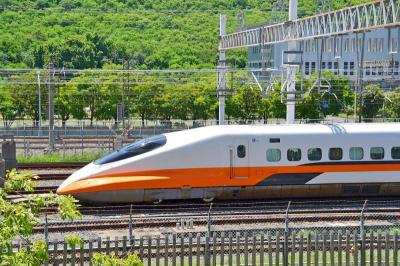
A signaling system malfunction disrupted high-speed rail (HSR) services beginning at 8am today, with trains temporarily reduced to three northbound and three southbound trains per hour as authorities conduct inspections. The malfunction occurred on a section of track in Miaoli County during pre-operation checks early this morning, forcing northbound and southbound trains to use a single track, the HSR operator said. The regular schedule has been replaced with three hourly trains offering only nonreserved seating in each direction, stopping at every station, it said, adding that business class cars would still have reserved seating. Departures from terminal stations are scheduled at the top

DRONE CENTRAL: Taiwan aims to become Asia’s democratic hub for drones, with most exports focused on high-quality military-grade models, an official said Taiwan’s drone industry is expected to expand significantly by 2030, producing 100,000 units per month and exporting half of them, the Ministry of Economic Affairs said yesterday. Current drone production capacity is about 15,000 units per month, but the industry can quickly scale up as demand increases, Industrial Development Administration Director-General Chiou Chyou-huey (邱求慧) told a news conference in Taipei. Taiwan’s drone output grew 2.5-fold last year to NT$12.9 billion (US$408.3 million) under a government program to develop the uncrewed vehicle sector, he said. The Executive Yuan in October last year approved plans to invest NT$44.2 billion into domestic production of uncrewed aerial

VERBOSE VESSELS: A CGA cutter and a China Coast Guard exchanged verbal barbs for more than a day in Taiwanese-controlled waters before the Chinese vessel left The Taiwanese and Chinese coast guards had a standoff near the strategically located Pratas Islands (Dongsha Islands, 東沙群島) in the north of the South China Sea, the Coast Guard Administration (CGA) said yesterday. The two sides engaged in intense radio exchanges over sovereignty claims during the 33-hour standoff. China Coast Guard vessel 3501 eventually left the restricted waters, 26.6 nautical miles (49.2km) west of the Pratas Islands, at 5pm yesterday, the CGA said. Lying approximately between southern Taiwan and Hong Kong, the Taiwan-controlled Pratas are seen by some security experts as vulnerable to Chinese attack due to their distance — more than
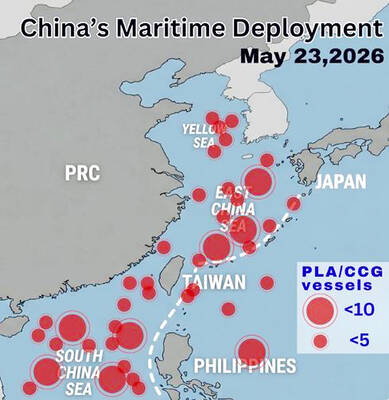
WARNING: China should stop engaging in actions that undermine regional peace and stability, as it would only build resentment among people across the Strait, the CGA said China has deployed more than 100 navy, coast guard and other vessels in waters from the Yellow Sea to the South China Sea and the western Pacific since US President Donald Trump and Chinese President Xi Jinping (習近平) met in Beijing, National Security Council Secretary-General Joseph Wu (吳釗燮) said yesterday. “In this part of the world, #China is the one & only PROBLEM wrecking the #StatusQuo & threatening regional peace & stability,” Wu wrote on X. In a separate post, he said Beijing was coercing Taiwan’s maritime domain, calling it illegal and provocative, after the Coast Guard Administration (CGA) expelled a


 RSS
RSS