


The final curtain was being drawn yesterday on the Taliban regime as it laid down arms in its last bastion of Kandahar and surrendered the remaining two provinces under its control.
The capitulation -- two months to the day after US forces launched a military campaign to track down Osama bin Laden and his al-Qaeda network and punish their Taliban protectors -- was going peacefully, the country's future leader said.
But fighting raged around in the rugged White Mountains of eastern Afghanistan, as tribal forces backed by US air strikes pursued their bid to flush out al-Qaeda fighters -- and perhaps bin Laden -- from their Tora Bora cave hideouts.
US Defense Secretary Donald Rumsfeld said Thursday that the fall of Kandahar would narrow the focus of the US campaign to the Tora Bora area.
US Marines stationed at a desert base southwest of Kandahar reported their first engagement with unidentified enemy troops, killing seven of them, a US officer there said.
Pashtun tribal leader Hamid Karzai, who takes over as the head of Afghanistan's new interim administration on Dec. 22, said his troops entered Kandahar yesterday as militiamen laid down their weapons and surrendered.
"My people have been entering the city. Some have already gone there, some are on their way," Karzai said. "The city of Kandahar is in the process of surrendering. It has been going on peacefully.
"We have sent two principal commanders to Kandahar to prevent the dispersal of weapons in the city."
But he said many Taliban fighters had fled rather than surrender and that looting had broken out after their departure.
The Pakistan-based Afghan Islamic Press (AIP) reported that the Taliban had transferred all power in Kandahar to a tribal council.
According to the surrender agreement, the city will be initially turned over to veteran mujahidin commander Mullah Naqibullah, another Pashtun tribal leader.
CNN, quoting sources in Kandahar, described the situation as chaotic, the streets flooded with Taliban and Arab fighters, tribal militia and armed bandits.
Markets were deserted and gunfire could be heard in the streets, it said.
A Taliban official said US air raids over the past two months had killed some 10,000 people in Kandahar, mostly Taliban fighters.
"During the last two weeks the casualties were so heavy that we were unable to resist the bombing and our defenses were broken," he said. "Seven times we tried to rebuild our defenses in the north and south and every time they were bombed. Rows and rows of Taliban soldiers were killed and we couldn't even find the bodies."
Dissent to the terms of the surrender came from within anti-Taliban ranks, however, with Kandahar governor Gul Agha, whose forces have been fighting for control of the city alongside those of Karzai, threatening to battle his way into the city to avoid any deal with the Islamic militia.
Agha's lieutenant, Gul Lali, said that while his commander favored Karzai's appointment as Afghan leader, he opposed the deal -- notably the implication that Taliban leader Mullah Mohammad Omar could be amnestied if he "renounces terrorism."
"We are against this consideration between Karzai and the Taliban," he said. "Mullah Omar is the first hand of al-Qaeda. We are not against Karzai but we cannot support this agreement.
"We will try to take control of the city so Gul Agha can be in control of Kandahar again," he said.
But Karzai played down the incident.
"It's OK. There was a misunderstanding," he said. "I hope everything will be fine. Gul Agha is a good Afghan."
Rumsfeld too has made it clear any deal that enables Omar or other senior Taliban leaders to walk free would be unacceptable.
Taliban officials also confirmed the surrender of neighboring Helmand and Zabul provinces, and tribal officials said they seized the strategic town of Spin Boldak on the Pakistan border, the scene of heavy fighting in past weeks.
"Around 500 Taliban soldiers in Spin Boldak fled the town ... and they took all their weapons and vehicles with them," said a spokesman for tribal commander Wakil Abdul Samad Khan.
"Early this morning our forces ... moved into Spin Boldak and they have taken control of the city," he said by telephone from the town. "There is calm and no fighting."
The AIP news agency reported that Afghan tribal fighters captured a key hill in their bid to flush out al-Qaeda fighters holed up in caves in the Tora Bora region.
Anti-Taliban fighters seized the Zir Sar hill overnight as their forces moved up toward the Melawa hills, where the al-Qaeda troops are now believed to be concentrated, AIP said.
A spokesman for commander Haji Zaman, who is leading the tribal fighters in the battle for Tora Bora, said fighting was still going on.
"Fighting is raging in the difficult terrain and we are hopeful that our forces will capture the entire area," spokesman Shakarullah said in Peshawar.
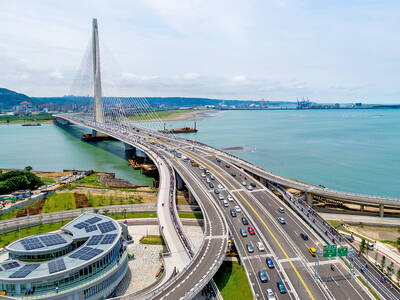
The Ministry of Transportation and Communications yesterday inaugurated the Danjiang Bridge across the Tamsui River in New Taipei City, saying that the structure would be an architectural icon and traffic artery for Taiwan. Feted as a major engineering achievement, the Danjiang Bridge is 920m long, 211m tall at the top of its pylon, and is the longest single-pylon asymmetric cable-stayed bridge in the world, the government’s Web site for the structure said. It was designed by late Iraqi-British architect Zaha Hadid. The structure, with a maximum deck of 70m, accommodates road and light rail traffic, and affords a 200m navigation channel for boats,

Taiwan Semiconductor Manufacturing Co (TSMC, 台積電), the world’s largest foundry service provider, yesterday said that global semiconductor revenue is projected to hit US$1.5 trillion in 2030, after the figure exceeds US$1 trillion this year, as artificial intelligence (AI) demand boosts consumption of token and compute power. “We are still at the beginning of the AI revolution, but we already see a significant impact across the whole semiconductor ecosystem,” TSMC deputy cochief operating officer Kevin Zhang (張曉強) said at the company’s annual technology symposium in Hsinchu City. “It is fair to say that in the past decade, smartphones and other mobile devices were
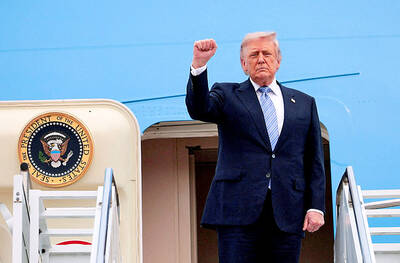
US-CHINA SUMMIT: MOFA welcomed US reassurance of no change in its Taiwan policy; Trump said he did not comment when Xi talked of opposing independence US President Donald Trump yesterday said he has not made a decision on whether to move forward with a major arms package for Taiwan after hearing concerns about it from Chinese President Xi Jinping (習近平). Trump’s comments on Taiwan came as he flew back to Washington after wrapping up critical talks in which both leaders said important progress was made in stabilizing US-China relations even as deep differences persist between the world’s two biggest powers on Iran and Taiwan. “I will make a determination,” Trump said, adding: “I’ll be making decisions. But, you know, I think the last thing we need right

TAIWAN ISSUE: US treasury secretary Scott Bessent said on the first day of meetings that ‘it wouldn’t be a US-China summit without the Taiwan issue coming up’ There were no surprises on the first day of the summit between US President Donald Trump and Chinese President Xi Jinping (習近平), the Mainland Affairs Council (MAC) said yesterday, as the government reiterated that cross-strait stability is crucial to the Asia-Pacific region, as well as the world. As the two presidents met for a highly anticipated summit yesterday, Chinese state media reported that Xi warned Trump that missteps regarding Taiwan could push their two countries into “conflict.” Trump arrived in China with accolades for his host, calling Xi a “great leader” and “friend,” and extending an invitation to visit the White House


 RSS
RSS