


Taiwan needs a superstar comic character, says Chang Min-hui (張敏慧), manager of Basisbooks (基地書店), which is exclusively devoted to Taiwanese comics.
Japanese heavyweights such as Doraemon, Son Goku and Naruto are not only household names in Japan, but are also wildly popular globally. The average Taiwanese, however, would likely be hard-pressed to name a single local comic character.
The immense star power of these Japanese characters have often been utilized to promote other industries, including the 2020 Tokyo Olympics. In Taiwan, it is the opposite, says Lo He-ling (羅禾淋), curator of this year’s Taiwan Comic Art Festival (台灣漫畫藝術節), where he explores ways to expand Taiwan’s comic audience through cross-platform collaboration.
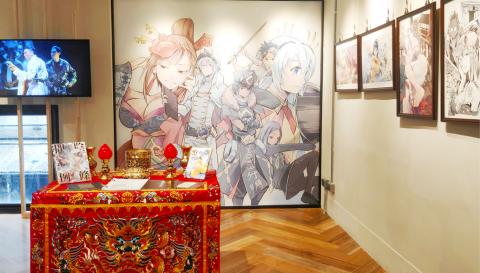
Photo: Han Cheung, Taipei Times
“Since Taiwanese comics are still a niche market, they must rely on other platforms,” Lo says. “How do we make Taiwanese comics an integral part of people’s lives [like they have in Japan]? We have to provide more avenues for people to come in contact with them.”
For example, non-comic reading fans of the television drama Yong-jiu Grocery Store (用九柑仔店) may be compelled to seek out the comic series by Ruan Guang-min (阮光民) that inspired the show.
Visitors to the festival, held in the exhibition space above Basisbooks until Oct. 23, may be surprised at the volume and variety of Taiwanese comics, which in recent years have been shifting towards local themes, from temple festivals to Aboriginal culture to the White Terror. In addition to viewing comics through stage plays, cuisine, literature and pop music, the exhibition is also collaborating with nearby guesthouses and boutique hotels as well as the Taipei Museum of Contemporary Art (MOCA, Taipei) to boost the industry’s visibility.
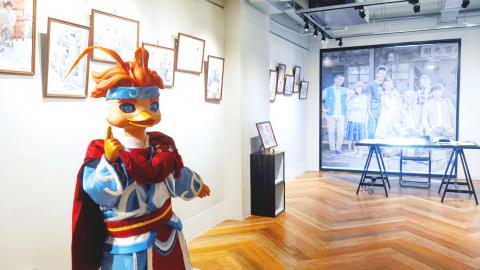
Photo: Han Cheung, Taipei Times
“There’s no way to directly compete with Japan,” Lo says. “But let’s not worry about the market for now; what we need is to continue developing a solid body of work. It’ll take five or 10 more years before there can be a market.”
A LATE START
While Japan has been pumping out smash hit mangas since the 1950s, Taiwan’s comic scene has only really taken flight in the past decade or so. In recent years, Taiwanese comics have made a splash at international festivals, while the Ministry of Culture continues to encourage creators through funding, hosting the annual Golden Comics Award and in January establishing Taiwan Comic Base, which contains Basisbooks.
But Chang says the reality is that, for example, while selections of Taiwanese comics are available in France in the local language, some of these works have gone out of print in Taiwan. Publishers still look at the mass market, and the situation is not unlike Taiwan’s film industry living under Hollywood’s shadow despite the improving quality of its output. Customers still come in looking for a popular Japanese manga and leave disappointed that the store only sells local art.
What’s encouraging, however, is the expanding demographic of local comic readers. In the past, not only were comics considered juvenile entertainment, parents also discouraged their children from reading them in fear of affecting their schoolwork. Today, Chang often sees entire families coming in to browse comics, with parents taking an active interest as well.
Lo says that the delayed development of Taiwan’s comic industry essentially stems from the government’s strict censorship system during the Martial Law era. Since publishing companies did not want to risk spending time and money cultivating local artists only to have the book fail government inspection, they took the safer path by pirating Japanese works. Taiwan had no copyright laws back then, and this was a low-risk business model.
There was a brief boom of local artists in the 1980s and 1990s, but they ultimately could not compete with Japanese works. Even after copyright laws were enacted, publishing companies preferred local artists who imitated Japanese styles and narratives.
The advent of the Internet led to the rise of independent comic artists in the 2000s who built their following online and sold their works and related products at fairs and conventions. Many of today’s bigger-name artists cut their teeth during that era, Lo says. Once they gained enough fans, then the publishing companies were interested.
Lo says an interesting development is that since these comic artists rely on followers, many also have developed a sense of social responsibility — an exhibition he curated in 2016 explores the proliferation during and after the 2014 Sunflower movement of comics that highlight social issues.
TAIWANESE STYLE?
The problem remains the shrinking publishing industry that is not just affecting the comic sector, but all print media. Chang says most people buy comics as collectables these days, which is why both the quality of printing and the prices are relatively higher, often including limited-release bonus material.
“That’s why cross-platform collaboration is crucial,” Lo says. “It’ll create a healthier ecosystem.”
Browsing through the exhibit, it’s evident that many of the Taiwanese artists remain heavily influenced by Japanese manga. This is inevitable, Lo says, due to market demand.
Japan was able to develop its distinct style quickly because its industry matured in the 1960s when information technology was far less advanced and the reach of globalization was not as strong. Doing so in the Internet age is a much slower process.
At the same time, the content is becoming overwhelmingly Taiwanese, with many works exploring deeper, more relatable slice-of-life, cultural or historic themes — and even Taiwanese cuisine.
“Instead of trying to create something that will inevitably be compared to Japanese comics, Taiwanese artists began to draw from what they’re familiar with, which is easier to depict and resonates more with readers,” Lo says. “It’s a good start.”
“As the artists mature, their followers are growing up too,” Chang says. “They’ve outgrown the standard love stories and battle epics.”
Chang has noticed that while there has yet to be a recognizable “Taiwanese” art style, comics too similar to Japanese manga are not preferred by international publishers or festivals since there is already an oversupply of that genre. Instead, the Taiwanese comics that gain popularity internationally are ones that have distinct elements from Taiwanese culture, or those that depict Taiwanese stories such as living under government suppression that also resonate with foreign audiences.
“Maybe this can be the so-called ‘Taiwan style,’” Chang says.
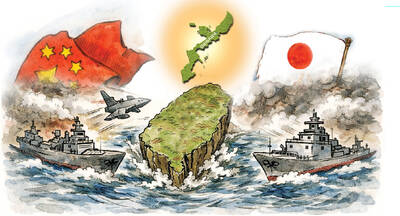
Beijing’s ironic, abusive tantrums aimed at Japan since Japanese Prime Minister Sanae Takaichi publicly stated that a Taiwan contingency would be an existential crisis for Japan, have revealed for all the world to see that the People’s Republic of China (PRC) lusts after Okinawa. We all owe Takaichi a debt of thanks for getting the PRC to make that public. The PRC and its netizens, taking their cue from the Chinese Communist Party (CCP), are presenting Okinawa by mirroring the claims about Taiwan. Official PRC propaganda organs began to wax lyrical about Okinawa’s “unsettled status” beginning last month. A Global

We lay transfixed under our blankets as the silhouettes of manta rays temporarily eclipsed the moon above us, and flickers of shadow at our feet revealed smaller fish darting in and out of the shelter of the sunken ship. Unwilling to close our eyes against this magnificent spectacle, we continued to watch, oohing and aahing, until the darkness and the exhaustion of the day’s events finally caught up with us and we fell into a deep slumber. Falling asleep under 1.5 million gallons of seawater in relative comfort was undoubtedly the highlight of the weekend, but the rest of the tour

Youngdoung Tenzin is living history of modern Tibet. The Chinese government on Dec. 22 last year sanctioned him along with 19 other Canadians who were associated with the Canada Tibet Committee and the Uighur Rights Advocacy Project. A former political chair of the Canadian Tibetan Association of Ontario and community outreach manager for the Canada Tibet Committee, he is now a lecturer and researcher in Environmental Chemistry at the University of Toronto. “I was born into a nomadic Tibetan family in Tibet,” he says. “I came to India in 1999, when I was 11. I even met [His Holiness] the 14th the Dalai

Music played in a wedding hall in western Japan as Yurina Noguchi, wearing a white gown and tiara, dabbed away tears, taking in the words of her husband-to-be: an AI-generated persona gazing out from a smartphone screen. “At first, Klaus was just someone to talk with, but we gradually became closer,” said the 32-year-old call center operator, referring to the artificial intelligence persona. “I started to have feelings for Klaus. We started dating and after a while he proposed to me. I accepted, and now we’re a couple.” Many in Japan, the birthplace of anime, have shown extreme devotion to fictional characters and


 RSS
RSS