


Just as I was about to leave the National Taiwan University (NTU) Insect Museum (國立臺灣大學昆蟲標本館), a volunteer on duty opened an unlabeled box and invited me to touch the insects inside. The bugs, each as long as my pinky and nearly as thick as my thumb, were Madagascar hissing cockroaches. True to their name, they sibilate with displeasure when prodded. I found this fascinating — yet realize that an opportunity to engage in cockroach-petting won’t by itself get many people rushing to visit this worthwhile little museum.
The museum is probably the smallest I’ve ever visited. It’s a single room, about the size of my bedroom, augmented by a few displays in the corridor outside. I learned several things inside, and was intrigued by a few others. As a place to kill a couple of hours between meetings, it’s just about perfect.
Part of NTU’s Department of Entomology, the museum is located inside the two-story block that was purpose-built for the department around the time of its founding in 1936. The building, which is protected under Taiwan’s heritage-preservation law, retains some of its original character, but looks cramped. The corridors are filled with equipment, including ultra-low temperature freezers and temperature-controled growth chambers in which insects are reared. The latter resemble the large reach-in refrigerators found in many restaurant kitchens, but look rather more high-tech.
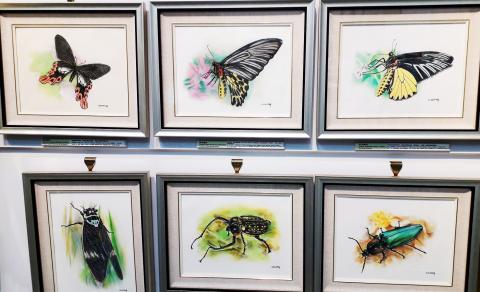
Photo: Steven Crook
The museum is upstairs in Room 207. Next to it, Room 205 is labeled “Insect Museum (Special Exhibition),” but only VIPs and recognized researchers are allowed inside. According to the Web site that introduces all 10 of NTU’s museums (www.museums.ntu.edu.tw), the department has a collection of 330,000 specimens, including some gathered from Taiwan’s forests and mountains before 1914.
The greater part of the collection, however, dates from after 1980, when the National Science Council (國家科學委員會; now the Ministry of Science and Technology, 科技部) began to fund comprehensive field surveys. One panel in the museum outlines the 12 methods that can be used to collect insects. Laying bait is among them; for butterflies, urine has been found to be the best.
Taiwan has around 19,000 insect species, 2 percent of the world’s total — amazing considering the island accounts for a mere 0.00024 percent of Earth’s dry land. Even now, new species are regularly identified.
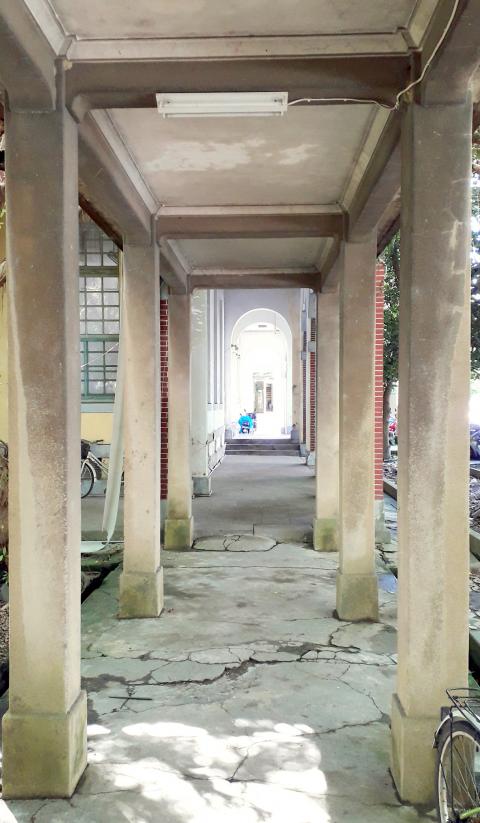
Photo: Steven Crook
Among the hundreds of specimens pinned in cases outside Room 207 are some incredibly tiny creatures. The majority are labeled with their Chinese and scientific names only. I zoomed in on those whose names suggest they were unique to — or had at least been discovered in — Taiwan. One is Epilichas taiwanensis, a toe-winged beetle first described in 1996. Another is Lucanus formosanus, an endemic stag beetle which grows to a length of up to 80mm.
Phelotrupes taiwanus was described by scientists in 1995. The Chinese name translates as “black snow dung beetle” (黑雪隱金龜) and they grow up to 20mm long. If you’re willing to poke through animal droppings during the warmer months in Syuejian Forest Recreation Area (雪見森林遊憩區), they’re apparently fairly easy to find.
Also here are Opilo formosanus (a checkered beetle and an endemic, according to the Taiwan Biodiversity Information Facility: taibif.tw) and Epepeotes ambigenus formosanus. The latter is a long-horned beetle that feeds on the leaves of fig trees; it has just one close relation, in the Philippines.
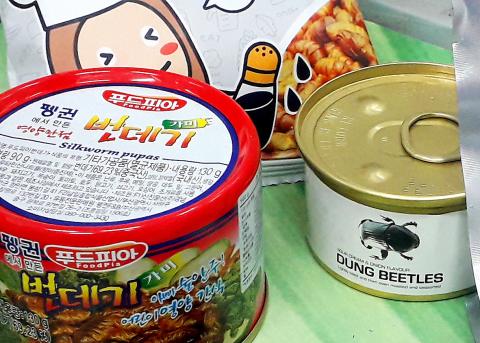
Photo: Steven Crook
Not all the information in Room 207 is presented in English as well as Chinese. However, one of the more detailed bilingual panels explains the discovery of the broad-tailed swallowtail butterfly (Agehana maraho), an endemic butterfly that continues to excite researchers.
First noticed in Yilan in the 1930s, it wasn’t recognized as a species in its own right until the 21st century. Because of its wingspan (up to 10cm) and the unusual shape of its red, brown and white hindwings, it was much sought by collectors. Now listed as a protected species, it was recently determined to have descended from a North American butterfly species which made its way to East Asia between 23 million and 5.33 million years ago.
The broad-tailed swallowtail butterfly is often referred to the “national butterfly of Taiwan.” Because it subsists solely on a type of Sassafras tree found between 900 and 2,400m above sea level, few Taiwanese have been able to see it in the wild.
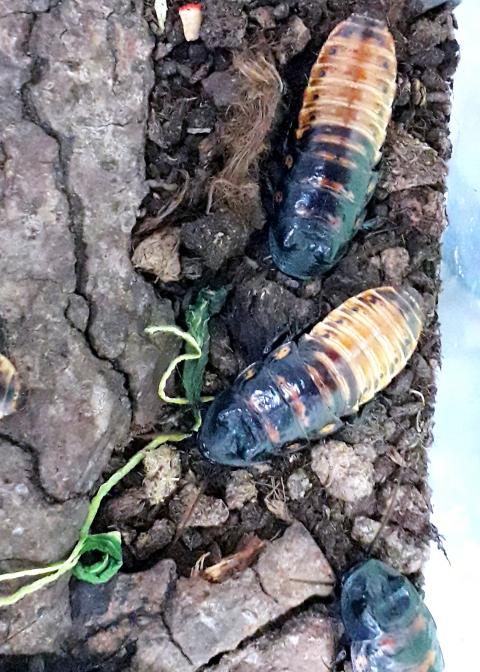
Photo: Steven Crook
Another panel outlines the research interests of the department’s professors, such as: conservation; insect behavior, including the dynamics of insect communities; insecticide toxicology and resistance; genetics; neurobiology (especially vision and color perception, which is important when designing yellow flypaper and other lure-and-kill devices); and insects as vectors transmitting animal and plant pathogens.
I was prepared for the silkworm pupae and crickets in the “Insects As Food” section, having sampled these delicacies in Thailand. But the can of sour-cream-and-onion-flavor dung beetles (labeled in English as well as Thai) took me by surprise. There’s no mention of the Taiwanese practice of steeping bee pupae in kaoliang liquor, a concoction which some people believe can help prevent rheumatism, gout and memory decline.
The box of purple-crow butterflies (labeled in English as well as Chinese) would be more interesting if it were accompanied by some information about these species’ remarkable migration. When the weather begins to turn cold, hundreds of thousands of Dwarf Crows, Striped Blue Crows, Double-branded Black Crows, and other butterflies fly around 250km from northern Taiwan. Many of them end up in Maolin District (茂林), where they assemble in such concentrations that this mountainous corner of Kaohsiung County is now known as the “Purple Butterfly Valley.” It’s one of the most remarkable lepidopteran gatherings in the world.
Steven Crook has been writing about travel, culture, and business in Taiwan since 1996. He is the co-author of A Culinary History of Taipei: Beyond Pork and Ponlai, and author of Taiwan: The Bradt Travel Guide, the third edition of which has just been published.

Paul Thomas Anderson’s “One Battle After Another” was crowned best picture at the 98th Academy Awards, handing Hollywood’s top honor to a comic, multi-generational American saga of political resistance. The ceremony Sunday, which also saw Michael B. Jordan win best actor and “Sinners” cinematographer Autumn Durald Arkapaw make Oscar history as the first female director of photography to win the award, was a long-in-coming coronation for Anderson, a San Fernando Valley native who made his first short at age 18 and has been one of America’s most lionized filmmakers for decades. Before Sunday, Anderson had never won an Oscar. But “One Battle

In Kaohsiung’s Indigenous People’s Park (原住民主題公園), the dance group Push Hands is training. All its members are from Taiwan’s indigenous community, but their vibe is closer to that of a modern, urban hip-hop posse. MIXING CULTURES “The name Push Hands comes from the idea of pushing away tradition to expand our culture,” says Ljakuon (洪濬嚴), the 44-year-old founder and main teacher of the dance group. This is what makes Push Hands unique: while retaining their Aboriginal roots, and even reconnecting with them, they are adamant about doing something modern. Ljakuon started the group 20 years ago, initially with the sole intention of doing hip-hop dancing.

What was the population of Taiwan when the first Negritos arrived? In 500BC? The 1st century? The 18th? These questions are important, because they can contextualize the number of babies born last month, 6,523, to all the people on Taiwan, indigenous and colonial alike. That figure represents a year on year drop of 3,884 babies, prefiguring total births under 90,000 for the year. It also represents the 26th straight month of deaths exceeding births. Why isn’t this a bigger crisis? Because we don’t experience it. Instead, what we experience is a growing and more diverse population. POPULATION What is Taiwan’s actual population?

You would never believe Yancheng District (鹽埕) used to be a salt field. Today, it is a bustling, artsy, Kowloon-ish “old town” of Kaohsiung — full of neon lights, small shops, scooters and street food. Two hundred years ago, before Japanese occupiers developed a shipping powerhouse around it, Yancheng was a flat triangle where seawater was captured and dried to collect salt. This is what local art galleries are revealing during the first edition of the Yancheng Arts Festival. Shen Yu-rung (沈裕融), the main curator, says: “We chose the connection with salt as a theme. The ocean is still very near, just a


 RSS
RSS