


With a pained expression on his face, Mihara Keigo says the culinary “masterpiece” he has just eaten “represents an unfriendly Taiwan-Japan relationship.” Apparently, salmon sashimi does not pair well with minced pork belly and soy sauce.
The bizarre culinary combination was prepared as part of a YouTube video, Making Japanese Style Braised Pork, which was shot by Sanyuan Japan, a channel created in 2016 by Keigo, who goes by the YouTube moniker Sanyuan.
In 2018, Sanyuan was joined by Junya Murakami and Katsumasa Tomita, two of his friends respectively known as Jun and Tommy. Tommy fell in love with Mandarin after studying in Taiwan for a year, and Jun was impressed with Taiwanese hospitality during his travels. But Sanyuan is clearly the star, charming Taiwanese audiences through hard work and a healthy dose of self-deprecation.

Photo Grabs From YouTube
“I’m tall, but not much of a looker,” Sanyuan quips in one video. “Can I ever be an idol?”
From his hilarious reaction when he first tasted stinky tofu, his amazement when witnessing people casually sitting on the ground at Taipei Main Station, to his appreciation for the hospitality he has experienced here, Sanyuan’s videos attract Taiwanese audiences because they offer insight into how Japanese perceive Taiwanese culture.
Sanyuan’s story is as much about leaving Japan as it was coming to Taiwan.
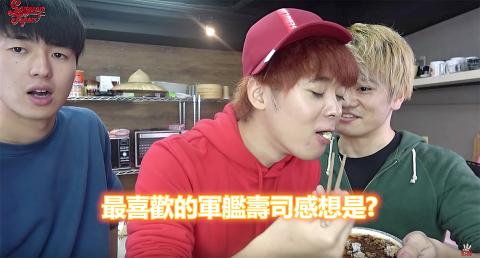
Photo Grabs From YouTube
“My life [in Japan] felt unfulfilled because I was working a desk job and ignoring my penchant for filming videos and my dream to become an idol. When I came across YouTube, I decided to give it a shot,” he said. “So, I quit.”
And, if the numbers are anything to go by, he has pretty much achieved his dream, as he is one of a handful of YouTubers that have reached over 1 million subscribers in Taiwan.
Sanyuan says he chose Taiwan because he wants to enhance Taiwan-Japan friendship, and creates video content based on cultural differences between the two countries.

Photo Grab From YouTube
His failed attempt to turn braised pork into a Japanese cuisine may seem ridiculous, but it reveals distinct taste preferences in Japan and Taiwan; his song based on similar phonetics in Mandarin and Japanese does not make much sense, but it showcases interesting cognates between the two languages; his documentary of spending a night at a stranger’s home verifies Taiwan’s reputation for friendliness.
Today, Sanyuan calls Taiwan a second home.
“Making videos is my way to give back to Taiwan.”
Having heard multiple anecdotes about how his fans have decided to travel to Taiwan or Japan after watching his videos, Sanyuan seems confident when saying that his channel serves as a bridge between the two countries.
When asked about the future, Sanyuan said: “I came to Taiwan to pursue my dream of becoming an idol, so I hope to write a song with a positive message that lingers in the minds of Taiwanese people for a really long time.”

Last week the government announced that by year’s end Taiwan will have the highest density of anti-ship missiles in the world. Its inventory could exceed 1,400, or enough for the opening two hours of an invasion from the People’s Republic of China (PRC). Snark aside, it sounds impressive. But an important piece is missing. Lost in all the “dialogues” and “debates” and “discussions” whose sole purpose is simply to dawdle and delay is what the Chinese Nationalist Party (KMT) alternative special defense budget proposal means for the defense of Taiwan. It is a betrayal of both Taiwan and the US. IT’S

Paul Thomas Anderson’s “One Battle After Another” was crowned best picture at the 98th Academy Awards, handing Hollywood’s top honor to a comic, multi-generational American saga of political resistance. The ceremony Sunday, which also saw Michael B. Jordan win best actor and “Sinners” cinematographer Autumn Durald Arkapaw make Oscar history as the first female director of photography to win the award, was a long-in-coming coronation for Anderson, a San Fernando Valley native who made his first short at age 18 and has been one of America’s most lionized filmmakers for decades. Before Sunday, Anderson had never won an Oscar. But “One Battle
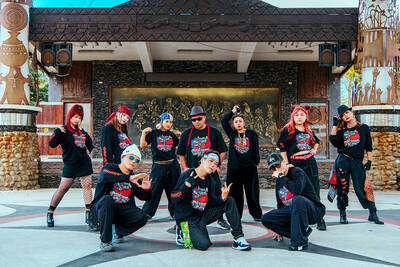
In Kaohsiung’s Indigenous People’s Park (原住民主題公園), the dance group Push Hands is training. All its members are from Taiwan’s indigenous community, but their vibe is closer to that of a modern, urban hip-hop posse. MIXING CULTURES “The name Push Hands comes from the idea of pushing away tradition to expand our culture,” says Ljakuon (洪濬嚴), the 44-year-old founder and main teacher of the dance group. This is what makes Push Hands unique: while retaining their Aboriginal roots, and even reconnecting with them, they are adamant about doing something modern. Ljakuon started the group 20 years ago, initially with the sole intention of doing hip-hop dancing.

You would never believe Yancheng District (鹽埕) used to be a salt field. Today, it is a bustling, artsy, Kowloon-ish “old town” of Kaohsiung — full of neon lights, small shops, scooters and street food. Two hundred years ago, before Japanese occupiers developed a shipping powerhouse around it, Yancheng was a flat triangle where seawater was captured and dried to collect salt. This is what local art galleries are revealing during the first edition of the Yancheng Arts Festival. Shen Yu-rung (沈裕融), the main curator, says: “We chose the connection with salt as a theme. The ocean is still very near, just a


 RSS
RSS