


Let us consider the state of academic books. Their authors usually write them because publication is necessary for promotion and tenure. And publishers publish them because they know a certain number of university libraries worldwide will buy a copy, thus guaranteeing a modest, but assured, profit.
Where does the general reader stand in this? By and large, nowhere. Some celebrated academic authors, such as Frank Dikotter or in an earlier age A.J.P. Taylor or Christopher Hill, will be read by the discerning public, but the rest must be satisfied with the attention of a very small coterie.
Whereas most modern intellectuals prefer to examine and celebrate modernism when contemplating the Far East, A Passage to China by University of Texas at Austin academic Tsai Chien-hsin looks at the tradition of loyalism as it presents itself in Chinese, and especially Taiwanese, eyes.
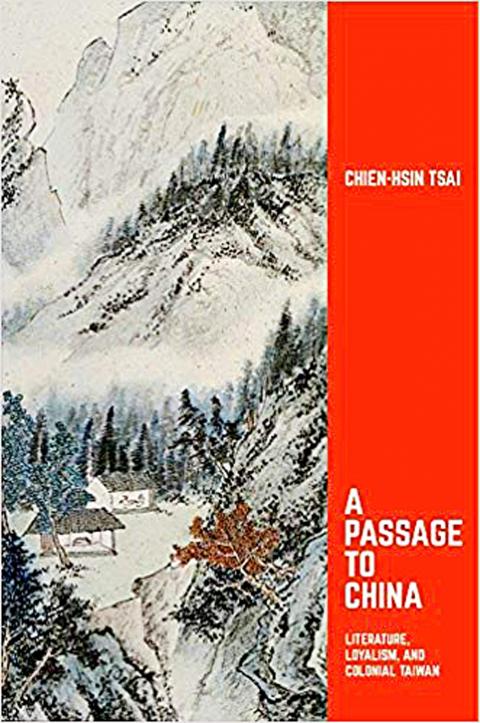
If loyalism, or loyalty, a great Confucian virtue, was originally to the great motherland of China, how were Taiwanese meant to feel when suddenly becoming citizens of the Japanese colonial empire in 1895, then becoming citizens of a society controlled by the repressive Chinese Nationalist Party (KMT) after 1945, or when being lured by the Green politics of the Democratic Progressive Party into the dream (so this author calls it) of a total independence from China? Loyalty to what, they may well have asked.
But China had experienced such challenges to the concept of loyalty before, especially with changes of imperial dynasty such as when the Mongols conquered the Southern Song and established the Yuan dynasty in 1271.
This was a difficult book to follow, at least for this reviewer, and it can safely be said it is not likely to recommend itself to non-specialist readers. Anyone bold enough to venture into its pages should be prepared for sentences such as this one: “This double perspective rereads and elucidates the dialectics between modernity and tradition.”
If you’re OK with that, then fine; go ahead. But citing as it does Derrida and other post-structuralist gurus, this is a hard book for non-believers in that system to come to terms with.
The author proceeds to examine the approach to loyalism in Taiwanese writers such as Chiu Feng-chia (丘逢甲), vice-president of the short-lived Republic of Formosa (台灣民主國) who tried to persuade Peking to stop the Japanese take-over of Taiwan, then retreated across the Taiwan Strait when he saw he had failed; Lien Heng (連橫, 1878-1936), author of General History of Taiwan covering 1,400 years (a scope still to be equaled); the Hakka writer Chung Li-ho (鍾理和, 1915-1960), with whom Tsai focuses on hospitality and the guest; and Wu Chuo-liu (吳濁流, 1900-1976), author of Orphan of Asia.
Their responses are predictably what is often called “nuanced.” Not so, however, in the case of China’s intellectual historian Liang Qichao (梁啟超, 1873-1929) who in his 1899 essay “On Patriotism” (or “On Loving the Nation”) stresses that a love for one’s nation is rooted in love for one’s family, as Confucius had originally said. This sentiment, as Tsai points out, appealed to traditionalists and reformers equally. It finds its modern-day echo, of course, in every Asian country.
Tsai is especially interesting on Gu Hongming (辜鴻銘, 1857-1928), a loyalist who eventually became a chief advisor to the Dowager Empress Cixi (慈禧太后). Despite having been educated at some of the best universities in Europe, not to mention being born in British Malaya, he became a champion of China against its Western enemies, and a strong supporter of the Boxer Rebellion. (This is despite Tsai calling his translations of Confucian classics “playful”). The UK writer Somerset Maugham visited him in 1922, over a decade after the fall of the emperors, and Ku told him that he still wore his queue to symbolize his loyalty. “I am the last representative of the old China,” he told Maugham.
This book is a strange mixture. In places its undoubted erudition makes it obscure to a non-specialist, whereas elsewhere it’s notably reader-friendly and even in places eloquently written. Erudition, in other words, is undoubtedly a virtue, but it can also be a problem.
Loyalty, Tsai concludes, is pluralistic, in other words having many aspects. In this it contributes to the assault on “essentialism” (thinking there is only one, essential aspect of things, and that this is immutable), a favorite target of post-structuralists everywhere. Loyalism, then, has many faces, and always has had.
Loyalty is of course a virtue that’s recognized worldwide, and its betrayal is widely condemned. In Shakespeare’s tragedies Horatio, Kent and Enobarbus are all loyal servants of their respective masters (Hamlet, Lear and Antony), and two of them die in that service.
“Taiwan resides in ‘the first symbolic universe’ of cultural China, as its people are descendants of Chinese migrant-settlers who still observe certain Han customs and live by the Confucian doctrines of filial piety and loyalty,” Tsai writes. Nevertheless, the advances of “desinicization” in Taiwan — meaning presumably the arrival of international concepts such as democracy, feminism and gay rights — have resulted in many Taiwanese being unwilling to discuss traditional concepts such as loyalism (highlighted by its inclusion in this book’s title).
It follows, of course, that Taiwanese who adhere to the concept of a Taiwan independent from China are even more likely to experience inner conflicts over issues such as these traditional Confucian ideals.
Thus, the author continues, “before Taiwanese nativism and separatism realize the dream of Taiwan independence, proponents must seek support from people who pledge loyalty to this future regime.” Is the writer of these words skeptical about this possible future? Not necessarily. This is a very pro-Taiwan book, difficult in places but elsewhere very informative.
In addition, I may be wrong but I have the impression that Tsai is a Chinese scholar first, and a post-structuralist (quite possibly a reluctant one) second. The book’s title refers of course to E.M. Forster’s 1924 novel A Passage to India.

The small platform at Duoliang Train Station in Taitung County’s Taimali Township (太麻里) served villagers from 1992 to 2006, but was eventually shut down due to lack of use. Just 10 years later, the abandoned train station had become widely known as the most beautiful station in Taiwan, and visitors were so frequent that the village had to start restricting traffic. Nowadays, Duoliang Village (多良) is known as a bit of a tourist trap, with a mandatory, albeit modest, admission fee of NT$10 giving access to a crowded lane of vendors with a mediocre view of the ocean and the trains

For many people, Bilingual Nation 2030 begins and ends in the classroom. Since the policy was launched in 2018, the debate has centered on students, teachers and the pressure placed on schools. Yet the policy was never solely about English education. The government’s official plan also calls for bilingualization in Taiwan’s government services, laws and regulations, and living environment. The goal is to make Taiwan more inclusive and accessible to international enterprises and talent and better prepared for global economic and trade conditions. After eight years, that grand vision is due for a pulse check. RULES THAT CAN BE READ For Harper Chen (陳虹宇), an adviser
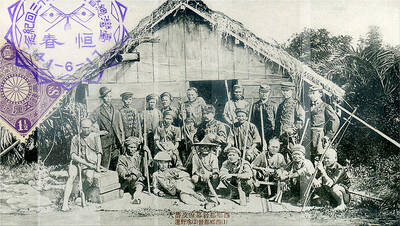
Traditionally, indigenous people in Taiwan’s mountains practice swidden cultivation, or “slash and burn” agriculture, a practice common in human history. According to a 2016 research article in the International Journal of Environmental Sustainability, among the Atayal people, this began with a search for suitable forested slopeland. The trees are burnt for fertilizer and the land cleared of stones. The stones and wood are then piled up to make fences, while both dead and standing trees are retained on the plot. The fences are used to grow climbing crops like squash and beans. The plot itself supports farming for three years.
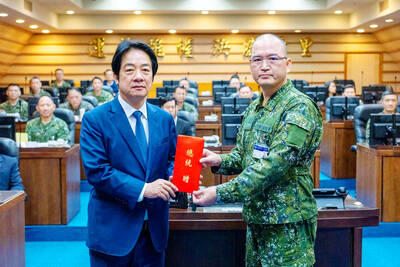
President William Lai (賴清德) on Nov. 25 last year announced in a Washington Post op-ed that “my government will introduce a historic US$40 billion supplementary defense budget, an investment that underscores our commitment to defending Taiwan’s democracy.” Lai promised “significant new arms acquisitions from the United States” and to “invest in cutting-edge technologies and expand Taiwan’s defense industrial base,” to “bolster deterrence by inserting greater costs and uncertainties into Beijing’s decision-making on the use of force.” Announcing it in the Washington Post was a strategic gamble, both geopolitically and domestically, with Taiwan’s international credibility at stake. But Lai’s message was exactly


 RSS
RSS