


Miaoli County has a thriving tourism sector, but few visitors bother with the county seat. Miaoli City isn’t a significant metropolis in any sense, and the opening of its high-speed railway station hasn’t led to a boom — in the three-and-a-half years since, the city’s population has dropped below 90,000.
Even so, it’s not a bad place to live, and not just because it’s near popular tourist destinations like Nanjhuang Township (南庄). Just as Taipei residents make the most of Yangmingshan National Park (陽明山國家公園), Miaoli folks seeking fresh air and exercise head for Maolishan Park (貓貍山公園), about 2km south of downtown.
The hill that gives the park its name is miniature by Taiwan’s standards, the summit being just 144m above sea level. To make sure I got a proper workout, I started my excursion by taking a local train to Nanshih Railway Station (南勢車站). It’s about 5km from Nanshih to Maolishan Park, and a bicycle path covers most of that distance.
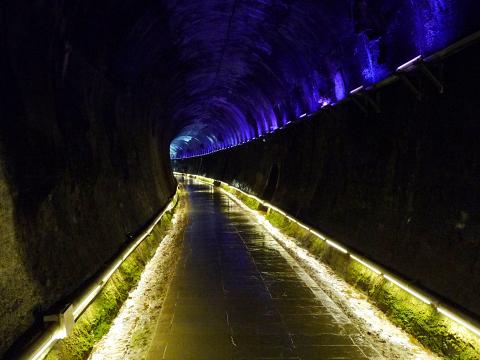
Photo: Steven Crook
BREEZY TUNNELS
Just before reaching Nanshih, northbound cyclists go through the 270m-long Old Tongluo Tunnel (舊銅鑼隧道). For most of the 20th century, this was a railway tunnel. When the old single-track line was replaced in 1998 with adjacent double tracks, the tunnel was decommissioned.
As far as I could see, there was nothing special about the old tunnel, nor the new one. The sun was getting higher in the sky, so without delay I got going.
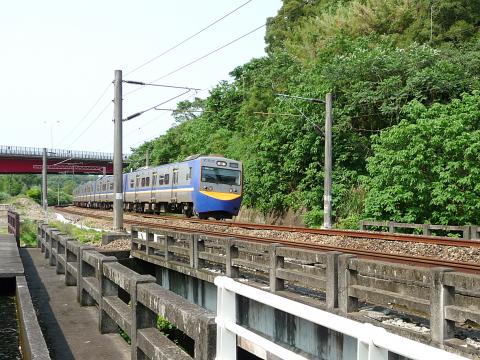
Photo: Steven Crook
But once on the bicycle trail, I kept coming across signs of misuse. Every single one of the metal hoops put in place to stop cars from driving on the trail had been removed and dumped by the side of the path.
Perhaps I was overreacting; only two or three cars passed me during the 80 minutes I spent on the path. Nevertheless, it struck me as yet another example of a local tendency to build infrastructure but not properly maintain it. Like a woman who applies makeup, but doesn’t brush her teeth, is sometimes how I think of it.
Despite there being a fair bit of shade along the trail, I was dripping with sweat by the time I reached the base of Maolishan. Fortunately, relief was nearby. The north-south railway goes right beneath Maolishan Park, and there’s another disused tunnel here.
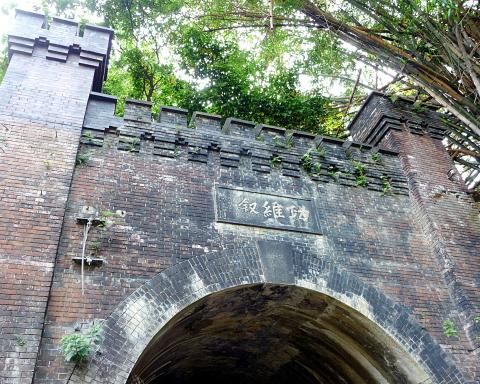
Photo: Steven Crook
Gongweisyu Tunnel (功維敘隧道) is 441, 452 or 465m in length, depending on which source you believe. Even before stepping inside, I could feel a cool breeze issuing from the entrance.
I wish I’d carried a thermometer to compare the air temperature in the middle of the tunnel with that of the outside world. The difference was at least 10, maybe as much as 15 degrees Celsius. It’s no wonder that some locals who come to Maolishan to exercise walk lengths of the tunnel, rather than expose themselves to the hot sun.
MARTYRS OF MIAOLI
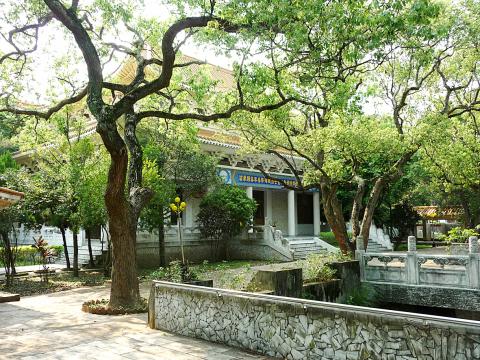
Photo: Steven Crook
Emerging from the eastern end of the tunnel, I took a steep path up the hillside, crossed Gongyuan Road (公園路) and began searching for the monuments and memorials that dot Maolishan Park.
Between 1946 and 1997, Maolishan was named Mount Fusing (福星山) in honor of Lo Fu-hsing (羅福星). Lo, who was born in 1886 in present-day Indonesia, lived in Miaoli for the final few years of his short life.
Thanks to Lo’s efforts to foment anti-Qing rebellions in China and anti-Japanese uprisings in Taiwan — for which he was executed by the Japanese colonial authorities in 1914 — he was until recently lionized by the Chinese Nationalist Party (KMT). In 1981, his portrait appeared on an NT$2 postage stamp.
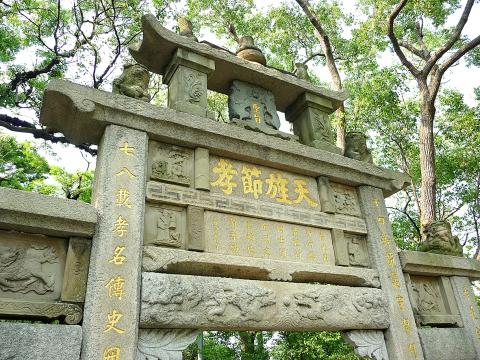
Photo: Steven Crook
A bronze bust of Lo can be found near Miaoli Martyrs’ Shrine (苗栗縣忠烈祠). Like many other martyrs’ shrines around Taiwan, that landmark, which is hidden behind thick tree cover, was built on a site that used to be a Shinto place of worship. It’s kept locked most of the time, and from what I’ve been able to find out, there’s nothing of particular interest inside.
Lo isn’t the only anti-Japanese activist commemorated within the park. When the Republic of Formosa (臺灣民主國) was established in 1895 — in response to Beijing ceding Taiwan to Tokyo at the end of the First Sino-Japanese War — Chiu Feng-chia (丘逢甲) was appointed vice-president and commander of the militia units that tried to resist the Japanese takeover. The republic quickly collapsed and Chiu fled to China, but he’s remembered here by a bland column that uses one of his honorific names, Chiu Tsang-hai (丘滄海).
Far more attractive is the Lai Clan Memorial Arch (賴氏節孝坊). In terms of both appearance and function, it’s a classic paifang (牌坊, Chinese gateway). This four-column, three-archway structure assembled from granite blocks commemorates the loyalty shown by Lai Ssu-niang (賴四娘) to her husband’s family.
Lai was born to a poor local family in 1806, and as was common in that era, her parents decided whom she would marry before she had even reached adolescence. She was betrothed to Liu Chin-hsi (劉金錫), but he died at the age of 14, before the marriage was consummated. Rather than seek a new husband, Lai stayed in the Liu household.
Lai’s neighbors and relatives petitioned the imperial court to recognize her selflessness. In 1883, five years before Lai’s death, the arch was erected beside Miaoli’s Wenchang Temple (文昌祠), 850m east of its current location.
In 1935, when the colonial authorities began widening the area’s roads, the arch was shifted a few hundred meters southwest to the grounds of Tianyun Temple (天雲廟). I haven’t been able to discover why the arch was moved to its current location in 1968 — but it surely enhances Maolishan Park far more than any of the KMT-era memorials.
Steven Crook has been writing about travel, culture, and business in Taiwan since 1996. He is the co-author of A Culinary History of Taipei: Beyond Pork and Ponlai and author of Taiwan: The Bradt Travel Guide the third edition of which has just been published.
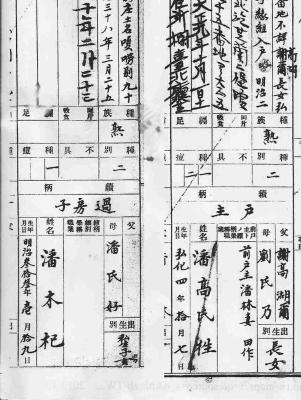
Feb. 9 to Feb.15 Growing up in the 1980s, Pan Wen-li (潘文立) was repeatedly told in elementary school that his family could not have originated in Taipei. At the time, there was a lack of understanding of Pingpu (plains Indigenous) peoples, who had mostly assimilated to Han-Taiwanese society and had no official recognition. Students were required to list their ancestral homes then, and when Pan wrote “Taipei,” his teacher rejected it as impossible. His father, an elder of the Ketagalan-founded Independence Presbyterian Church in Xinbeitou (自立長老會新北投教會), insisted that their family had always lived in the area. But under postwar
In 2012, the US Department of Justice (DOJ) heroically seized residences belonging to the family of former president Chen Shui-bian (陳水扁), “purchased with the proceeds of alleged bribes,” the DOJ announcement said. “Alleged” was enough. Strangely, the DOJ remains unmoved by the any of the extensive illegality of the two Leninist authoritarian parties that held power in the People’s Republic of China (PRC) and Taiwan. If only Chen had run a one-party state that imprisoned, tortured and murdered its opponents, his property would have been completely safe from DOJ action. I must also note two things in the interests of completeness.
Taiwan is especially vulnerable to climate change. The surrounding seas are rising at twice the global rate, extreme heat is becoming a serious problem in the country’s cities, and typhoons are growing less frequent (resulting in droughts) but more destructive. Yet young Taiwanese, according to interviewees who often discuss such issues with this demographic, seldom show signs of climate anxiety, despite their teachers being convinced that humanity has a great deal to worry about. Climate anxiety or eco-anxiety isn’t a psychological disorder recognized by diagnostic manuals, but that doesn’t make it any less real to those who have a chronic and
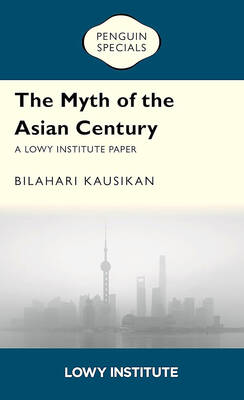
When Bilahari Kausikan defines Singapore as a small country “whose ability to influence events outside its borders is always limited but never completely non-existent,” we wish we could say the same about Taiwan. In a little book called The Myth of the Asian Century, he demolishes a number of preconceived ideas that shackle Taiwan’s self-confidence in its own agency. Kausikan worked for almost 40 years at Singapore’s Ministry of Foreign Affairs, reaching the position of permanent secretary: saying that he knows what he is talking about is an understatement. He was in charge of foreign affairs in a pivotal place in


 RSS
RSS