


May 13 to May 19
After browsing over Wang Da-hong’s (王大閎) plans for Sun Yat-sen Memorial Hall, then-president Chiang Kai-shek (蔣介石) nodded, smiled and even offered a few words of approval.
“He was polite; he knew my personality,” the China-born, Europe and US-educated Wang recalled, referring to a 1961 incident where his insistence on his ideals cost him the chance to design the National Palace Museum (NPM).
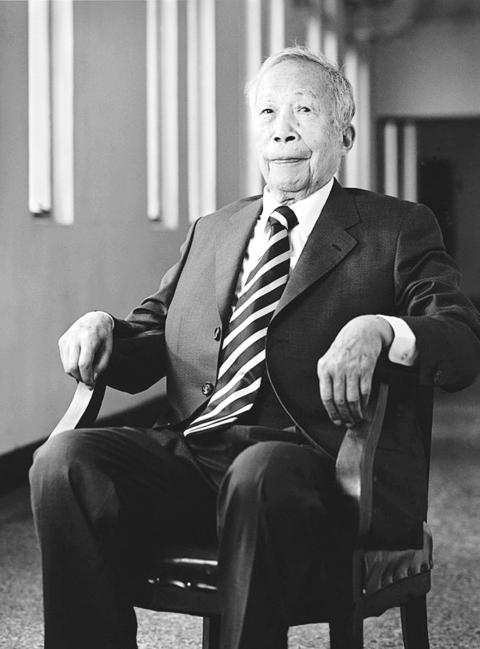
Photo courtesy of Hsu Sung-ming
A few days later, Wang received a call from Chiang’s secretary — the president thought the building was too Westernized; it needed to be more Chinese. The submission guidelines specifically asked for a building that would reflect Chinese culture while drawing from Western elements, but having lived in Europe and the US from the age of 13 to 28, Wang’s thinking was probably too progressive for the conservative government bigwigs.
It was late 1965, and China was on the eve of the Cultural Revolution, which would soon smash many things traditional. Chiang’s government in Taiwan was still clinging to its spot in the UN as the legitimate ruler of China, and it would benefit Taiwan to portray itself as the rightful heirs of Chinese culture. The NPM was completed earlier that year, and Sun’s memorial was Chiang’s next pet project.
Wang was unhappy with the request, but after the NPM debacle, he had learned to compromise. It took almost two years for Chiang to approve what Wang considered his “most difficult project ever,” breaking ground on March 12, 1968 and opening on May 16, 1972.
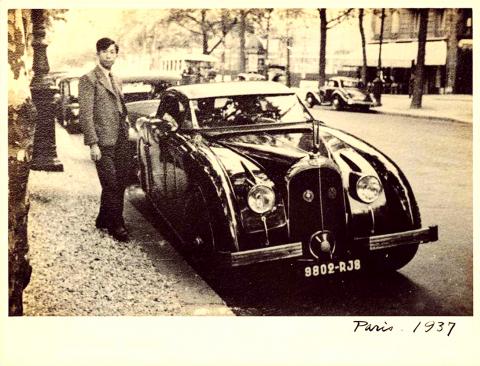
Photo courtesy of Wikimedia Commons
FIFTEEN YEARS IN THE WEST
Wang was born in Beijing to a prominent family as the son of Wang Chung-hui (王寵惠), a close associate of Sun who joined the Chinese Nationalist Party (KMT) in 1912 and held a number of important positions during its time in China. After the KMT fled to Taiwan, the elder Wang served as minister of justice until his death in 1958.
Through his father’s work in Europe as a diplomat, the younger Wang enrolled in a Swiss academy as a teenager, later completing his master’s degree in architecture at Harvard University, where he studied alongside I.M. Pei (貝聿銘) under Bauhaus founder Walter Gropius. He returned to China in 1945 and set up shop, moving to Taiwan via Hong Kong in 1952.
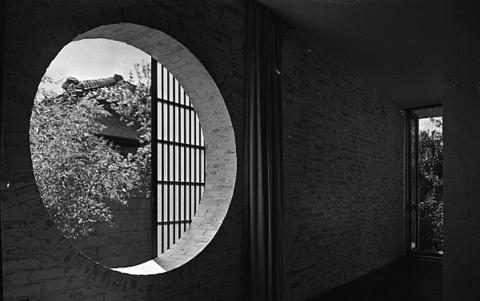
Photo: Liu Te-hsin, Taipei Times
Wang’s first attempt at public architecture was the proposal submitted for the NPM in 1961. While the authorities chose his design, Wang’s ideas were too progressive for the committee, leading them to hand the project to one of the jurors. According to an article on Wang by architecture professor Hsu Ming-sung (徐明松), Wang commented: “Politicians should be politicians, and professionals should be professionals.”
Wang died in May last year, leaving behind an architectural legacy in Taipei. He was responsible for a number of buildings on the National Taiwan University campus, the Lin Yutang House (林語堂故居) at Yangmingshan, numerous structures at Academia Sinica, the Asia Cement building as well as the current Ministry of Foreign Affairs and Ministry of Education.
His private residence on Taipei’s Jianguo S Road (建國南路) was his first project in Taiwan, representative of his combination of classical Chinese design elements with modern techniques. Demolished in the 1970s, it was rebuilt in 2017 at Fine Arts Park as the Wang Da-hong House Theater.
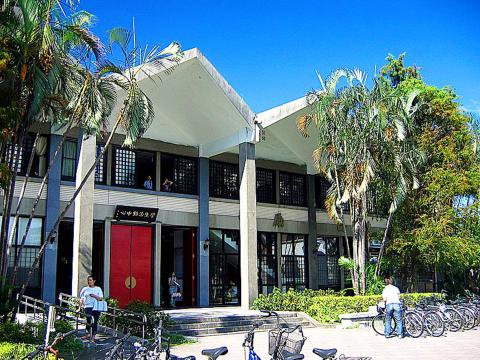
Photo courtesy of Wikimedia Commons
IMMORTALIZING SUN
Chiang first brought up the idea for a memorial hall for KMT founder Sun Yat-sen during a Central Standing Committee meeting in 1963, calling for a task force to prepare for Sun’s upcoming 100th birthday on Nov. 12, 1965. One of its five directives was “construction of a memorial hall.”
“In addition to grand ceremonies during [Sun’s] 100th birthday, we especially need a hardware facility that inherits the past and inspires the future in order to show our eternal remembrance of [Sun],” Chiang said.
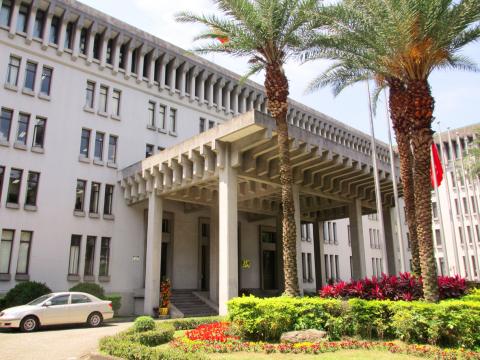
Photo courtesy of Wikimedia Commons
Wang answered the call for design submissions, beating out 11 other architects for the prize. According to an oral history published by the memorial, Chiang was not the only one who thought the design was too Western. Committee members expected a imperial Chinese design like the Grand Hotel (圓山飯店), and could not understand why Wang incorporated so many modern elements into his proposal.
A poor speaker, Wang had to explain to each official that since Sun fought against imperial rule, it would be an insult to him for his memorial to completely imitate Qing-era architecture, which he described as “extravagant and decadent.” This decadence, he argued, was exactly what led Sun to start a revolution.
EVOLVING SPACE
When the memorial was first complete, then-Taipei mayor Henry Kao (高玉樹) proposed that no civilian building nearby should be taller than the memorial. Again, Wang argued that such restrictions would clash with Sun’s democratic ideals. Kao agreed — otherwise that area of Taipei would have looked quite different today.
Kao explains in the same oral history that the land the memorial occupies was originally designated for “Park No. 6.” He ordered the demolition of illegal structures in the vicinity as well as the removal of military rail tracks for a nearby armory, while the remaining land mostly contained rural paths and rice paddies. A large amount of dirt was needed to create level ground to build the memorial, and the hole dug in a corner of the grounds became today’s Lake Cui (翠湖).
Chiou Chi-yuan (邱啟瑗) writes in The Reformation and Development of National Dr. Sun Yat-sen Memorial Hall in Taiwan (台灣國父季輾館之變革與發展) that the hall focused on highlighting Sun’s accomplishments as well as the KMT’s achievements compared to the condition of China. Until 2002, the displays were curated by a team from the KMT Party History Institute (黨史館) who set up office on the memorial grounds. Today it is administered by the Ministry of Culture.
Chiang’s funeral in 1975 was held here, and his son Chiang Ching-kuo (蔣經國) and his successor Lee Teng-hui (李登輝) both assumed their presidencies at the memorial hall. While there is still rich material about Sun’s life, the hall is now better known for hosting various exhibitions and performances, including the Golden Horse and Golden Bell Awards.
Taiwan in Time, a column about Taiwan’s history that is published every Sunday, spotlights important or interesting events around the nation that have anniversaries this week.
Taiwan’s English education system is being pulled apart by three opposing forces. Bilingual Nation 2030 pulls students toward English and global communication. Artificial Intelligence (AI) readiness pulls them toward digital judgment, verification and AI-mediated work. But Taiwan’s old exam culture pulls them back toward memorization, grammar drills, timed reading and correct answers. If the education system keeps using old exams to define success, it risks producing graduates who are neither genuinely bilingual nor genuinely AI-ready, but trained for tasks machines can already perform. The first force is Bilingual Nation 2030. Launched in 2018, the policy aimed to “help Taiwan’s workforce connect
It seems every few days one bumps into one of those “real man” comments in which Taiwan is urged to “face reality” or similar, and “make a deal,” with the speaker implying that soon it will be too late. “Deal” advocates always present themselves as having a superior grip on reality, and the manly ability to make the “hard choice.” Their testosterone-laden language often echoes that of Taiwan sellout advocates. Note that such commentary always specifies a process (“make a deal, work with, make progress”), never the end state of what occupation by a violent authoritarian colonialist state will entail. In
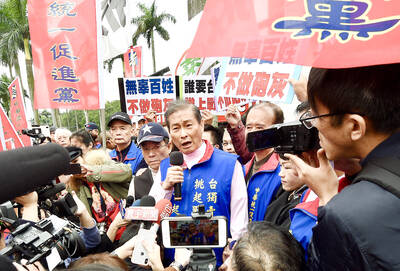
There are shadowy cabals plotting to sell out Taiwan to be annexed by China, by invasion if necessary. Fortunately, they are buffoons. In 2019, former Bamboo Union gangster and founder of the China Unification Promotion Party (CUPP), Chang An-le (張安樂, colorfully known as “White Wolf”), led a protest at the Legislative Yuan against comments made by then-premier Su Tseng-chang (蘇貞昌) that in the event of an attack by China, he would never surrender, but would protect the nation by fighting to the end, even if he only had a broom. Chang had party members bring a wooden casket that they
June 1 to June 7 "If all Taiwanese were as afraid of dying as you, then what would happen?” Physician Shih Chiang-nan (施江南) reportedly said this to his wife Chen Chiao-tung (陳焦桐) after she urged him to stop intervening on behalf of Taiwanese soldiers stranded overseas after serving in the Japanese Army during World War II. Shih had clashed with high-ranking officials over the issue, engaged in several heated arguments with Taiwan governor-general Chen Yi (陳儀) and allegedly shouted at general Ko Yuan-fen (柯遠芬), chief of staff of the Taiwan Garrison Command, over


 RSS
RSS