


A feeling of guilt overtakes me as I browse through Museum 207’s latest exhibition. The night before, I was cleaning my room — Marie Kondo style — and I thought of all the objects I threw away because they were slightly damaged, including a sweater that only had a tiny hole.
In tune with Dihua Street’s spirit of preserving traditions, Museum 207’s latest exhibition is titled “Cherishing the Old” (舊的不去), and focusing on techniques for repairing clothes, chairs, bowls, fishing nets and so on from a time when most people couldn’t afford to just go out and buy a new one.
The exhibition’s explainer is probably meant to make visitors feel guilty: “In today’s culture of casual ‘buy and discard,’ we have also forgotten how to cherish. We hope this exhibition will let us savor the beauty of cherishing the old by revisiting the dying craft of ‘repair,’” it reads.
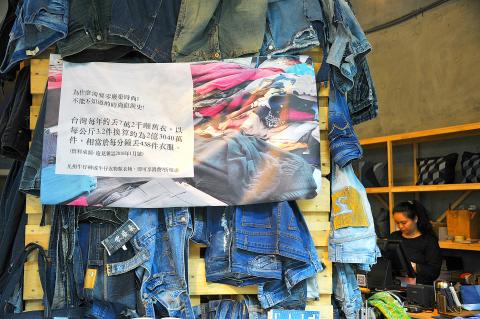
Photo: Han Cheung, Taipei Times
Sustainability and minimizing waste has been a hot topic in Taiwan, especially with the government’s efforts in reducing plastic and promoting green energy. Related exhibitions and enterprises can be found all around the country these days — the Taiwan Design Center’s comprehensive “Circular Design — Are You In-Circled?” (循環設計展 — 你在圈內嗎?) show just concluded this past weekend, while reusable sanitary pads and metal straws have become mainstays of crafts markets.
After Museum 207, I head to Huashan 1914 Creative Park to explore the idea of repair and reuse in a modern and commercial context at the “Zero Waste Exhibition” (零廢棄時尚) pop up shop curated by Storywear (故事衣), a fashion brand that repurposes used jeans and collaborates with traditional or disadvantaged craftspeople.
According to a shop display, 438 pieces of clothing are discarded per minute in Taiwan. This number is only increasing. Last month, Greenpeace Taiwan announced that people are discarding clothes at twice the rate they did in 2000, yet they own 60 percent more clothing. “Fast fashion must slow down,” the organization warned.
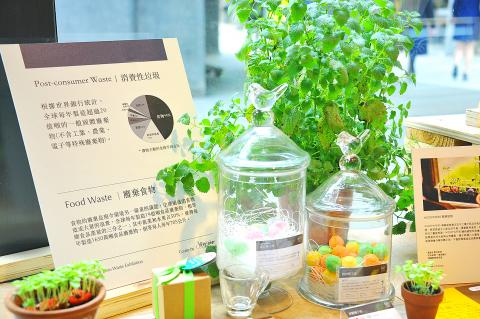
Photo: Han Cheung, Taipei Times
EVERYTHING CAN BE REPAIRED
Visitors to the 207 Museum are confronted with questions that urge them to think about how they live: “In an age where a ceramic cup costs NT$199, would you repair a broken cup?”
Some of the anecdotes are quite fascinating. Apparently in ancient China, coastal inhabitants used powdered oyster shell mixed with glutinous rice to mend broken bowls, while earthworm mucus or garlic juice was used in Europe.
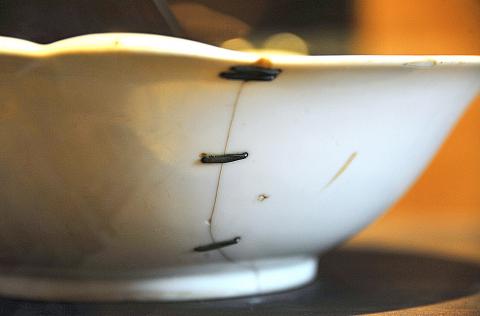
Photo: Han Cheung, Taipei Times
Each section includes a short video with interviews and action sequences from actual repair craftspeople in Taiwan that contextualizes the text and artifacts. The highlight of the show is probably several bowls by Kansanlau (江山樓), a famous entertainment venue from the Japanese colonial era that’s known for once serving the late Japanese emperor Hirohito when he was still the crown prince. The mended bowls look quite ordinary until a museum staff told me to lower my head and look at the vessel’s side, where the repaired fissures are bolstered by metal staples that are not seen anywhere today.
“The staple repair is a sign of how precious porcelain ware was at that time,” the description reads.
The exhibition is small, only containing two narrow floors typical of Dihua Street buildings, but its detailed descriptions containing actual interviews with experts (and excellent English translations) and well-produced videos give life to the ordinary household objects that they accompany. From cracked records to fishing nets to oil umbrellas, nothing cannot be fixed.
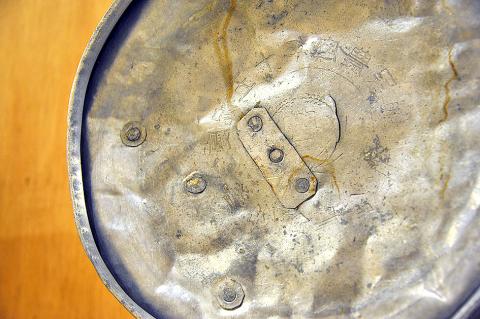
Photo: Han Cheung, Taipei Times
Most of the objects are repaired so well that it’s hard to tell what work went into them, which makes sense in such an exhibition to show the highest quality repair skills, but it’s far more interesting to look at bowls and pans that are patched, stapled and welded back together.
Since the show focuses on traditional crafts, very little of it is dedicated to the value of these dying arts in the modern world. There’s just one tiny display about the work of Chen Kao-teng (陳高登), where the display reads, “a traditional technique has become a lifestyle.”
Chen is well-versed in these ancient methods but he infuses them with a creative touch, such as fusing different materials or making the metal patches look like modern zippers and other objects.
I’m already convinced that I should go home and save that sweater before the garbage truck comes, but I don’t want to just mend the hole, but try something more ambitious. I head to the fashion exhibition at Huashan to explore more possibilities.
REUSE AND REVITALIZE
If the Dihua Street exhibition was small, “Zero Waste Exhibition” is even smaller, occupying just a single glass room at Huashan. Storywear founder Kuan Chen (陳冠百) spent the past year and a half preparing for this venture, which uses discarded blue jeans to make all kinds of clothes, bags and accessories, using everything down to the labels and belt loops.
The products are all made by traditional Taiwanese tailors and craftspeople, especially focusing on older and disadvantaged people, including a woman whose child has cerebral palsy. Each unique piece comes with a detailed label that notes the collaborating organization, how many hours were put into making the piece and a signature by the maker. The label is made from seed paper that can be planted, and the string that attaches it to the product is made from old burlap sacks.
While the exhibition obviously takes on the form of a clothing store, it weaves environmental messages and information — in Chinese only — between the displays, which are also made with repurposed wooden crates.
The centerpiece is a 300cm-tall “demin tree” made of about 75 pairs of donated jeans — highlighting the fact that manufacturing that number of jeans produced 210,000 gallons of wastewater. Statistics are plastered over the display, noting that the fashion industry is the second most polluting trade in the world after oil. It’s a clever way to combine a store and exhibition about an important topic without being too preachy. The store also showcases wares from other zero-waste designers, such as jewelry made from computer boards and repackaged antique tools and knick-knacks.
If the “Cherishing the Old” was about appreciating traditions, “Zero Waste Exhibition” displays the potential of keeping these crafts significant in the modern world. I still have a lot of stuff to get rid of at home as I resume my cleaning endeavor, but I’ll definitely be taking a second look at my waste pile.
“Cherishing the Old” runs until July 7. “Zero Waste Exhibition” at Huashan ends on Sunday but Storywear will have another display at Taipei’s Flora Expo Park starting Tuesday.
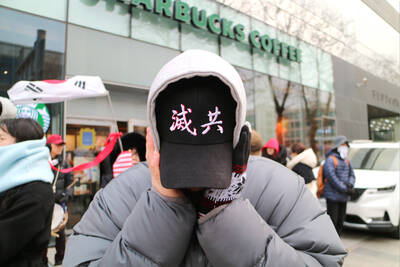
On a harsh winter afternoon last month, 2,000 protesters marched and chanted slogans such as “CCP out” and “Korea for Koreans” in Seoul’s popular Gangnam District. Participants — mostly students — wore caps printed with the Chinese characters for “exterminate communism” (滅共) and held banners reading “Heaven will destroy the Chinese Communist Party” (天滅中共). During the march, Park Jun-young, the leader of the protest organizer “Free University,” a conservative youth movement, who was on a hunger strike, collapsed after delivering a speech in sub-zero temperatures and was later hospitalized. Several protesters shaved their heads at the end of the demonstration. A
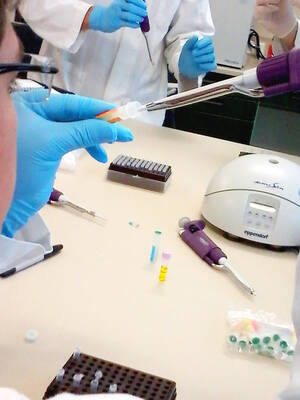
Google unveiled an artificial intelligence tool Wednesday that its scientists said would help unravel the mysteries of the human genome — and could one day lead to new treatments for diseases. The deep learning model AlphaGenome was hailed by outside researchers as a “breakthrough” that would let scientists study and even simulate the roots of difficult-to-treat genetic diseases. While the first complete map of the human genome in 2003 “gave us the book of life, reading it remained a challenge,” Pushmeet Kohli, vice president of research at Google DeepMind, told journalists. “We have the text,” he said, which is a sequence of
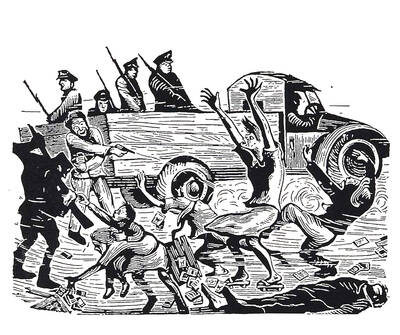
In August of 1949 American journalist Darrell Berrigan toured occupied Formosa and on Aug. 13 published “Should We Grab Formosa?” in the Saturday Evening Post. Berrigan, cataloguing the numerous horrors of corruption and looting the occupying Republic of China (ROC) was inflicting on the locals, advocated outright annexation of Taiwan by the US. He contended the islanders would welcome that. Berrigan also observed that the islanders were planning another revolt, and wrote of their “island nationalism.” The US position on Taiwan was well known there, and islanders, he said, had told him of US official statements that Taiwan had not
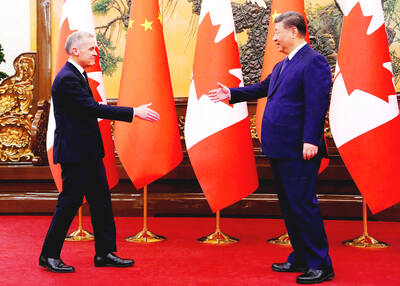
Britain’s Keir Starmer is the latest Western leader to thaw trade ties with China in a shift analysts say is driven by US tariff pressure and unease over US President Donald Trump’s volatile policy playbook. The prime minister’s Beijing visit this week to promote “pragmatic” co-operation comes on the heels of advances from the leaders of Canada, Ireland, France and Finland. Most were making the trip for the first time in years to refresh their partnership with the world’s second-largest economy. “There is a veritable race among European heads of government to meet with (Chinese leader) Xi Jinping (習近平),” said Hosuk Lee-Makiyama, director


 RSS
RSS