


The name Johnnie To (杜琪峯) is ubiquitous in Hong Kong cinema, but the prolific director and producer claims he might have never ended up making films, if it wasn’t for a stroke of luck 45 years ago.
As a then broke and unemployed 17-year-old, To joined Hong Kong’s leading television station TVB (Television Broadcasts Limited) on a whim, with no clue that it would eventually lead him to his true calling.
“I really just needed a job and some money. It wasn’t my choice, but I happened to be assigned to the drama department,” he says. “If I had been sent to the engineering department, I might have ultimately become an engineer.”

Photo courtesy of the Far East Film Festival
Today, the 63-year-old godfather of Hong Kong gangster films continues to be one of the most active and commercially successful filmmakers in the local industry, both in terms of quantity and quality. To has made more than 50 films since debuting in 1980, releasing at least two to three films a year without fail under his production company Milkyway Image (銀河映像).
The three-time Golden Horse best director winner has also reaped critical acclaim overseas, with major film festivals including Cannes, Venice and Toronto premiering his works. Last October, the Toronto International Film Festival screened a retrospective on 19 of To’s iconic films, including The Mission (鎗火, 1999) and Election (黑社會, 2005), while the recent Far East Film Festival in Udine, Italy closed their 20th edition with a restored version of his 2004 judo drama, Throw Down (柔道龍虎榜).
“This is one of my favorite movies,” To says. “I made Throw Down at a time when Hong Kong was suffering from the SARS epidemic, and the morale of the people was low. But as the title Throw Down implies, you have to get back up.”
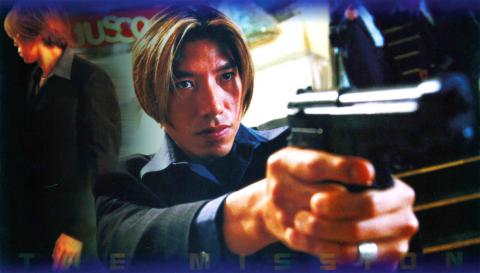
Photo courtesy of the Far East Film Festival
It’s an encouraging message that could likewise be conveyed to Hong Kong’s declining film industry, which now produces around 60 films annually — a far cry from its peak of 400 in the golden era of the early 1990s. Meanwhile, To has diversified by tackling different genres, with films such as romantic drama Linger (蝴蝶飛, 2008) and musical-comedy Office (華麗上班族, 2015).
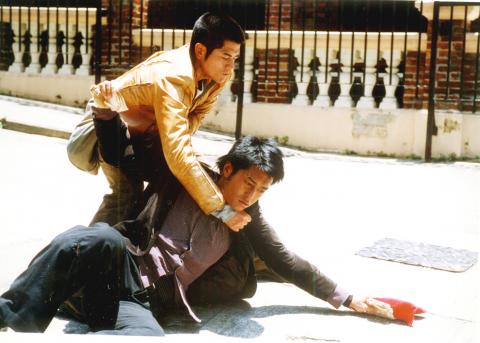
But he is best known for his gritty, highly-stylized action thrillers that go deep into the dark underbelly of Hong Kong triad society, exploring enduring themes of brotherhood, loyalty and honor.
“The most important thing is to keep your own original ideas and never copy other people’s stuff,” he responds, when probed on his formula for success. “Since the triad genre already exists, I always try to create something different from what has already been shown by injecting my own personality and observations of life, so that people will notice that this is my movie.”
Photos courtesy of the Far East Film Festival
GUT INSTINCT
With his scripts always incomplete at the point of shooting, the auteur, who never studied filmmaking, relies on gut instinct and improvisation on set. He adds: “Every time I look at my lens, I see new ideas pop up; I breathe off all these new energies. That’s why I keep changing my script — to me, that’s the best way to make a movie.”
To, like many other directors, still prefers shooting on film over digital, though he’s not averse to the latest technological trends. For one, he embraces the idea of having more of his films acquired by Netflix — Three (三人行, 2016) and Election are already available for viewing on the global platform.
“I don’t mind my films not being shown on the big screen. The Internet, pay-per-view and streaming are opening up more opportunities for audiences worldwide to see films. As a filmmaker, I’m happy to participate in new platforms that show our works,” he says, adding that it would be nice to see his 2003 crime thriller, PTU, on Netflix.
NURTURING NEW TALENT
Audiences here and all over Asia may have to settle for watching To’s old films online for now — the director remains coy on the details of the anticipated third installment of his hit crime series Election. Having been relatively quiet for the past year, To says he is currently focusing his time on nurturing new talent in the Hong Kong Fresh Wave Short Film Program, which he founded in 2005.
“At that point in time, I felt that I was pretty well-established as a filmmaker. So I wanted to do something to give back to the Hong Kong film industry, like sharing my experiences with new filmmakers,” he says. “It’s my sincere wish that Fresh Wave directors can go out on their own and bring more new works in Hong Kong cinema.”
As for his next projects, To is not content with getting by and doing the bare minimum. “After 45 years, it’s not about the money anymore,” he adds.
“It’s about making a movie that I can feel will really represent myself, and one that will have an impact on future filmmakers. That’s my new goal for the future,” To says.

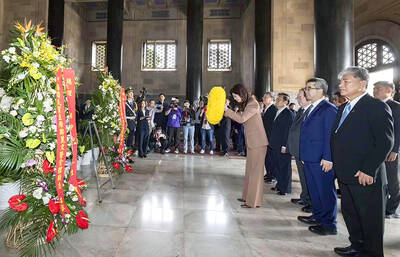
The problem with Marx’s famous remark that history repeats itself, first as tragedy, the second time as farce, is that the first time is usually farce as well. This week Chinese Nationalist Party (KMT) Chair Cheng Li-wun (鄭麗文) made a pilgrimage to the People’s Republic of China (PRC) “to confer, converse and otherwise hob-nob” with Chinese Communist Party (CCP) officials. The visit was an instant international media hit, with major media reporting almost entirely shorn of context. “Taiwan’s main opposition leader landed in China Tuesday for a rare visit aimed at cross-strait ‘peace’”, crowed Agence-France Presse (AFP) from Shanghai. Rare!

What is the importance within the Chinese Nationalist Party (KMT) of the meeting between Xi Jinping (習近平), the leader Chinese Communist Party (CCP), and Cheng Li-wun (鄭麗文), the leader of the KMT? Local media is an excellent guide to determine how important — or unimportant — a news event is to the public. Taiwan has a vast online media ecosystem, and if a news item is gaining traction among readers, editors shift resources in near real time to boost coverage to meet the demand and drive up traffic. Cheng’s China trip is among the top headlines, but by no means
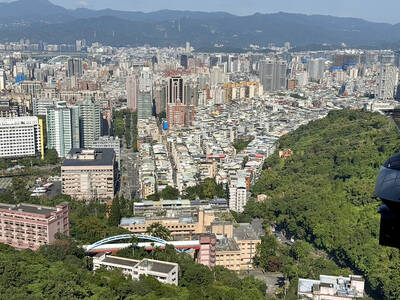
A recent report from the Environmental Management Administration of the Ministry of Environment highlights a perennial problem: illegal dumping of construction waste. In Taoyuan’s Yangmei District (楊梅) and Hsinchu’s Longtan District (龍潭) criminals leased 10,000 square meters of farmland, saying they were going to engage in horticulture. They then accepted between 40,000 and 50,000 cubic meters of construction waste from sites in northern Taiwan, charging less than the going rate for disposal, and dumped the waste concrete, tile, metal and glass onto the leased land. Taoyuan District prosecutors charged 33 individuals from seven companies with numerous violations of the law. This

Sunflower movement superstar Lin Fei-fan (林飛帆) once quipped that the Democratic Progressive Party (DPP) could nominate a watermelon to run for Tainan mayor and win. Conversely, the DPP could run a living saint for mayor in Taipei and still lose. In 2022, the DPP ran with the closest thing to a living saint they could find: former Minister of Health and Welfare Chen Shih-chung (陳時中). During the pandemic, his polling was astronomically high, with the approval of his performance reaching as high as 91 percent in one TVBS poll. He was such a phenomenon that people printed out pop-up cartoon


 RSS
RSS