


In November last year, Malaysian artist Jeffrey Lim (林猷進) had just wrapped up a presentation on his photography project at Taipei’s Open Contemporary Art Center, an artist-run space, when he was asked why he embarked on it.
“I wanted to find out who am I,” said Lim, who was in town for a short visit on the invitation of Nusantara Archive, a Taiwan-based artists’ platform.
Lim’s deceptively simple answer led him to Taipei this month for a one-month art residency and his first solo exhibition, KANTA Portraits/work in progress (鏡頭下的容顏記 / 持續進行中), which begins on Saturday at Taipei’s Studio 94, an eclectic artist space run by non-profit Thermos Foundation. The exhibition will showcase a selection of works rooted in the theme: “exploring the ideas of identity, culture and nationhood through photography.”
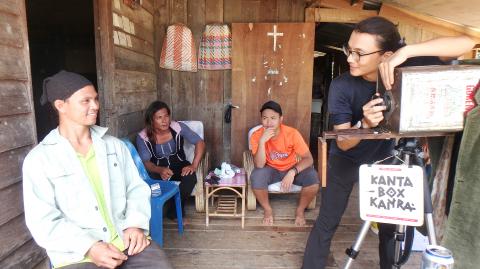
Photo courtesy of Jeffrey Lim
Thermos serves as a platform to support alternative artists through workshops, events and exhibitions.
“I was moved by Jeff’s answer,” says Thermos director Sarina Yeh (葉姿吟) who was in the audience. “Many people fail to ask: Who am I? What do I really want in life?’ In the end, we follow the mainstream because we never question ourselves.”
PORTRAITS OF MALAYSIA
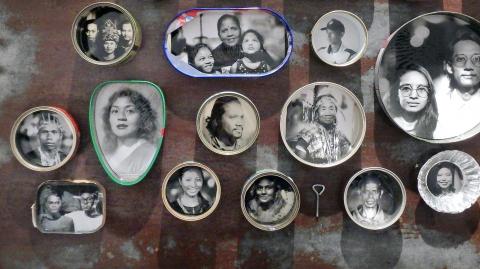
Photo courtesy of Jeffrey Lim
The main showpiece, Dinding Potret Kanta (2014-2017, translated as “Kanta Wall Portraits”), is a collection of portraits of Malaysians. Hand-printed on silver resin-coated paper, the portraits are framed in aluminum and steel food cans and bottle caps, and mounted on a 1.9m by 0.5m oxidized zinc panel.
Since 2014, Lim has been criss-crossing Malaysia, capturing portraits of everyday people in urban and remote villages using his handmade box cameras.
Dinding illustrates Lim’s use of typological photography — an approach that uses the camera as a tool to capture and classify subjects, to study identity through portraiture.
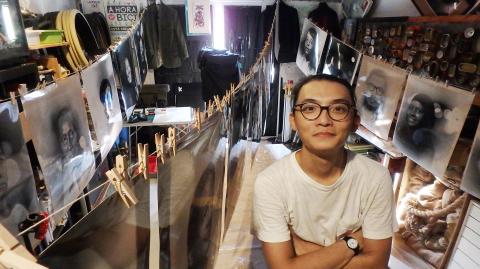
Photo courtesy of Jeffrey Lim
THROUGH THE LENS
Lim, 39, tells the Taipei Times that the project’s name Kanta (“lens” in Malay) holds a double meeting.
“Kanta is the medium that captures light to enable sight or image. The metaphorical meaning is how the different lens or filters affect how we view the world.”
Lim started the Kanta project in 2011 as an examination of self, identity, family history and its links to Malaysia. Lim, a second generation Malaysian Chinese, is labeled as a Chinese on his Malaysian ID, with Chinese and English names.
“But I have little or no affiliation to anything Chinese or China.”
In the project’s context, Lim attempts to question and deconstruct the nationally-constructed ideals of race, culture and religion that tries to define what and who its people are.
Dinding was exhibited at the recently-concluded Kuala Lumpur Art Biennale last year and acquired by Malaysia’s National Visual Arts Gallery for its permanent collection.
Lim’s use of photography as a medium stems from the measly but invaluable stash of old photographs of his ancestors that he found in his family archive.
His tool of choice — also called a mobile “photo studio” — was inspired by the Afghan Box Camera Project, a documentary by Austrian artist Lukas Birk and Irish ethnographer Sean Foley. Known as kamra-e-faoree, or “instant camera,” the homemade wooden device, which dates back to the 19th century, has been used in Afghanistan for generations. They are still used in remote parts of India, Europe, Brazil and Cuba, Lim said.
The pinhole camera uses no film but can capture and develop images.
“It’s basically light through a pinhole falling onto paper coated with silver,” Lim says. “My love for image-making and darkroom printing are found all rolled into one using a box camera.”
After receiving a seed funding grant from Kuala Lumpur-based Five Arts Centre in 2013, Lim fashioned several iterations of the box camera from recycled steel sheet tins used for storing cooking oil or biscuits, repurposed wood, glass offcuts and old bicycle tubes.
AUSTRONESIAN LINKS TO TAIWAN
The first time Yeh saw Lim’s portraits in November, she recalled getting goosebumps.
“I don’t know these people’s backgrounds, ethnicities or family history. But I see them as human beings,” Yeh says. “We don’t have to fit into a box. And perhaps Kanta project and this exhibition can inspire us to ‘unbox’ ourselves,” she says.
Thermos is sponsoring Lim’s research into Taiwan’s interiors.
During his Studio 94 residency, Lim will collaborate with Taiwanese artist Luc Chen (陳姿華), and journey to her Rukai ancestral village in Wutai Township (霧台), Pingtung County. Taipei-based Chen uses a homemade box camera as well, and wants to explore family ties, social structures and links to her own identity, through photography.
In his research, Lim learned about the many links between Taiwan and Malaysia.
Lim says there are two main language groups in Malaysia: The Austroasiatic, or West Malaysia, and Austronesian, West and East Malaysia. Many scholars have cited Taiwan as a starting point for the Austronesian language group.
“The Rukai community forms one of the original Austronesian language groups and has a close link to the Asia Pacific region,” he says.
After Pingtung, Lim plans to travel to Orchid Island (蘭嶼) to photograph and document the Tao (達悟族) people (known also as the Yami, 雅美族). Tao Aborigines originated from the Western Malayo-Polynesian (Austronesian) linguistic group. Their seafaring culture is synonymous with the seafaring cultures of Southeast Asia.
During his residency, Lim will document the social circumstances between rural and urban societies and to understand cultural identities — how people live, their spirituality and social environment, in contrast to how the country projects their identities. The artists will later present a series of photographic prints for display with stories and images also in audio or video formats.
THE JOURNEY CONTINUES
As Lim’s quest for identity continues, what has he uncovered so far?
“I realized this search for identity has evolved, from self definition, to the understanding that culture always reinvents itself and can never be defined or identified,” Lim says.
“Being conscious of the construct, the fragility and predicament of our times, and the reflection of human condition, perhaps it has become a pursuit to find a future beyond borders.”
Ajay Verma, a consultant gastroenterologist at Kettering general hospital in Northamptonshire, says our gut is a “complex machine.” “It is constantly providing us with the nutrition we need, initially to grow and develop, and then for us to survive, thrive and repair from injury and illness.” How can we keep it functioning well? Put simply: “Make sure what you put into it is balanced, and that you clear out its waste products adequately,” Verma says. “In a general gastroenterology clinic, the most common conditions we see are irritable bowel syndrome (IBS), gastroesophageal reflux disease, inflammatory bowel disease and constipation,” says Nisha

And so, in the wake of US President Donald Trump’s trip to the People’s Republic of China (PRC), all the experts on the Strait of Hormuz suddenly became experts on US-China-Taiwan relations. The Internet has certainly expanded human knowledge. Lots of these sudden experts made noise this week about Trump’s words after the meeting with PRC dictator Xi Jin-ping (習近平). Trump is going to sell out Taiwan! Longtime Taiwan commentator J. Michael Cole summed the situation up neatly in the Guardian: “We need to keep in mind that he has a tendency to say many things — sometimes contradicting himself within

Last week US President Donald Trump was asked by a reporter whether he would speak on the phone to the President of Taiwan. “l’ll speak to him. I speak to everybody. We have that situation very well in hand,” Trump said. This marked the second time in a couple of weeks he had said he would talk to the President of Taiwan. In 2016 he famously took a call from then-president Tsai Ing-wen (蔡英文), when he was president-elect. Despite warnings that the apocalypse was nigh because of a phone call, the world quickly forgot about the conversation between two democratically-elected presidents.
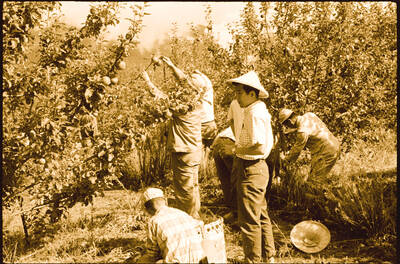
May 25 to May 31 Few believed that apples could be cultivated on a commercial scale in Taiwan’s high mountains. When horticulturalist Cheng Chao-hsiung (程兆熊) first proposed the idea in 1955, both American and Taiwanese colleagues dismissed it as implausible, arguing that temperate fruit could not be reliably grown on a subtropical island, especially on rugged terrain. However, it was this terrain in the Central Mountain Range where many Chinese Civil War veterans were resettled in the late 1950s. With limited job prospects and no family in Taiwan, they were placed on cooperative farms aimed toward self-sufficiency. Some say the conditions


 RSS
RSS