


May 7 to May 13
Like Beck Weathers, who was featured prominently in the 2015 Hollywood blockbuster Everest, Makalu Gau (高銘和) also lost his nose and fingers (and parts of his feet) in the same disaster that claimed eight lives.
Gau, whose English name refers to the fifth highest mountain in the world, was a leader of the Taiwanese expedition to Everest on May 10, 1996, one of four teams that were involved in the catastrophe caused by a combination of a severe blizzard, various delays, questionable decisions, illnesses and running out of oxygen.
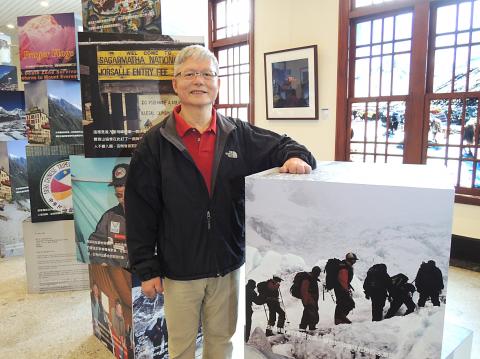
Photo courtesy of Wikimedia Commons
Survivor Jon Krakauer (author of the bestseller-turned-movie Into the Wild) did not have kind words for Gau in his account of the disaster Into Thin Air — claiming that he was climbing too slow, acting callous about the death of a teammate and finally setting for the summit when he had agreed to stay back to avoid overcrowding.
Even the only line about the Taiwanese team in the script for Everest was about how slow they were. While this column does not strive to dispute these accusations, we will be examining the events from Gau’s perspective through his books about the experience.
RACING THE STORM
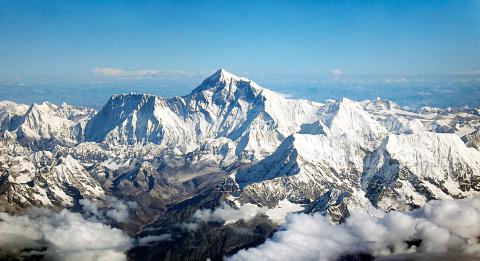
Photo courtesy of Wikimedia Commons
Gau was not the first Taiwanese to make it to the summit Everest. That honor belongs to Wu Chin-hsiung (吳錦雄), who made it to the summit with a group of Chinese mountaineers in 1993. In 1995, a Taiwanese team repeated the feat by entering the mountain from Tibet. In contrast, Gau’s expedition started from the south slope in Nepal.
Gau had a bigger goal than just scaling the mountain — it was part of a project to take photos of the top 100 peaks of China. It was not love at first sight between Gau and the mountains. He writes that it was a gradual appreciation after his coworkers invited him on a hiking trip at his first job. He had already attempted Mount Everest once before this expedition, making it up to 8,000 meters before aborting the mission.
Gau’s team of nine left Taipei two months before the climb, reaching Mount Everest’s base camp by April 2.
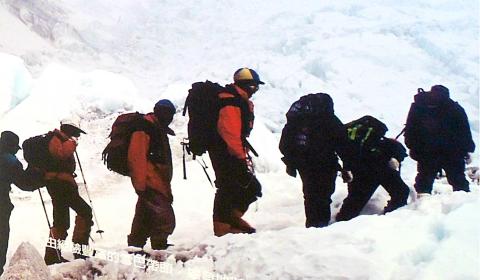
Photo courtesy of Wikimedia Commons
On May 5, the team decided that Gau and Chen Yu-nan (陳玉男) would take a stab at the peak on May 10, with another pair trying on May 12. The chef baked a cake that night to wish the mountaineers good luck.
Gau was about 800 meters from the top when he heard that Chen was dead. That morning, Chen slipped and fell while relieving himself outside of their tent. Not wanting to hold Gau back, Chen told Gau to go ahead to the next camp and that he would meet Gau there.
Gau waited and waited, only to find out later that Chen had turned back with the help of the local Sherpa guides. A few hours later, the base camp radioed him with the tragic news.
“My mind was a mess,” Gau recalls in Above the Clouds: The Report of the 1996 Everest Expedition (白雲之上: 1996中華民國聖母峰遠征隊攀登報告書).
He discussed with the Sherpas whether he should carry on or not, and they decided that if the storm subsided and the New Zealand and American teams took action, he would follow them.
A little after midnight, Gau put on six layers of clothes, four pairs of pants and three gloves and set out with three Sherpas. Thirteen hours later, the weather got worse and one of the Sherpa’s oxygen tanks malfunctioned. They advised Gau to turn back, but he refused.
“If they told me to stop this morning, maybe I would have listened,” he writes. “But we’ve been climbing for 13 hours. I could see the peak. I couldn’t just give up like that!”
As the Sherpas continued to persuade Gau, he watched the New Zealand and American team pass by, trudging forward in the wind. In a split-second decision, the Sherpas and Gau followed behind.
Gau had no time to celebrate, as dark clouds gathered as soon as he reached the top. He spent less than 10 minutes taking photos holding flags with his sponsors’ logos on them and hastily began his descent.
SURVIVING AT 8,400 METERS
The storm got worse, and even the Sherpas were on edge because their original path had been covered by snow. Gau’s oxygen ran out, and soon he became separated from the Sherpas. Having no idea which direction to go with any false step a 2,700m plunge, Gau tried to radio the camp, but his fingers were frozen and the many layers of gloves prevented him from turning the device on.
With no food, no oxygen and no tent, all Gau could do was sit there and try his best not to fall asleep. He couldn’t even get to his lighter in his inner jacket because of his frozen hands, nor could he press the buttons on his voice recorder to utter some last words for his family.
“I suddenly realized, there would be only two reasons that I died here: lack of oxygen and freezing temperatures,” Gau recalls. “I cleared the ice from my nostrils and started taking deep breaths while trying to squirm around to create some heat. Finally, the sun came up.”
As the wind stopped and with the sunlight in his face, Gau finally drifted off. He woke up to someone calling his name and it turned out to be the Sherpa whose oxygen tank malfunctioned earlier and had to turn back.
Gau could still stumble along the first day of the descent, but on the second day he was immobile. The Sherpas tried to take turns carrying him at first, but finally gave up and wrapped him in thick sleeping bags and dragged him in the snow with a rope.
“My mind was very clear as this all was happening,” Gau recalls.
He met Wu (the aforementioned first Taiwanese to scale Everest) at the base camp. Wu also had his fingers and toes amputated after suffering serious frostbite while scaling Mount McKinley a year before.
“I’m going to suffer the same fate as you,” Gau joked as he was hauled onto the helicopter back to Kathmandu. He was the only mountaineer that day to survive above the altitude of 8,400 meters.
Gau often wonders why he survived. He boils it down to three reasons: he was wearing more layers than anyone else, he had spent a lot of time in high-altitude Tibet and perhaps being blessed by three living Buddhas also had something to do with it.
Gau’s serious injuries did not dampen his enthusiasm. After 15 painful surgeries and difficult rehabilitation, he trained himself to use a camera with no fingers and returned to Tibet in 1999 to continue his photography project.
Now 69 years old, Gau is still visiting mountains and snapping away, hoping to complete his task within the next few years. With 78 of 100 peaks captured, he headed to China again in March to continue his lifelong mission.
Taiwan in Time, a column about Taiwan’s history that is published every Sunday, spotlights important or interesting events around the nation that have anniversaries this week.

Growing up in a rural, religious community in western Canada, Kyle McCarthy loved hockey, but once he came out at 19, he quit, convinced being openly gay and an active player was untenable. So the 32-year-old says he is “very surprised” by the runaway success of Heated Rivalry, a Canadian-made series about the romance between two closeted gay players in a sport that has historically made gay men feel unwelcome. Ben Baby, the 43-year-old commissioner of the Toronto Gay Hockey Association (TGHA), calls the success of the show — which has catapulted its young lead actors to stardom -- “shocking,” and says

The 2018 nine-in-one local elections were a wild ride that no one saw coming. Entering that year, the Chinese Nationalist Party (KMT) was demoralized and in disarray — and fearing an existential crisis. By the end of the year, the party was riding high and swept most of the country in a landslide, including toppling the Democratic Progressive Party (DPP) in their Kaohsiung stronghold. Could something like that happen again on the DPP side in this year’s nine-in-one elections? The short answer is not exactly; the conditions were very specific. However, it does illustrate how swiftly every assumption early in an

Inside an ordinary-looking townhouse on a narrow road in central Kaohsiung, Tsai A-li (蔡阿李) raised her three children alone for 15 years. As far as the children knew, their father was away working in the US. They were kept in the dark for as long as possible by their mother, for the truth was perhaps too sad and unjust for their young minds to bear. The family home of White Terror victim Ko Chi-hua (柯旗化) is now open to the public. Admission is free and it is just a short walk from the Kaohsiung train station. Walk two blocks south along Jhongshan
Francis William White, an Englishman who late in the 1860s served as Commissioner of the Imperial Customs Service in Tainan, published the tale of a jaunt he took one winter in 1868: A visit to the interior of south Formosa (1870). White’s journey took him into the mountains, where he mused on the difficult terrain and the ease with which his little group could be ambushed in the crags and dense vegetation. At one point he stays at the house of a local near a stream on the border of indigenous territory: “Their matchlocks, which were kept in excellent order,


 RSS
RSS