


Troubled to see a long queue of asylum seekers shivering for hours on a winter’s day outside Berlin’s notoriously chaotic registration center, Van Bo Le-Mentzel decided to take action.
“I fetched my drill and collected some wood that I found randomly in the streets and brought it to the line where people were standing there bored to death and we just started building,” the architect says.
The end products were pint-sized playhouses that children could crawl into for shelter as well as break up the monotony of the endless wait.
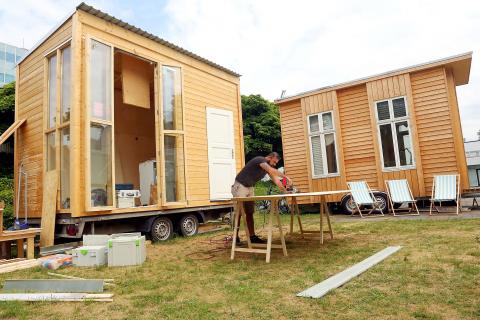
Photo: AFP
It also marked the birth of the so-called Tiny House University, a project bringing together architects, designers and refugees to experiment with innovative ways to house a population in need.
“We are trying to create new kinds of housing forms in society in which it’s possible to live and survive without having land or money,” said Le-Mentzel.
TINY HOUSE EXHIBITION
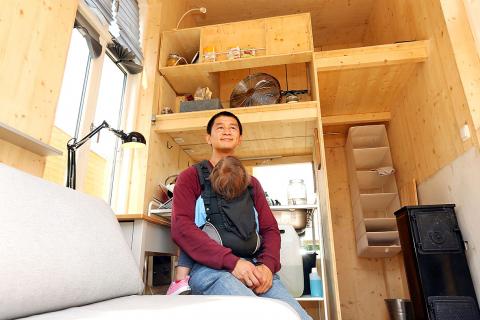
Photo: AFP
The tiny house trend emerged several years ago, largely in the US as people chose to downsize their living space out of environmental or financial concerns. In Berlin, it has been given a twist for contemporary needs.
For a start, Le-Mentzel’s team which includes six refugees, is collaborating with the Bauhaus Archiv to build 20 tiny houses occupying 10 square meters each.
Together, the houses will form a temporary village on exhibition until March 2018.
Some will serve as lodging, while others are destined to be a library, cafe, workshop or community center.
Each building is fitted on wheels — which Le-Mentzel said means they can be parked on public streets as a form of trailer.
“In Berlin we have 1.5 million cars registered and they are all standing in the streets overnight, not in use. Each car is about 10 square meters,” noted Le-Mentzel.
“So I’m asking what would happen if we just replace these 1.5 million cars with tiny houses or with mobile playgrounds for kids or with open spaces where neighbors can cook together, eat together, find company together, where refugees can create a start-up in the streets — opening a restaurant, (giving) a haircut.”
MICROCOSM OF SOCIETY
Like metropolitan cities worldwide, property prices in Berlin have shot up as the city shed its Cold War divided past to become a tourism and party hotspot, as well as an investment magnet.
Although new builds are mushrooming across the capital, refugees and low-income locals are finding themselves priced out.
Le-Mentzel views his Tiny100 as a prototype for small apartments which can be let out for about NT$3,500 a month to low earners.
His ultimate goal is to fit out a building not only with regular-sized apartments, but also such compact homes, allowing the “rich and poor, students and entrepreneurs” to live together.
“It will be a house that mirrors society,” he said, adding that talks are ongoing with “three or four investors” about making his dream come true.
“But we are at the beginning of the process.”
Ali Fadi, a Kurdish refugee from Syria, has not thought that far to having his own tiny apartment.
The 33-year-old is simply reveling at being able to practice his trade.
Fadi is an experienced carpenter, but had found himself shut out of the German job market because he lacked the paper qualifications.
Measuring a piece of wood before sawing it off for the tiny house that would house a cafe, Fadi said he hopes that his work in the project would help overcome the bureaucratic barrier.
“I hope I can get a job doing this,” said Fadi.
Party for 13
At a warehouse area in southern Berlin, another member of the team, Noam Goldstein, is fitting insulation into one of the 20 tiny houses.
His version of the small home would feature not just the usual trappings of an apartment, but also include solar panels, a compost toilet and a hydroponics garden.
The carpenter expects material cost for the house to run between NT$428,000 and NT$535,000.
While some components like windows have to be purchased, Goldstein said much of the wood used is recycled pallet wood.
“When you look at the financial aspect, it provides a very cheap way for people to build their own house,” said Goldstein.
Researcher Amelie Salameh, who was among the initial ones to try out the first of the 20 tiny houses overnight, is a convert.
Measuring just six square meters, the first tiny house built by Le-Mentzel himself for the project is a self-contained unit with a living room, kitchen, sleeping area, toilet and shower.
“The way it was designed, there were mirrors, a lot of light, I never felt trapped inside,” said Salameh, who lived in the house called Tiny100 for three weeks.
She even had two friends sleep over for a night, and once also hosted a visit of 13 people.
“We had a few beers, it was fun,” she said, adding that “you just have to think about where you’re putting your stuff, and to tidy up constantly, because the place gets full quickly.”
As I finally slid into the warm embrace of the hot, clifftop pool, it was a serene moment of reflection. The sound of the river reflected off the cave walls, the white of our camping lights reflected off the dark, shimmering surface of the water, and I reflected on how fortunate I was to be here. After all, the beautiful walk through narrow canyons that had brought us here had been inaccessible for five years — and will be again soon. The day had started at the Huisun Forest Area (惠蓀林場), at the end of Nantou County Route 80, north and east

Specialty sandwiches loaded with the contents of an entire charcuterie board, overflowing with sauces, creams and all manner of creative add-ons, is perhaps one of the biggest global food trends of this year. From London to New York, lines form down the block for mortadella, burrata, pistachio and more stuffed between slices of fresh sourdough, rye or focaccia. To try the trend in Taipei, Munchies Mafia is for sure the spot — could this be the best sandwich in town? Carlos from Spain and Sergio from Mexico opened this spot just seven months ago. The two met working in the

Exceptions to the rule are sometimes revealing. For a brief few years, there was an emerging ideological split between the Democratic Progressive Party (DPP) and Chinese Nationalist Party (KMT) that appeared to be pushing the DPP in a direction that would be considered more liberal, and the KMT more conservative. In the previous column, “The KMT-DPP’s bureaucrat-led developmental state” (Dec. 11, page 12), we examined how Taiwan’s democratic system developed, and how both the two main parties largely accepted a similar consensus on how Taiwan should be run domestically and did not split along the left-right lines more familiar in

This month the government ordered a one-year block of Xiaohongshu (小紅書) or Rednote, a Chinese social media platform with more than 3 million users in Taiwan. The government pointed to widespread fraud activity on the platform, along with cybersecurity failures. Officials said that they had reached out to the company and asked it to change. However, they received no response. The pro-China parties, the Chinese Nationalist Party (KMT) and Taiwan People’s Party (TPP), immediately swung into action, denouncing the ban as an attack on free speech. This “free speech” claim was then echoed by the People’s Republic of China (PRC),


 RSS
RSS