


Yu Kai-ming (余凱明) is having fun making paintings talk while his classmates are stuck in summer cram school.
The junior high school student is spending his summer at Skyrock Projects, an academy for “creative technologists” where students create video games that respond to the players’ pulses or set up systems to maintain and monitor an urban garden.
Yu likes the lively atmosphere with lots of interaction between teachers and students. He also takes computer classes at school, but there they just “stare at the teacher” while following the same tutorial for a certain program.
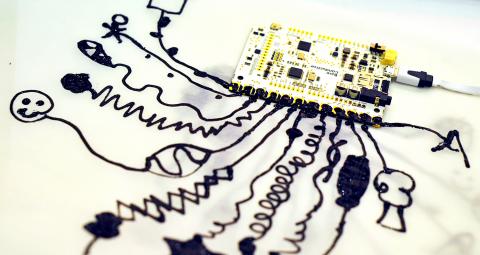
Photo: Han Cheung, Taipei Times
“I’m learning faster this way,” he says.
Yu invited his friends to join him, but their parents wouldn’t allow it as high school entrance exams loom next year.
As a new business that has been open for less than a month, cofounder Simon Thomas faces the task of selling his program to parents who are primarily concerned about their children’s test scores. His goal is to give students a boost in creativity and critical thinking, which he believes are not only lacking in the local curriculum but also Western-style international schools.
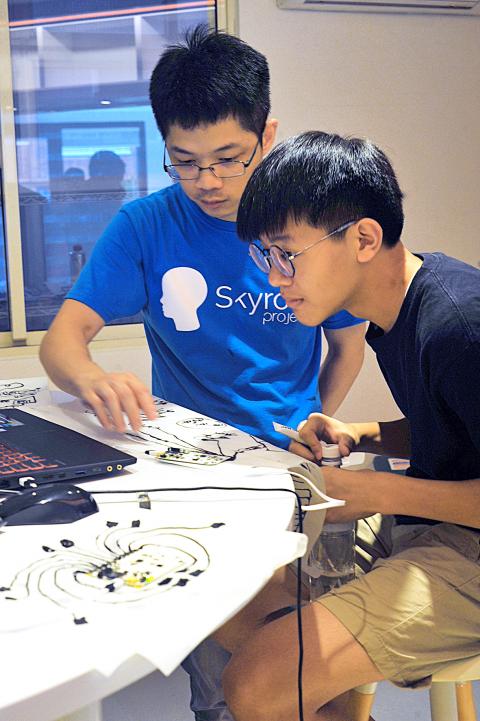
Photo: Han Cheung, Taipei Times
“Our biggest job is to convince [parents] that a [creative] portfolio carries just as much weight as a transcript,” he says. “If it doesn’t now, it will in the future.”
BORN FROM FRUSTRATION
Thomas and cofounder Tony Cornes both left their jobs as Taipei European School high school teachers because they felt that the set curriculum didn’t provide enough room to design long-term creative programs. They opened Skyrock Projects, which features an original curriculum, as a supplement to formal schooling,
“Usually companies start the same way — with a frustration,” Thomas says.
While this lack of creativity and critical thinking is more pronounced in local education, Thomas says it is a global phenomenon. Not only is creativity hard to teach, it’s also hard to quantify as the lessons are often unstructured with unpredictable outcomes.
“It’s really hard to standardize subjectivity,” he says. “Until we can design assessment materials or have enough faith in the system that we don’t need to standardize it, there will always be a dearth … of [programs] that prioritize a creative outcome over one that is accurate and correct.”
Thomas believes that creative thinking will ultimately help the students learn faster, but unlike cram schools, he can’t guarantee the parents that their children will achieve better scores. He says it is even a harder sell for adults, who ask how the program can improve their careers or help land their dream jobs.
“There’s no guarantee,” Thomas says. “But you can develop a portfolio that says, ‘Here’s my ability to have original thought and execute something that hasn’t been done before. Do you need this skill in your office?’”
CREATIVE CONFIDENCE
To be successful at Skyrock Projects, the students need to develop what Thomas calls “creative confidence.”
“You can do whatever you want,” Thomas says. “For someone to be able to look at a blank page, see nothing, and devise a plan … form a strategy and execute. That’s a really powerful thing people don’t get taught in school,” Thomas says.
This week, the students are working with conductive paint. One group has drawn a floor plan of the school and connected it to a laptop via a computer board. Their goal is to make the laptop play a descriptive audio clip whenever someone presses a room on the floor plan.
Last week focused on creating games involving human biological functions. Among the results was a Memory game where players would lose points for pressing too hard on the controls. in another, players physically jump up and down to avoid obstacles but the game gets harder as the player’s pulse speeds up.
Classes are offered in English, English with Mandarin assistance and Mandarin, and the students are a mix from international, alternative and local schools. Communication is essential as the students work closely with the teacher and each other. They are also recorded presenting their work at the end of each session.
There are no textbooks, and Cornes says that teachers may not turn on classroom projectors for days.
“What we do is not about the teacher. It’s about what you’re doing as an individual. The pace of which you work is determined by your skill,” he says.
And this means that there’s no room for slacking off.
“You have to stay engaged,” Cornes says. “There’s no hiding. If you pause, you get left behind. In a conventional class, you can still get notes from somewhere else.”

As I finally slid into the warm embrace of the hot, clifftop pool, it was a serene moment of reflection. The sound of the river reflected off the cave walls, the white of our camping lights reflected off the dark, shimmering surface of the water, and I reflected on how fortunate I was to be here. After all, the beautiful walk through narrow canyons that had brought us here had been inaccessible for five years — and will be again soon. The day had started at the Huisun Forest Area (惠蓀林場), at the end of Nantou County Route 80, north and east

Specialty sandwiches loaded with the contents of an entire charcuterie board, overflowing with sauces, creams and all manner of creative add-ons, is perhaps one of the biggest global food trends of this year. From London to New York, lines form down the block for mortadella, burrata, pistachio and more stuffed between slices of fresh sourdough, rye or focaccia. To try the trend in Taipei, Munchies Mafia is for sure the spot — could this be the best sandwich in town? Carlos from Spain and Sergio from Mexico opened this spot just seven months ago. The two met working in the

Exceptions to the rule are sometimes revealing. For a brief few years, there was an emerging ideological split between the Democratic Progressive Party (DPP) and Chinese Nationalist Party (KMT) that appeared to be pushing the DPP in a direction that would be considered more liberal, and the KMT more conservative. In the previous column, “The KMT-DPP’s bureaucrat-led developmental state” (Dec. 11, page 12), we examined how Taiwan’s democratic system developed, and how both the two main parties largely accepted a similar consensus on how Taiwan should be run domestically and did not split along the left-right lines more familiar in

This month the government ordered a one-year block of Xiaohongshu (小紅書) or Rednote, a Chinese social media platform with more than 3 million users in Taiwan. The government pointed to widespread fraud activity on the platform, along with cybersecurity failures. Officials said that they had reached out to the company and asked it to change. However, they received no response. The pro-China parties, the Chinese Nationalist Party (KMT) and Taiwan People’s Party (TPP), immediately swung into action, denouncing the ban as an attack on free speech. This “free speech” claim was then echoed by the People’s Republic of China (PRC),


 RSS
RSS