


Red-whiskered bulbuls start chirping around 5:00 am at Wonderland Villas, a hilltop complex in leafy northern Hong Kong whose own history charts the territory’s political, economic and social fortunes.
Built in 1984, the year colonial power Britain signed an agreement to hand Hong Kong back to China, the complex was one of the pioneering designs of its time, a cluster of 22 curvaceous white apartment blocks complete with clubhouse, tennis courts and swimming pool.
Prices at Wonderland have risen, waned and risen again, as Hong Kong property has swung through boom and bust to become one of the world’s most expensive markets.
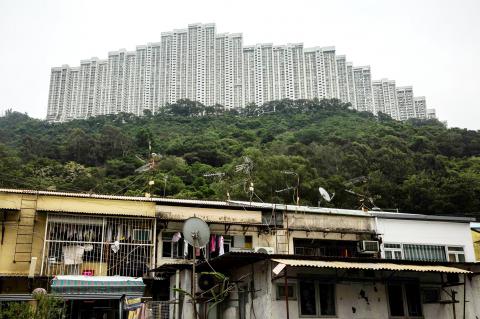
Photo: AFP
The lack of affordable housing has become a major political issue for Hong Kong as it approaches the 20th anniversary of the British handover of the territory. But Wonderland was once an attainable aspiration. Former tailor Winnie Wong, now 70, bought a three-bedroom apartment there with her husband in 1997, when Hong Kong was transferred to China and became a semi-autonomous territory.
Some emigrated ahead of the handover, worried about Beijing calling the shots. Wong said she was concerned, but decided to hold on.
“My dad once said, the more you flee, the harder it gets,” she said.
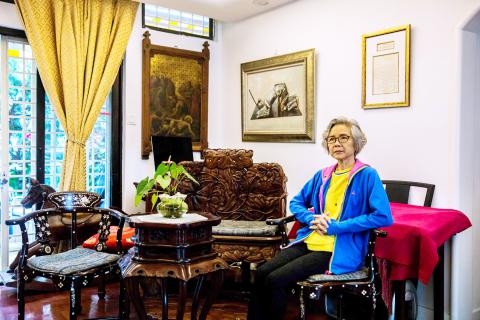
Photo: AFP
From the late 1970s, China began to open up its economy, helping transform Hong Kong from a manufacturing hub to a service oriented gateway to the mainland.
The Wongs are typical of a savvy post-war generation who traded up as Hong Kong grew. They bought their first apartment in 1970 for HK$45,000 (US$5,775), moving seven times before they splashed out HK$7.85 million on their Wonderland Villas home — it is now worth double that.
The comfortable 1,600-square-feet (149-square-metre) apartment, decorated with artworks and family photos, boasts lush green views and a large terrace.
“For my generation, it was easier to buy a home if you worked hard,” Wong says.
CHINA’S INFLUENCE
After rising steadily through the 1980s and 1990s, property prices crashed in the last quarter of 1997 as the Asian financial crisis sent markets tumbling.
Hong Kong’s economy was dealt another blow in 2003 when an outbreak of the respiratory virus SARS killed 299 people in the territory.
Those crises were reflected at Wonderland — while the Wongs kept their heads above water, almost 30 indebted homeowners were forced to forfeit their flats between 1997 and 2003 and prices plunged by more than two thirds.
However, thanks to China’s economic growth and Hong Kong’s encouragement of Chinese tourists, which boosted retail industries, the market rallied as the 2000s wore on. Industrialists and wealthy businessmen snapped up homes at Wonderland as they had in its heyday.
A handful of Chinese buyers also bought there, but most preferred higher-profile central condos expected to rise more in value, albeit with less space. “From the perspective of expats or Chinese, when they invested in an unfamiliar place they would choose well-known properties or those built atop subway stations. So that started to turn around the direction of investment,” local estate sales manager Ken Lee said.
INFLATED MARKET
Despite falling out of fashion, a Wonderland Villas home like the Wongs’ still fetches HK$16 million.
But while they have watched their investment grow, younger generations find it increasingly hard to buy.
A survey this year by research organization Demographia named Hong Kong the world’s least affordable territory for housing — the median property price exceeds the median annual household income 18.1 times, well ahead of Sydney and Vancouver in second and third place.
Chinese buyers parking their capital in Hong Kong property is one factor driving up prices.
The local government also stands accused of colluding with developers instead of pushing for affordable accommodation. Residents are increasingly forced to live in cramped conditions at spiraling costs.
Some analysts say a recent government pledge to create more homes should eventually bring values down.
“With more projects going to be launched in the market, [developers] have to price them more competitively,” property analyst Joyce Kwock of Nomura said.
Residents at Wonderland Villas are now mostly retirees, their families, and those who enjoy proximity to nature.
Its airy layout and verdant, suburban surroundings contrast with the newer urban towers that favor glass, marble and chandeliers.
The next generation of Wongs have set up home there — one of the couple’s daughters lives in a neighboring block with her own family.
As many middle-class parents now do, the Wongs helped her with the down-payment.
“It’s hard for younger people to make it independently now,” Wong said.
She and her husband have no plan to move as they enjoy a happy retirement.
“It would be hard for us to find another place this green,” she says.
“We like the quiet here.”
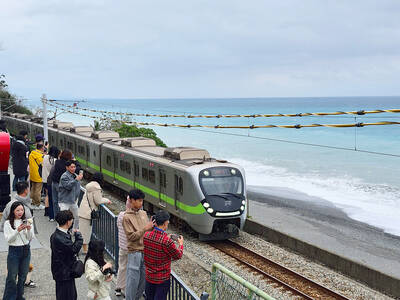
The small platform at Duoliang Train Station in Taitung County’s Taimali Township (太麻里) served villagers from 1992 to 2006, but was eventually shut down due to lack of use. Just 10 years later, the abandoned train station had become widely known as the most beautiful station in Taiwan, and visitors were so frequent that the village had to start restricting traffic. Nowadays, Duoliang Village (多良) is known as a bit of a tourist trap, with a mandatory, albeit modest, admission fee of NT$10 giving access to a crowded lane of vendors with a mediocre view of the ocean and the trains
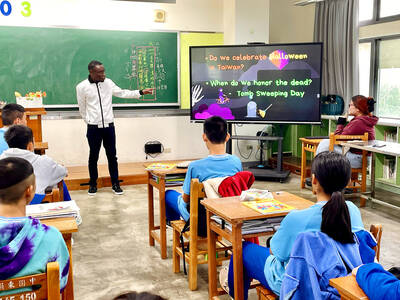
For many people, Bilingual Nation 2030 begins and ends in the classroom. Since the policy was launched in 2018, the debate has centered on students, teachers and the pressure placed on schools. Yet the policy was never solely about English education. The government’s official plan also calls for bilingualization in Taiwan’s government services, laws and regulations, and living environment. The goal is to make Taiwan more inclusive and accessible to international enterprises and talent and better prepared for global economic and trade conditions. After eight years, that grand vision is due for a pulse check. RULES THAT CAN BE READ For Harper Chen (陳虹宇), an adviser
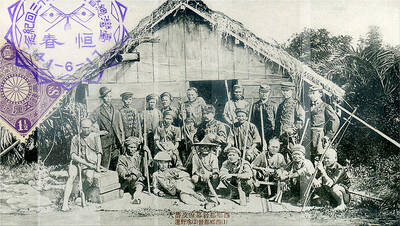
Traditionally, indigenous people in Taiwan’s mountains practice swidden cultivation, or “slash and burn” agriculture, a practice common in human history. According to a 2016 research article in the International Journal of Environmental Sustainability, among the Atayal people, this began with a search for suitable forested slopeland. The trees are burnt for fertilizer and the land cleared of stones. The stones and wood are then piled up to make fences, while both dead and standing trees are retained on the plot. The fences are used to grow climbing crops like squash and beans. The plot itself supports farming for three years.

President William Lai (賴清德) on Nov. 25 last year announced in a Washington Post op-ed that “my government will introduce a historic US$40 billion supplementary defense budget, an investment that underscores our commitment to defending Taiwan’s democracy.” Lai promised “significant new arms acquisitions from the United States” and to “invest in cutting-edge technologies and expand Taiwan’s defense industrial base,” to “bolster deterrence by inserting greater costs and uncertainties into Beijing’s decision-making on the use of force.” Announcing it in the Washington Post was a strategic gamble, both geopolitically and domestically, with Taiwan’s international credibility at stake. But Lai’s message was exactly


 RSS
RSS