


From a restaurant serving burgers and pizzas made with local noodles to a social media star giving street food a touch of haute cuisine, a new wave of innovative chefs are putting a modern twist on Indonesia’s traditional fare.
New eateries have sprung up rapidly in recent years in the capital Jakarta offering a wide array of foreign foods to cater to a growing consumer class which has emerged after a long economic boom.
But rather than focus entirely on cuisine from overseas, some chefs decided to fuse the new influences with age-old Indonesian foods.
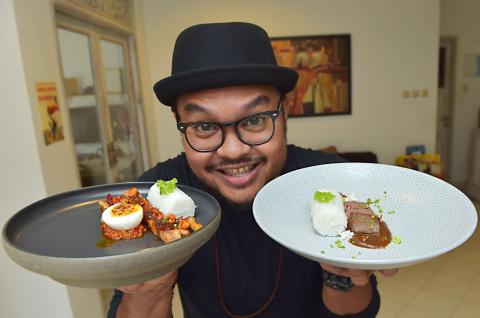
Photo: AFP
One eatery offering fusion food is Mammamie, whose name is a playful take on an Italian expression of shock combined with the local word for noodles, mie.
It uses the country’s favorite instant noodles, Indomie — cheap blocks of fodder in colorful packaging that are sold at almost every grocery store and supermarket — to make Western dishes. Among the most popular are the “mizza,” a pizza whose base is made out of noodles, and a “merger,” a burger which has buns fashioned from Indomie. It also serves burrito, quesadillas and sushi dishes made with the noodles.
Cafe owner Muhammad Luqman Baehaqi said he was trying to appeal to young Indonesians who were keen to try Western foods but still enjoyed Indomie.
“There isn’t a single Indonesian person that doesn’t know Indomie,” the 39-year-old said. “It’s tasty and familiar to all of us.”
The small cafe can seat about 20 people on chairs designed to look like Indomie packing cases and has a distinctly hipster vibe, with young office workers enjoying dishes that cost the equivalent of about two to four dollars under an image of late Apple founder Steve Jobs.
GOURMET STREET FOOD
While the Mammamie cafe uses Indonesian ingredients to spice up Western dishes, Jakarta chef Dede Akbar is taking local dishes as his starting point, and seeking to make them more classy.
In his brightly-decorated kitchen, the 34-year-old carefully placed two blocks of tempe — a traditional soybean patty — onto a plate. He blowtorched a hard-boiled egg, and added small flowers as a garnish before artistically dripping sauce across the dish.
Satisfied with his creation, he took out a camera and snapped pictures from various angles, before uploading them to Instagram. It was his popular Instagram account Warteg Gourmet, which currently has about 40,000 followers, that catapulted him to fame.
Wartegs are modest stalls or kiosks selling cheap food, often cramped spaces on street corners where blue-colour workers stop for a bite and to smoke a cigarette. But rather than drab dishes for people earning low incomes, Akbar said he celebrates warteg food as it has “different textures and a wide range of colors that we can play with.”
Akbar was inspired to make haute-cuisine, warteg-style food after becoming annoyed at the careless presentation of dishes at the traditional streetside eateries.
What started off as a hobby became an obsession, and eventually Akbar found he was receiving so many invites to be a “food stylist” at events that he quit his day job as an advertising agency art director to become a full-time chef.
He hopes his efforts can help raise the profile of humble Indonesian street food, which is not as well-known as local cuisine from other parts of Asia, such as Thailand.
“I want to make Indonesian food more appreciated by Indonesians in general and recognized internationally,” he said.

The small platform at Duoliang Train Station in Taitung County’s Taimali Township (太麻里) served villagers from 1992 to 2006, but was eventually shut down due to lack of use. Just 10 years later, the abandoned train station had become widely known as the most beautiful station in Taiwan, and visitors were so frequent that the village had to start restricting traffic. Nowadays, Duoliang Village (多良) is known as a bit of a tourist trap, with a mandatory, albeit modest, admission fee of NT$10 giving access to a crowded lane of vendors with a mediocre view of the ocean and the trains

For many people, Bilingual Nation 2030 begins and ends in the classroom. Since the policy was launched in 2018, the debate has centered on students, teachers and the pressure placed on schools. Yet the policy was never solely about English education. The government’s official plan also calls for bilingualization in Taiwan’s government services, laws and regulations, and living environment. The goal is to make Taiwan more inclusive and accessible to international enterprises and talent and better prepared for global economic and trade conditions. After eight years, that grand vision is due for a pulse check. RULES THAT CAN BE READ For Harper Chen (陳虹宇), an adviser

Traditionally, indigenous people in Taiwan’s mountains practice swidden cultivation, or “slash and burn” agriculture, a practice common in human history. According to a 2016 research article in the International Journal of Environmental Sustainability, among the Atayal people, this began with a search for suitable forested slopeland. The trees are burnt for fertilizer and the land cleared of stones. The stones and wood are then piled up to make fences, while both dead and standing trees are retained on the plot. The fences are used to grow climbing crops like squash and beans. The plot itself supports farming for three years.

President William Lai (賴清德) on Nov. 25 last year announced in a Washington Post op-ed that “my government will introduce a historic US$40 billion supplementary defense budget, an investment that underscores our commitment to defending Taiwan’s democracy.” Lai promised “significant new arms acquisitions from the United States” and to “invest in cutting-edge technologies and expand Taiwan’s defense industrial base,” to “bolster deterrence by inserting greater costs and uncertainties into Beijing’s decision-making on the use of force.” Announcing it in the Washington Post was a strategic gamble, both geopolitically and domestically, with Taiwan’s international credibility at stake. But Lai’s message was exactly


 RSS
RSS