


On March 24, the Council of Grand Justices held a historic debate for a constitutional interpretation regarding petitions submitted by gay rights pioneer Chi Chia-wei (祁家威) and the Taipei City Government on the issue of same-sex marriage. Since Taiwan is the first Asian country to approve a constitutional interpretation on the issue, it attracted attention at home and abroad.
Several legal professionals and government officials, among others, expressed their opinions to the Grand Justices on whether the recognition of marriage should only be between a “man and a woman,” as stipulated in the Civil Code (民法). A ruling is expected within a month.
Chi, who first attempted to file a similar petition in 1986, said that a constitutional interpretation in support of same-sex marriage is likely to hasten the legislation process. Yet even before the debate, there were troubling signs both at the legislature and within the administration of President Tsai Ing-wen (蔡英文) that support for same-sex marriage might be dwindling.
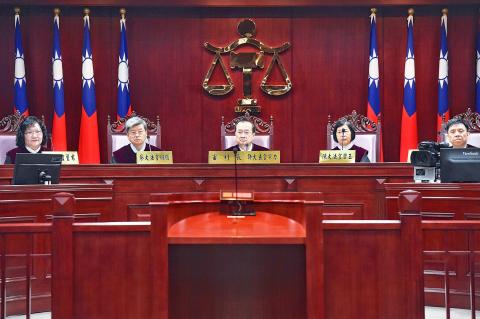
Photo: Huang Yao-cheng, Taipei Times
MINISTER UNDER FIRE
During the debate, Minister of Justice Chiu Tai-san (邱太三) raised eyebrows when he stated that marriage equality might ruin the institution of marriage.
“Has there ever been a cultural institution or social phenomenon for same-sex marriage in the thousands of years of our country’s history?” he asked, displaying an astonishing ignorance of the issue.
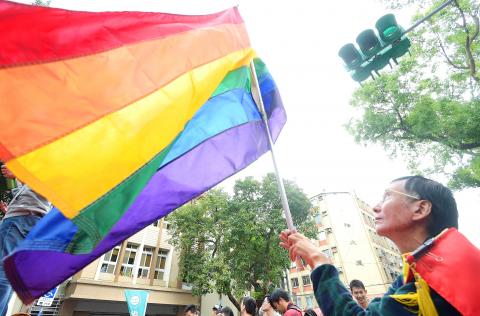
Photo: Chang Chia-ming, Taipei Times
Chiu pledged to safeguard the thousands-year-old tradition, while describing same-sex relationships as a “phenomenon newly invented in the 1970s.”
Chiu claimed that legalizing same-sex marriage would destroy a number of traditional cultural and ritual practices, citing “ancestral tablets” for deceased fathers and mothers as an example.
“What are we going to write [for same-sex couples] on the ancestral tablets once same-sex marriage is legalized?” he asked the panel.
Ancestral tablets, of course, are not the issue. But by linking non-legal issues to the amendments to the Civil Code, Chiu exposed his ignorance of the key point: protection of equal rights. In spite of his role as justice minister, he sounded like a spokesman for the Alliance of Taiwan Religious Groups for the Protection of the Family (Family Alliance, 護家盟), an anti-gay organization.
Responding to public criticism, Premier Lin Chuan (林全) said that the minister’s remarks “do not represent the Executive Yuan.”
The justice ministry’s attitude toward lesbian, gay, bisexual and transgender (LGBT) people was also revealed by a leaked report. According to news outlet Up Media (上報), the ministry issued an internal report that suggested a “special law” (專法) for same-sex couples, instead of amending the Civil Code, so as to avoid potential political risks.
Despite the growing support for marriage equality in recent years, the ministry’s report suggests a same-sex partnership act until “social consensus is reached.”
WORRYING SIGNS
Meanwhile, there are indications that the government may be adjusting its stance. Tsai recently received representatives from 22 religious groups at the Presidential Office. When some representatives expressed opposition to the draft amendments, Tsai reportedly said, “[I’m] a little surprised. I didn’t expect the legislation to be so urgent and cause such an uproar.” Her statement was seen by LGBT people as a compromise with religious forces.
Moreover, soon after the current legislative session began, the Cabinet announced more than 40 draft bills on its priority list. Unfortunately, the marriage equality bill wasn’t one of them.
“Differences between supporters and opponents of the issue have not been resolved,” said Cabinet spokesman Hsu Kuo-yung (徐國勇).
As the Grand Justices are to issue a constitutional interpretation on the issue within a month, such signs of a policy U-turn are disturbing. Hopefully the Grand Justices can remain neutral and make the decision based on expertise and humanity, so marriage equality will no longer be empty talk.
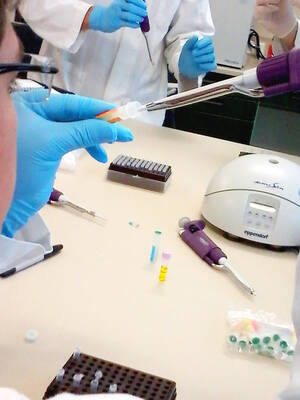
Google unveiled an artificial intelligence tool Wednesday that its scientists said would help unravel the mysteries of the human genome — and could one day lead to new treatments for diseases. The deep learning model AlphaGenome was hailed by outside researchers as a “breakthrough” that would let scientists study and even simulate the roots of difficult-to-treat genetic diseases. While the first complete map of the human genome in 2003 “gave us the book of life, reading it remained a challenge,” Pushmeet Kohli, vice president of research at Google DeepMind, told journalists. “We have the text,” he said, which is a sequence of
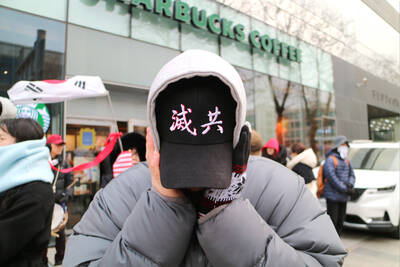
On a harsh winter afternoon last month, 2,000 protesters marched and chanted slogans such as “CCP out” and “Korea for Koreans” in Seoul’s popular Gangnam District. Participants — mostly students — wore caps printed with the Chinese characters for “exterminate communism” (滅共) and held banners reading “Heaven will destroy the Chinese Communist Party” (天滅中共). During the march, Park Jun-young, the leader of the protest organizer “Free University,” a conservative youth movement, who was on a hunger strike, collapsed after delivering a speech in sub-zero temperatures and was later hospitalized. Several protesters shaved their heads at the end of the demonstration. A
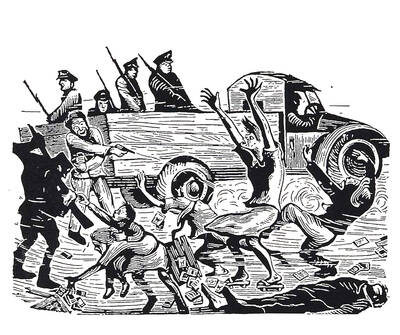
In August of 1949 American journalist Darrell Berrigan toured occupied Formosa and on Aug. 13 published “Should We Grab Formosa?” in the Saturday Evening Post. Berrigan, cataloguing the numerous horrors of corruption and looting the occupying Republic of China (ROC) was inflicting on the locals, advocated outright annexation of Taiwan by the US. He contended the islanders would welcome that. Berrigan also observed that the islanders were planning another revolt, and wrote of their “island nationalism.” The US position on Taiwan was well known there, and islanders, he said, had told him of US official statements that Taiwan had not

We have reached the point where, on any given day, it has become shocking if nothing shocking is happening in the news. This is especially true of Taiwan, which is in the crosshairs of the Chinese Communist Party (CCP), uniquely vulnerable to events happening in the US and Japan and where domestic politics has turned toxic and self-destructive. There are big forces at play far beyond our ability to control them. Feelings of helplessness are no joke and can lead to serious health issues. It should come as no surprise that a Strategic Market Research report is predicting a Compound


 RSS
RSS