


This new book, from a distinguished professor at the University of Macau, argues that a concept such as “Chinese literature” is tricky and also outmoded because it’s frequently used as a synonym for “literature from China.”
This, Zhu Shoutong (朱壽桐) argues, is unsatisfactory in several ways, firstly because it excludes literature from Taiwan, Hong Kong, Macau and elsewhere, and secondly because it implicitly refers only to books written in the simplified Chinese script. Far more valuable, Zhu claims, is a wider category that includes works from the whole Chinese-speaking world.
There is nothing political about this, the author writes, because what are being treated are books, mostly imaginative ones, that have no relation to current political issues. The question of simplified versus traditional Chinese scripts isn’t political either because, even in China, there are literary forms where the traditional script is still being used. The book’s title, New Literature in Chinese: China and the World, in other words, expresses exactly what its content deals with.

The fact that Zhu is himself from China, and received all his education there, makes his argument for a global category of writing in Chinese all the more persuasive. There are 34 references to Taiwan listed in the index, for instance, and the book’s reach extends even further afield.
The appeal for a pan-Chinese area of study looks so simple that one wonders what else the author will discuss to make a book-length argument. Zhu has plenty of additional and supportive ideas, however, backed up by an extraordinarily wide frame of reference.
His first chapter, for example following a preface in which the main idea is expounded, looks at the history of the study of modern Chinese and other writing, with references to literary theorists such as Louis Althusser, Northrop Frye, Harold Bloom, Terry Eagleton and Jacques Derrida, as well as “a leading Slovak literary theorist” called Dionyz Durisin. This, in other words, is an exceptionally learned and wide-ranging survey, and all written in absolutely flawless, and indeed eloquent, English. It is, as a result, a book to be reckoned with.
Zhu writes that the literature of Taiwan came as a “big surprise” to many readers from elsewhere when they realized that it had, not great differences from, but a lot in common with writing from China, displaying a similar exaggeration of effects and politicized ways of talking, despite what were in earlier decades intransigent ideological differences.
As one instance of the value and indeed importance of considering literature written in Chinese as a unified whole, wherever it was produced, the author cites the writer Kenneth Pai (白先勇) who was born in China, whose early work was published in Taipei, and who now lives and publishes in the US. He cannot be considered a writer from any one of these places, the author cogently argues, but as a producer of “New Literature in Chinese” on a worldwide stage.
He also cites a friend of his, the poet and professor Fu Tianhong (傅天虹), who was born in China, has lived in Taiwan and Hong Kong, and, now back in China again, visits Macau (which he loves) every week. How can such a writer be classified as belonging to one territory? No, he’s nothing if not a member of a global Chinese-speaking world, and should be evaluated by comparison with his peers writing in Chinese in a variety of different territories.
Zhu doesn’t deny that writers in Chinese living abroad simultaneously occupy a position in the culture of their adopted countries, citing the Baima (White Horse) Society set up by expatriate writers in New York in the 1950s. They called themselves Chinese literature’s “third center”, the other two centers being Beijing and Taipei. This society is part of the literary history of the US, Zhu says, but a feeling of isolation is nonetheless common among such writers, and where they feel most at home is in the motherly embrace of the ancient Chinese language.
Indeed, the China novelist Mo Yan (莫言) said at a conference in 2008 that diasporas such as that of the Chinese are becoming more and more a feature of modern life. It is in this context that Zhu’s book should be read. To treat all writing in Chinese as belonging to the one category becomes more and more inevitable in an era of globalization, and Zhu’s book is consequently nothing if not timely.
Zhu devotes a considerable amount of space to drama, and especially to the change from the old “literary” theater to one he considers is based on sound and images rather than words. An early instance of this, he says, was Taiwan’s “Small Theater” movement of 1986-1987, which anticipated much that was to come later and elsewhere.
After considering the 19th century Danish critic Georg Brandes, apparently very influential in China, Zhu points out how many great European writers were themselves exiles for at least part of their lives — Dostoyevsky, Mann, Kundera, Solzhenitsyn, and many more. He hardly needs to point out the parallel with the fact that so many eminent writers in Chinese live in places other than China.
Then there’s a long section about the US humanist from the 1930s Irving Babbitt and his complex influence on the China author Lu Xun (魯迅) and others, especially writers who studied in the US. The relevance of this to the book’s main theme is presumably as an example of cross-cultural relations during China’s Republican era, and China’s relationship to world culture is clearly one of this author’s main interests.
New Literature in Chinese is a work by a notably learned, but also humane, authority, a man with exceptionally wide sympathies. The lucidity of his prose without doubt reflects the lucidity and analytical reach of his mind. The University of Macao is consequently exceedingly fortunate to have him on its teaching staff, and the UK’s Cambridge Scholars Publishing to have this book on its list.

If one asks Taiwanese why house prices are so high or why the nation is so built up or why certain policies cannot be carried out, one common answer is that “Taiwan is too small.” This is actually true, though not in the way people think. The National Property Administration (NPA), responsible for tracking and managing the government’s real estate assets, maintains statistics on how much land the government owns. As of the end of last year, land for official use constituted 293,655 hectares, for public use 1,732,513 hectares, for non-public use 216,972 hectares and for state enterprises 34 hectares, yielding

The small platform at Duoliang Train Station in Taitung County’s Taimali Township (太麻里) served villagers from 1992 to 2006, but was eventually shut down due to lack of use. Just 10 years later, the abandoned train station had become widely known as the most beautiful station in Taiwan, and visitors were so frequent that the village had to start restricting traffic. Nowadays, Duoliang Village (多良) is known as a bit of a tourist trap, with a mandatory, albeit modest, admission fee of NT$10 giving access to a crowded lane of vendors with a mediocre view of the ocean and the trains
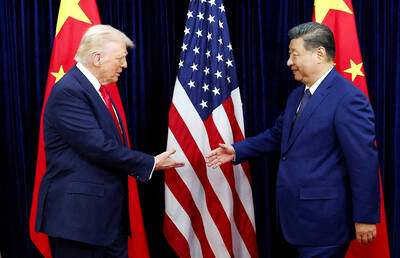
The March/April volume of Foreign Affairs, long a purveyor of pro-China pablum, offered up another irksome Beijing-speak on the issues and solutions for the problems vexing the People’s Republic of China (PRC) and the US: “America and China at the Edge of Ruin: A Last Chance to Step Back From the Brink” rang the provocative title, by David M. Lampton and Wang Jisi (王緝思). If one ever wants to describe what went wrong with US-PRC relations, the career of Wang Jisi is a good place to start. Wang has extensive experience in the US and the West. He was a visiting

One of the challenges with the sheer availability of food in today’s world is that lots of us end up spending many of our waking hours eating. Whether it’s full meals, snacks or desserts, scientists have found that it’s not uncommon for us to be mindlessly grazing at some point during all of our 16 or so waking hours. The problem? As soon as this food hits the bloodstream in the form of glucose, it initiates the release of the hormone insulin. This in turn activates a switch present in every one of our cells, which is responsible for driving cell


 RSS
RSS