


It’s a New Year and LAB Space has prepared a new, jam-packed season.
The year starts with I, Claudia by Kristen Thomson, a poignant play about a young girl struggling with the many challenges that life presents as she comes of age.
Claudia is about to enter the teen years, and her troubles are just beginning. First there is puberty, and then her parents are getting a divorce. To add to that she is not with the popular in-crowd at school. And if that is not enough, Claudia has a dreaded science project due and her schoolmates, who were supposed to help, have bailed out. What more problems can one have in life’s personal journey?
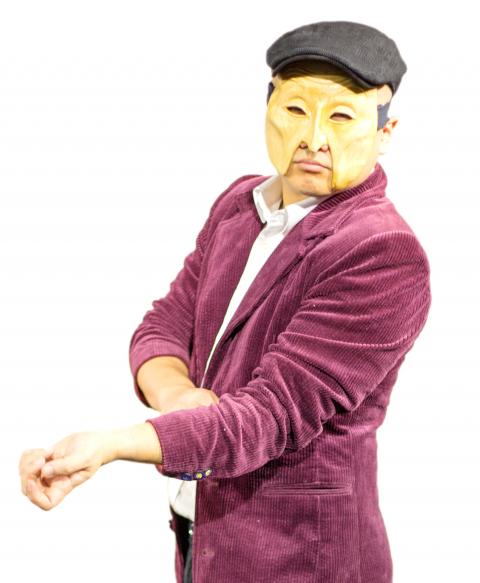
Photo courtesy of LAB Space
Theater wise, this is a one-person show where all four roles (two male and two female) are played by one actor using masks to change roles. Those four are Claudia the protagonist, Leslie (her father’s girl friend), Douglas (her grandfather whose wife just passed away) and Drachman, the school custodian who knows that Claudia’s refuge for sorting life out is the school basement.
Derek Kwan (關顯揚) who played in Michael, the “Neanderthal-type” blue collar, self-made man in last year’s God of Carnage takes on this challenge as well as the play’s theme that we only discover our true selves when we, like Claudia, reflect on our sorrows.
Book early for this show for it only runs for two weekends.
And then what about the rest of this? LAB Space has a lot more in store for all. A.R. Gurney’s star-crossed Love Letters and an intimate cabaret happen in February just before Valentine’s Day. Next come the tempestuous, The Blonde, the Brunette, and the Vengeful Redhead in the summer and the all-familiar 24 Hour Theater Festival in the fall. Closing the year are The Diary of Anne Frank and Twas the Night Before Christmas, a Christmas story as told by a mouse who realizes his house was missed last Christmas. This will be an eventful year and the LAB has other special activities planned as well.

It’s a good thing that 2025 is over. Yes, I fully expect we will look back on the year with nostalgia, once we have experienced this year and 2027. Traditionally at New Years much discourse is devoted to discussing what happened the previous year. Let’s have a look at what didn’t happen. Many bad things did not happen. The People’s Republic of China (PRC) did not attack Taiwan. We didn’t have a massive, destructive earthquake or drought. We didn’t have a major human pandemic. No widespread unemployment or other destructive social events. Nothing serious was done about Taiwan’s swelling birth rate catastrophe.
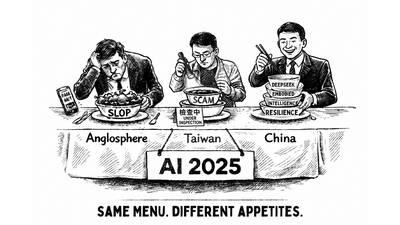
Words of the Year are not just interesting, they are telling. They are language and attitude barometers that measure what a country sees as important. The trending vocabulary around AI last year reveals a stark divergence in what each society notices and responds to the technological shift. For the Anglosphere it’s fatigue. For China it’s ambition. For Taiwan, it’s pragmatic vigilance. In Taiwan’s annual “representative character” vote, “recall” (罷) took the top spot with over 15,000 votes, followed closely by “scam” (詐). While “recall” speaks to the island’s partisan deadlock — a year defined by legislative recall campaigns and a public exhausted

In the 2010s, the Communist Party of China (CCP) began cracking down on Christian churches. Media reports said at the time that various versions of Protestant Christianity were likely the fastest growing religions in the People’s Republic of China (PRC). The crackdown was part of a campaign that in turn was part of a larger movement to bring religion under party control. For the Protestant churches, “the government’s aim has been to force all churches into the state-controlled organization,” according to a 2023 article in Christianity Today. That piece was centered on Wang Yi (王怡), the fiery, charismatic pastor of the

Hsu Pu-liao (許不了) never lived to see the premiere of his most successful film, The Clown and the Swan (小丑與天鵝, 1985). The movie, which starred Hsu, the “Taiwanese Charlie Chaplin,” outgrossed Jackie Chan’s Heart of Dragon (龍的心), earning NT$9.2 million at the local box office. Forty years after its premiere, the film has become the Taiwan Film and Audiovisual Institute’s (TFAI) 100th restoration. “It is the only one of Hsu’s films whose original negative survived,” says director Kevin Chu (朱延平), one of Taiwan’s most commercially successful


 RSS
RSS