


It’s a Monday afternoon in Taipei’s Ximending (西門町) and Leben Hsieh (謝立邦) is setting up his tricycle. A carbon dioxide tank is attached to the back wheel. He pops open the front of the wooden cart — supported by the tricycle’s two front wheels — and shows me the cask and freezer inside. It’s been a challenge keeping beer chilled in Taipei’s scorching weather.
Hsieh says that it’s his slow day — who drinks beer on a Monday afternoon? Just as he says that, a man tries to take a picture of us. We have our first customers — a couple visiting from Thailand.
Hsieh normally keeps two types of craft beer on tap — a local brew and an imported one. Today, it’s a Coffee Amber from Jim & Dad’s Brewing in Yilan and a Copper Cone Pale Ale from Epic Brewing in Salt Lake City. The amber hasn’t had time to cool yet, so he recommends the pale ale.
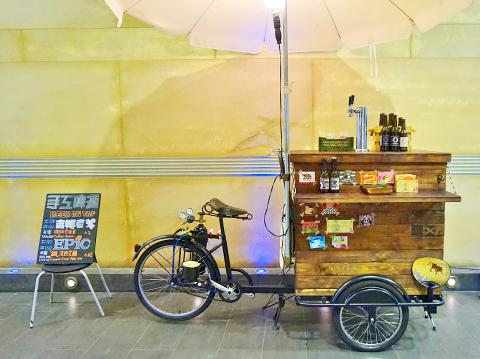
Photo: Dana Ter, Taipei Times
Before he sold craft beer from a tricycle, the Taichung native worked at a department store in Taipei where he would go out for drinks with his colleagues after work. This was a few years ago and bars sold mostly lagers.
“Back then, as long as there was beer, I was happy,” Hsieh tells me.
This changed when he bought a bottle of Duchesse de Bourgogne, a sour ale brewed by Brewery Verhaeghe in Belgium.
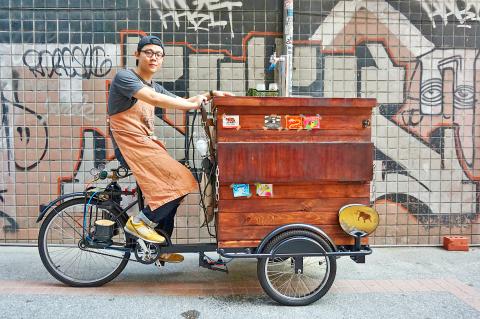
Photo: Dana Ter, Taipei Times
“The beer tasted so sour that I thought it had gone bad. I was so angry that I nearly went back to the store to return it,” he says.
Now he sees this as a turning point. The experience made him realize that craft beer is about variety — wheat ales, IPAs, stouts. These days, Hsieh prefers bitter, hoppy brews, especially the IPAs brewed by Danish brewery Mikkeller — this is obvious from all the Mikkeller stickers plastered on his cart.
BEWILDERED CUSTOMERS
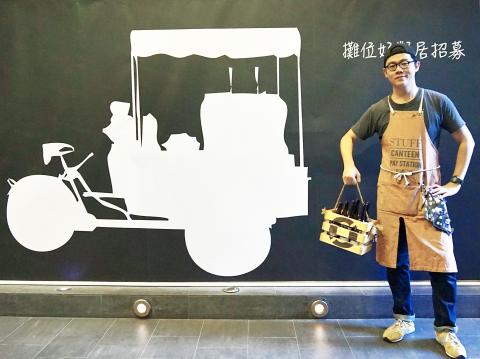
Photo: Dana Ter, Taipei Times
Hsieh’s initial idea was to open his own pub selling craft beer when he started working for Finding Burger (尋堡) in Ximending earlier this year. The shop owners were thinking of introducing craft beer but wanted to do so in a way that was more original.
Hsieh visited Tokyo a while back and saw a Tokyo Beer Porter Volkswagen driving around Shibuya District at night selling beer. He did more research online and found that other breweries such as the Auckland-based Funk Estate were selling beer from cargo bikes.
That’s when he came up with the idea of Beer Cargo (精釀啤酒三輪車) in April. When he first opened, he got a lot of bewildered customers.
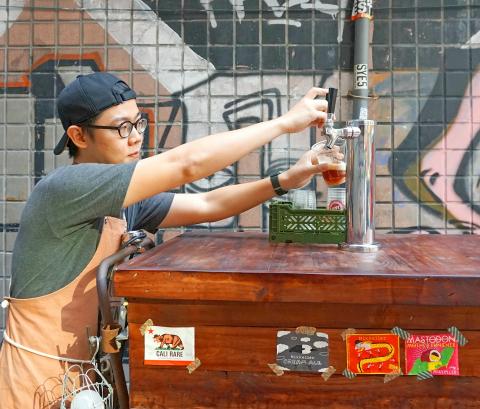
Photo: Dana Ter, Taipei Times
“People would approach me asking for an iced coffee and look a bit bewildered when I said I only sold beer,” Hsieh says.
During the day, his tricycle is normally parked outside of Finding Burger. He says it’s to avoid unnecessary trouble — the bankers next door don’t like it when he cycles by and the police once asked him what he was doing but quickly backed off when he said he was with the burger shop. He learned that despite hipsterfication of the area, the days of illegal roving vendors still bear a scar for many Ximending residents.
It’s totally different at night. He cycles out during sunset to meet regular customers, normally office workers in need of a pint after a hard day’s work.
“These are people who used to go to 7-Eleven to buy a can of Taiwan Beer,” Hsieh says. “They used to ask, why does your beer cost more than NT$200? But now they’re glad for another option.”
HOME ON THREE WHEELS
The tricycle itself is enough to draw the attention of curious passersby. Hsieh traveled to Tainan to find woodworkers to make the cart. Though the southern city is said to be renowned for its skilled craftsmen, it took Hsieh a while to find an appropriate woodworker to construct the vintage-style cart he had in mind. In the end, he found one who normally worked on LED-lit trucks that carried professional funeral mourners and betel nut girls.
And the woodworker did a great job. Inside the cart are a lot of hidden compartments where Hsieh stashes his personal articles — a can opener, a pocket book on Taiwanese slang and name cards he collects from customers, including one from the owner of London’s Beavertown Brewery who just happened to be walking past Hsieh’s tricycle during his vacation in Taiwan.
“My girlfriend says that when I’m on the road, my tricycle is like my house,” Hsieh quips.
Another nice touch is the vintage leather seat made by an elderly lady in Tainan. Hsieh also has with him second-hand stools which he plops next to his tricycle for customers, should they wish to enjoy their beer there. The stools were all discarded by shop owners in Ximending.
Hsieh’s tricycle has caught the attention of a few craft beer lovers on social media. He had one customer from California tell him that he decided to plan a trip to Taipei after seeing pictures of the tricycle on Instagram.
“I felt really bad that I made him travel all the way from California,” Hsieh jokes.
On a good day — normally weekends and holidays — he has up to 30 customers. On days like today, however, he’s content with taking it slow and cleaning and polishing his tricycle.
Warning: Excessive consumption of alcohol can damage your health.
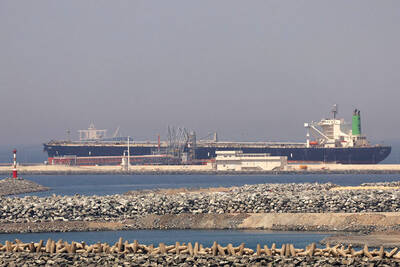
The breakwater stretches out to sea from the sprawling Kaohsiung port in southern Taiwan. Normally, it’s crowded with massive tankers ferrying liquefied natural gas from Qatar to be stored in the bulbous white tanks that dot the shoreline. These are not normal times, though, and not a single shipment from Qatar has docked at the Yongan terminal since early March after the Strait of Hormuz was shuttered. The suspension has provided a realistic preview of a potential Chinese blockade, a move that would throttle an economy anchored by the world’s most advanced and power-hungry semiconductor industry. It is a stark reminder of
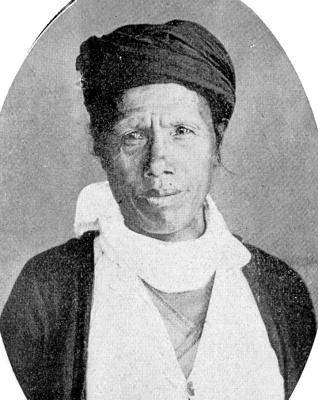
May 11 to May 17 Traversing the southern slopes of the Yushan Range in 1931, Japanese naturalist Tadao Kano knew he was approaching the last swath of Taiwan still beyond colonial control. The “vast, unknown territory,” protected by the “fierce” Bunun headman Dahu Ali, was “filled with an utterly endless jungle that choked the mountains and valleys,” Kano wrote. He noted how the group had “refused to submit to the measures of our authorities and entrenched themselves deep in these mountains … living a free existence spent chasing deer in the morning and seeking serow in the evening,” even describing them as

As a different column was being written, the big news dropped that Chinese Nationalist Party (KMT) caucus whip Fu Kun-chi (傅?萁) announced that negotiations within his caucus, with legislative speaker Han Kuo-yu (韓國瑜) of the KMT, party Chair Cheng Li-wun (鄭麗文), Taichung Mayor Lu Shiow-yen (盧秀燕) and Taiwan People’s Party (TPP) Chair Huang Kuo-chang (黃國昌) had produced a compromise special military budget proposal. On Thursday morning, prior to meeting with Cheng over a lunch of beef noodles, Lu reiterated her support for a budget of NT$800 or NT$900 billion — but refused to comment after the meeting. Right after Fu’s
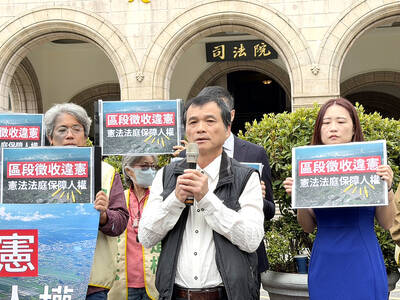
What government project has expropriated the most land in Taiwan? According to local media reports, it is the Taoyuan Aerotropolis, eating 2,500 hectares of land in its first phase, with more to come. Forty thousand people are expected to be displaced by the project. Naturally that enormous land grab is generating powerful pushback. Last week Chen Chien-ho (陳健和), a local resident of Jhuwei Borough (竹圍) in Taoyuan City’s Dayuan District (大園) filed a petition for constitutional review of the project after losing his case at the Taipei Administrative Court. The Administrative Court found in favor of nine other local landowners, but


 RSS
RSS