


You know you’ve reached 3 Idiots Toast and Curry when you see three chairs in the shape of butts.
The little open-air vegetarian eatery is located in an alley directly across the street from the Taipower Building (台電大樓) in Gongguan. Its walls are adorned with red brick walls and the wooden tables are covered with sackcloth, lending it a rustic vibe.
Opened two months ago by Andy Arya, the owner of the Out of India chains, the restaurant is named after the 2009 Bollywood comedy 3 Idiots. Just in case that isn’t clear, hung on the wall is a movie poster showing the three protagonists sitting on butt-shaped chairs striking rodeo poses.
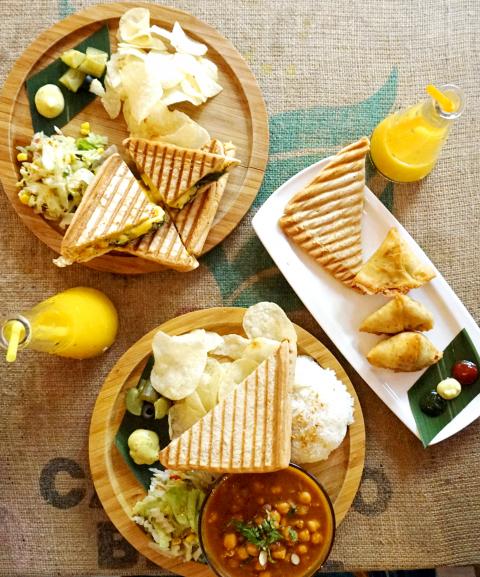
Photo: Dana Ter, Taipei Times
While Bollywood might have a certain appeal to local patrons — 3 Idiots was hugely popular in Taiwan — it was kungfu that brought Arya here 17 years ago. The New Delhi-bred restaurateur, who grew up watching Bruce Lee (李小龍) and Jackie Chan (成龍) movies, planned on visiting his friend, a monk living in Taipei, for two weeks.
“It was a good life,” Arya tells me. “You just pray in the morning, eat, sleep and watch some TV.”
Loving what seemed like the simple life, Arya stayed on, enrolling at the National Taiwan Normal University to study Chinese, all the while scraping funds together to make ends meet. He worked as a dishwasher at a Thai restaurant and taught English at three different schools at the same time. He was even homeless for two nights, resorting to sleeping in Da-an Park when his landlord changed the locks on his apartment because he couldn’t pay the rent.
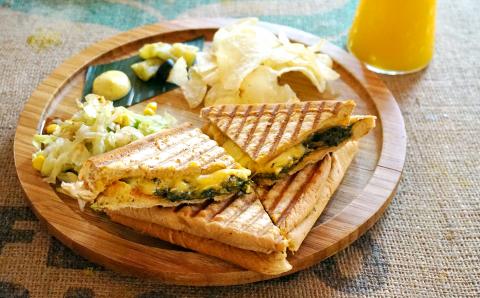
Photo: Dana Ter, Taipei Times
Though he lived a good life teaching English, Arya felt that it wasn’t his calling and since he had been cooking at home from the age of eight, opening a restaurant wasn’t too crazy an idea.
“I’m Indian. I love cooking. I wanted to open a restaurant that served the food that I enjoyed eating during my childhood,” Arya says.
Having been in the restaurant business for a decade, Arya knows how to sell a concept. Three Idiots is Instagram-worthy. Food is served on round, wooden plates and the fresh fruit juices are served in glasses shaped like lab flasks. Unfortunately, however, the restaurant’s aesthetic was as good as it got.

Photo: Dana Ter, Taipei Times
My friend and I ordered samosas (NT$150), spinach cottage toast (NT$150) and chole masala (NT$260).
The food isn’t quite up to par as Out of India. Perhaps 3 Idiots is trying to be too many things at once — toast and curry, Indian and fusion, vegetarian but packed with carbs.
The samosas are of the standard spiced potato and pea variety — but served with a slice of toast, for some reason. The shell isn’t as crispy and charred as I would have liked, and the filling, though pleasantly savory, is a bit bland and could have been enlivened with a dash of onions or green chili.
Though the intention is to serve “fusion” cuisine, the choice of dipping sauces — mint, mustard and tomato — is mystifying. A side of chutney with tamarind would have provided a far more refreshing complement to the dryness of the samosa shell.
It gets somewhat better with the spinach and cottage cheese toast made with a mixture of homemade cottage cheese, cheddar and mozzarella. The creaminess from the different types of cheese pairs well with the savory spinach and tomatoes, though the cheese could have been a little gooier. The bread, however, was barely toasted. That was the deal breaker.
While I appreciate the side of pickles and the mayonnaise mustard dipping sauce, the side salad with small bits of shredded lettuce and corn is puzzling. (It was probably placed there to appease Taiwanese patrons as that seems to be norm in many restaurants).
The chole masala (or chana masala as it is more commonly known) redeemed the other dishes. The generous portion of chickpea curry with a side of white rice and toast is the most Indian out of all the dishes we sampled and the most satisfying. I can deal with dipping toast instead of naan bread into the curry — it certainly fared better than being eaten with samosas.
The curry, which includes chickpeas, pumpkin, potatoes, almonds, cashews, ginger, turmeric, tomato puree and nine types of spices (though no onion and garlic), boasts a complex, sour citrus flavor. The chickpeas, which simmered in the curry, were both soft and chewy. Though chole masala is known as being a dry dish, I found it to be the most invigorating out of all the food we had.
It seems as if more thought had been put into the concept and decor rather than crafting the actual dishes. Pairing nearly every dish with a slice of toast seems like a stretch — especially when the pairing does not make a lot of sense, as with toast and samosas.
And the toast: Although it is a big part of the menu, 3 Idiots fails to deliver. There is only one variety, which tastes like sliced white bread. Using a different type of bread with a flavor more akin to naan would certainly spice things up.
That being said, the curry is the restaurant’s stand out dish. I just wish there were more curry options on the menu. But I will give 3 Idiots the benefit of the doubt because they plan to introduce more menu items, including hummus and falafel (which might be duds as the restaurant did not exactly succeed in changing my perception of “fusion” food), in the near future.
I did, however, upload a picture of my meal with a rustic filter on Instagram which received a ton of likes.
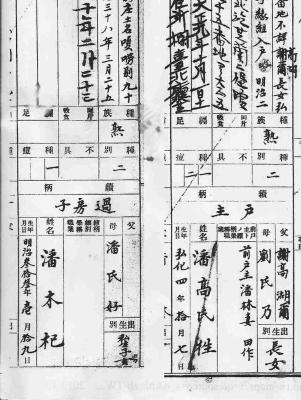
Feb. 9 to Feb.15 Growing up in the 1980s, Pan Wen-li (潘文立) was repeatedly told in elementary school that his family could not have originated in Taipei. At the time, there was a lack of understanding of Pingpu (plains Indigenous) peoples, who had mostly assimilated to Han-Taiwanese society and had no official recognition. Students were required to list their ancestral homes then, and when Pan wrote “Taipei,” his teacher rejected it as impossible. His father, an elder of the Ketagalan-founded Independence Presbyterian Church in Xinbeitou (自立長老會新北投教會), insisted that their family had always lived in the area. But under postwar
In 2012, the US Department of Justice (DOJ) heroically seized residences belonging to the family of former president Chen Shui-bian (陳水扁), “purchased with the proceeds of alleged bribes,” the DOJ announcement said. “Alleged” was enough. Strangely, the DOJ remains unmoved by the any of the extensive illegality of the two Leninist authoritarian parties that held power in the People’s Republic of China (PRC) and Taiwan. If only Chen had run a one-party state that imprisoned, tortured and murdered its opponents, his property would have been completely safe from DOJ action. I must also note two things in the interests of completeness.

Taiwan is especially vulnerable to climate change. The surrounding seas are rising at twice the global rate, extreme heat is becoming a serious problem in the country’s cities, and typhoons are growing less frequent (resulting in droughts) but more destructive. Yet young Taiwanese, according to interviewees who often discuss such issues with this demographic, seldom show signs of climate anxiety, despite their teachers being convinced that humanity has a great deal to worry about. Climate anxiety or eco-anxiety isn’t a psychological disorder recognized by diagnostic manuals, but that doesn’t make it any less real to those who have a chronic and
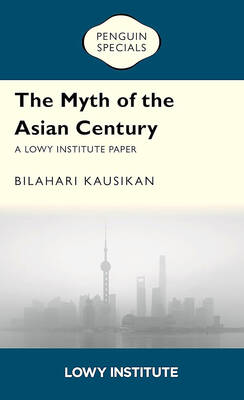
When Bilahari Kausikan defines Singapore as a small country “whose ability to influence events outside its borders is always limited but never completely non-existent,” we wish we could say the same about Taiwan. In a little book called The Myth of the Asian Century, he demolishes a number of preconceived ideas that shackle Taiwan’s self-confidence in its own agency. Kausikan worked for almost 40 years at Singapore’s Ministry of Foreign Affairs, reaching the position of permanent secretary: saying that he knows what he is talking about is an understatement. He was in charge of foreign affairs in a pivotal place in


 RSS
RSS