


While touring California’s Sonoma Valley years ago, Brett Tieman felt a mix of envy and reverence for the vineyard owners.
“Their job is to make alcohol. That’s just crazy,” Tieman says.
Tieman says this while taking a swig of his brewery’s citrusy IPA at the Corner Office near Sun Yat-sen Memorial Hall in Taipei. Just a couple of days ago, he was overseeing the entire operation from milling to fermentation at his contract brewery in Hsinchu.
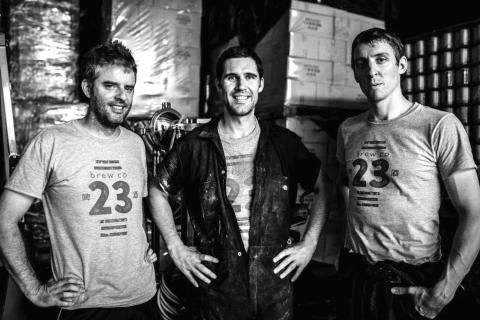
Photo courtesy of Robin Serious
When Tieman first visited Taiwan in 2003, he remembers drinking mainly Taiwan Beer, Heineken and Carlsberg. He said it was disappointing since he considers himself to be the type of traveler who prefers to visit restaurants and bars rather than museums. Despite this, however, he fell in love with Taiwan during several short trips here with his wife. Eventually, the couple decided to uproot from New York.
“One of the most rewarding things you can do in your life is to cash out of New York,” Tieman tells me.
LUCKY NUMBER
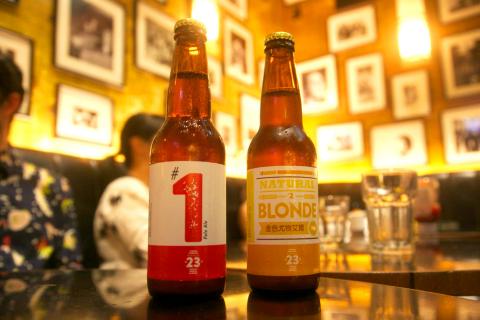
Photo courtesy of Robin Serious
It was 2012 when Tieman “cashed out.” Taiwan’s craft beer scene had expanded. Breweries like North Taiwan Brewery, Jolly and Le Ble d’Or were putting out a solid selection of ales and stouts, while Belgian beers were selling like hot cakes. But unlike other Asian cities such as Hong Kong or Shanghai, it was still unusual for a group of friends to hit up a bar for the sole purpose of tasting craft beers, similar to how one samples wine or Chinese tea.
Although Tieman had relocated to Taiwan partly because he wanted to start his own business, it wasn’t his initial idea to run a brewery. He never brewed his own beer in the US — there wasn’t a need for it. Tieman began to miss the beverage, though, and after joining a Facebook group consisting of homebrewers in Taiwan, he started home brewing as a hobby. Back then, beer kits weren’t sold in Taiwan. He relied on a brewing software which did the calculations for him, but it was still a bit tricky without a beer kit which provides you with the malt already in liquid form.
“I jumped straight into the deep end,” Tieman says.
It was through the Facebook group that he met Rob Baumgarten and Matt Frazar. In June 2014, the trio founded 23 Brewing Company. The brewery was part of the second wave of craft brewing companies to launch in Taiwan (Redpoint and 55th Street Craft Brewery being other examples).
The name of the brewery was Baumgarten’s idea. Not only is the ordinal number a reference to Taiwan’s 23 million residents, but it also alludes to the 23 enigma — the belief that bizarre and mystifying events around the world can be traced back to the number 23. More importantly, the Beer Judge Certification Program’s guidelines originally included 23 different categories for beer.
Tieman and his partners spend one day a week at their contract brewery in Hsinchu where they talk to the brew master and oversee the process.
As Tieman likes to say, “Brewing is like plumbing — you’re basically a plumber.”
The process — mill, mash, boil, ferment — seems simple but it’s easy to make careless mistakes if you’re not focused entirely on one task, like forgetting to close a valve. There is also pressure to continually improve their flavor due to increasing competition in the craft beer market.
Tieman says that although it’s certainly exciting to experience firsthand Taiwan’s craft beer revolution, he also feels that they have to continuously step above the bar and make each batch better than the next.
HOP TO SUCCESS
Their efforts have certainly paid off. Their three signature beers boast an appealing simplicity (citrusy but not over the top, smooth finish) mixed with a distinct Taiwanese flair (not too bitter), the result of which sits well with both session drinkers as well as those who prefer to take it slow.
“We use a hodgepodge of ingredients from all over the world to make American-style beer in Taiwan,” Tieman says.
Made with musky citra hops, the #1 Pale Ale (5.5 percent alcohol) is crisp, refreshing and reminiscent of California pale ales. The citrus flavor is highly evident, with a hint of floral undertones.
The Natural Blonde (5 percent alcohol) has more of a neutral bitterness that’s also malty and tropical with a smooth finish. Tieman says the ale was made for those not quite ready for the bitterness of American ales.
If you prefer bold, bitter and hoppy, try the IPA (6.5 percent). The blend of citrus and pine gives it an added kick.
They’ve also recently released their first collaboration with 55th Street Craft Brewery. The 78 Series Imperial Porter (7.8 percent, and 23 plus 55 is 78), is, as its name suggests, a dark, mocha-flavored porter. Brewed with local raw, unrefined sugar, its deep chocolate taste makes it a good winter brew.
For the most part, 23 Brewing likes to keep it hoppy, and they’ll be reverting to hoppy flavors for their next release, their Saison, albeit with some spicy undertones.
I ask Tieman if he still feels jealous of Sonoma’s winemakers. While he loves making his own alcohol now, he says the concept of “destination breweries” — the idea of touring a brewery much like you would a vineyard — hasn’t exactly latched on yet. In Taiwan, a lot of breweries are located in industrial districts. The exception is Jim & Dad’s Brewing Company in Yilan.
Tieman is certain this will change, though.
“It’s been a wild ride,” he adds.
But the reality is that craft beer in Taiwan is still a nascent industry, and for Tieman, the key is to make small, incremental changes while keeping in mind that other countries have decades of a head start.
“When I come back from a trip to the US, I’m like, our beer sucks. But after a month or so, I think, actually, our beer is pretty awesome.”
Warning: Excessive consumption of alcohol can damage your health.
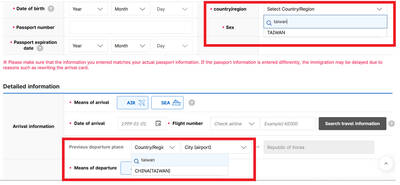
Jason Han says that the e-arrival card spat between South Korea and Taiwan shows that Seoul is signaling adherence to its “one-China” policy, while Taiwan’s response reflects a reciprocal approach. “Attempts to alter the diplomatic status quo often lead to tit-for-tat responses,” the analyst on international affairs tells the Taipei Times, adding that Taiwan may become more cautious in its dealings with South Korea going forward. Taipei has called on Seoul to correct its electronic entry system, which currently lists Taiwan as “China (Taiwan),” warning that reciprocal measures may follow if the wording is not changed before March 31. As of yesterday,

The Portuguese never established a presence on Taiwan, but they must have traded with the indigenous people because later traders reported that the locals referred to parts of deer using Portuguese words. What goods might the Portuguese have offered their indigenous trade partners? Among them must have been slaves, for the Portuguese dealt slaves across Asia. Though we often speak of “Portuguese” ships, imagining them as picturesque vessels manned by pointy-bearded Iberians, in Asia Portuguese shipping between local destinations was crewed by Asian seamen, with a handful of white or Eurasian officers. “Even the great carracks of 1,000-2,000 tons which plied
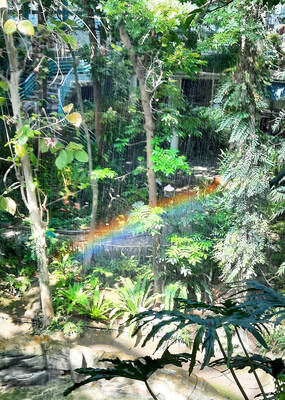
It’s only half the size of its more famous counterpart in Taipei, but the Botanical Garden of the National Museum of Nature Science (NMNS, 國立自然科學博物館植物園) is surely one of urban Taiwan’s most inviting green spaces. Covering 4.5 hectares immediately northeast of the government-run museum in Taichung’s North District (北區), the garden features more than 700 plant species, many of which are labeled in Chinese but not in English. Since its establishment in 1999, the site’s managers have done their best to replicate a number of native ecosystems, dividing the site into eight areas. The name of the Coral Atoll Zone might
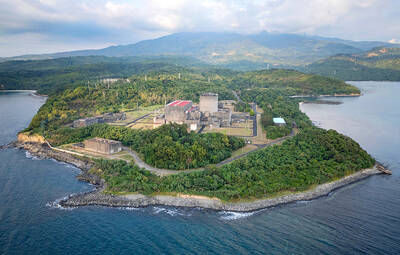
Nuclear power is getting a second look in Southeast Asia as countries prepare to meet surging energy demand as they vie for artificial intelligence-focused data centers. Several Southeast Asian nations are reviving mothballed nuclear plans and setting ambitious targets and nearly half of the region could, if they pursue those goals, have nuclear energy in the 2030s. Even countries without current plans have signaled their interest. Southeast Asia has never produced a single watt of nuclear energy, despite long-held atomic ambitions. But that may soon change as pressure mounts to reduce emissions that contribute to climate change, while meeting growing power needs. The


 RSS
RSS