


A little over six years ago, Ayesha Mehta and Ping Chu were caught in a downpour in Taidong. These strangers started chatting over cups of tea, and the concept for a place where experimenting, creating and listening was hatched. Soon after, the doors of Aveda Learning Kitchen were opened and 100 people showed up, communal bottle of wine in hand, and Red Room was born. Red Room will celebrate its sixth anniversary with Renaissance Festival, a free event on Saturday at the Taiwan Air Force Innovation Base (TAF 空總創新基地).
Over the past six years, the monthly Stage Time and Wine has become the cornerstone event of Red Room. Everyone has five minutes to do whatever he or she pleases, and no one can do wrong. The stage has been witness to many unforgettable moments of silence, dance, song, poetry readings, long sobs, mass hugs and more. The only rule of the performances is that they are authentic and vulnerable.
Stage Time and Juice was later added to the docket for children. The same rules were applied and Red Room quickly realized that this was an excellent idea because the positive impact of creating and sharing with adults is increased tenfold with kids.
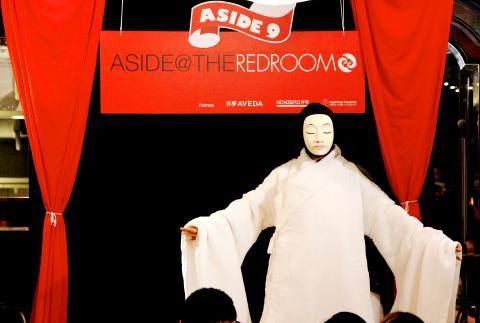
Photo courtesy of Red Room
Red Room also runs Aside and Red Room Radio Redux every month, along with many other specialized events focusing on the arts.
BRIGHT FUTURE
Thousands of people have come through Red Room’s doors over the past six years and many return over and over.
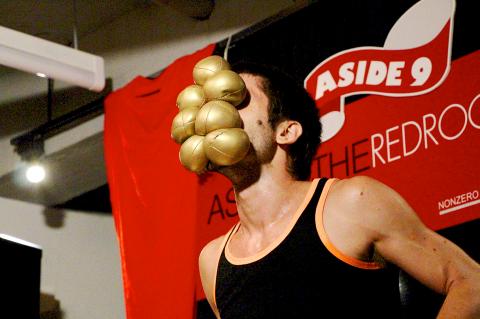
Photo courtesy of Red Room
“In a world so hectic, it’s important to set aside some quality time to nourish what is really important — beauty and love,” said Julia Kao (高子晴), a long time Red Roomer who is now working for the company.
“By actively celebrating what gives us depth as sentient beings through stories, songs and movement, we are fulfilled in our search for meaning and connection,” Kao said.
In September, Red Room relocated to the second floor of the library at the Taiwan Air Force Innovation Base. With Roma Mehta as director and Manav Mehta as curator, and many others pitching in, the new space is called Red Room International Village.
Organizers say the goal is to have a welcoming place for the international creative community to gather and create. There have been events going on in the space for the past two months, but Saturday’s Renaissance Festival, with 24 booths, all day live music and all the regular Red Room shows, is the first big step toward its bright future.
Performance Notes:
What: Red Room Renaissance Festival (文藝復興紅房六週年慶)
Where: Taiwan Air Force Innovation Base (TAF 空總創新基地),177, Sec 1, Jianguo S Rd (台北市建國南路一段177號)
When: Saturday from 11am to 9pm
Admission: Free
On the Net:www.facebook.com/redroomtaipei

Taiwan’s English education system is being pulled apart by three opposing forces. Bilingual Nation 2030 pulls students toward English and global communication. Artificial Intelligence (AI) readiness pulls them toward digital judgment, verification and AI-mediated work. But Taiwan’s old exam culture pulls them back toward memorization, grammar drills, timed reading and correct answers. If the education system keeps using old exams to define success, it risks producing graduates who are neither genuinely bilingual nor genuinely AI-ready, but trained for tasks machines can already perform. The first force is Bilingual Nation 2030. Launched in 2018, the policy aimed to “help Taiwan’s workforce connect
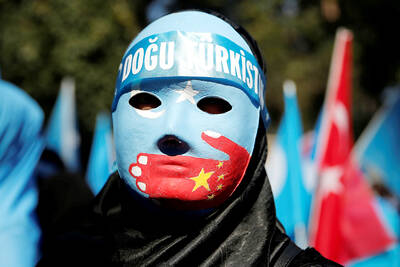
It seems every few days one bumps into one of those “real man” comments in which Taiwan is urged to “face reality” or similar, and “make a deal,” with the speaker implying that soon it will be too late. “Deal” advocates always present themselves as having a superior grip on reality, and the manly ability to make the “hard choice.” Their testosterone-laden language often echoes that of Taiwan sellout advocates. Note that such commentary always specifies a process (“make a deal, work with, make progress”), never the end state of what occupation by a violent authoritarian colonialist state will entail. In

There are shadowy cabals plotting to sell out Taiwan to be annexed by China, by invasion if necessary. Fortunately, they are buffoons. In 2019, former Bamboo Union gangster and founder of the China Unification Promotion Party (CUPP), Chang An-le (張安樂, colorfully known as “White Wolf”), led a protest at the Legislative Yuan against comments made by then-premier Su Tseng-chang (蘇貞昌) that in the event of an attack by China, he would never surrender, but would protect the nation by fighting to the end, even if he only had a broom. Chang had party members bring a wooden casket that they
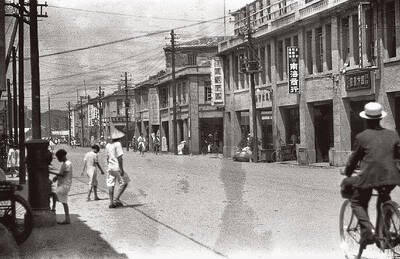
June 1 to June 7 "If all Taiwanese were as afraid of dying as you, then what would happen?” Physician Shih Chiang-nan (施江南) reportedly said this to his wife Chen Chiao-tung (陳焦桐) after she urged him to stop intervening on behalf of Taiwanese soldiers stranded overseas after serving in the Japanese Army during World War II. Shih had clashed with high-ranking officials over the issue, engaged in several heated arguments with Taiwan governor-general Chen Yi (陳儀) and allegedly shouted at general Ko Yuan-fen (柯遠芬), chief of staff of the Taiwan Garrison Command, over


 RSS
RSS