


Earlier this year, the Taipei Times published an editorial highlighting the severity of environmental pollution caused by plastic waste and the harm it has not only on aquatic life but on us as well, since plastic residue eventually enters our food chain (“Nation engulfed in plastic tsunami,” Jan. 9, 2015). Now that summer is here, it’s important to keep this in mind and refrain from littering as we head out to the beach — and for those of us who really want to get involved in keeping the coast clean, there will be a beach clean-up on Sunday morning by the Toucheng river mouth (頭城河出海口) in Yilan County (宜蘭).
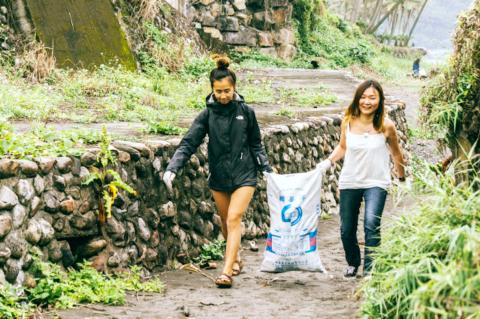
Organized by Love Your Coast Taiwan — a Facebook community consisting of individuals and local businesses such as Rising Sun Surf Inn, Bottle Shop Taiwan and Lian Kuai Co (連岡股份有限公司) collaborating to organize monthly clean-ups — the goal is simple: pick up rubbish, meet new people and take a dip in the ocean afterward to cool off.
“We’re trying to make the clean-ups really safe, fun and easy for people to take part in,” Duncan Gibb from Love Your Coast Taiwan told the Taipei Times. “Providing snacks and refreshments for people should make it much more enjoyable.”
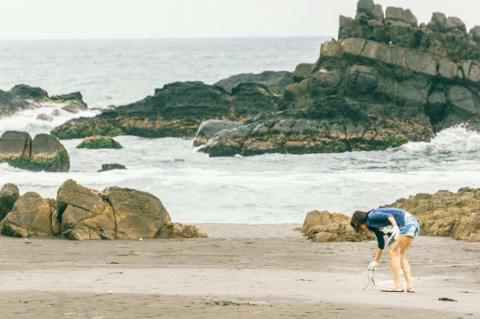
Photo Courtesy of Love Your Coast Taiwan
Although the places on the bus from Taipei to Toucheng provided by Lian Kuai Co for the event have already filled up, it’s still cheap and easy to get to Toucheng on your own via the train from Taipei Main Station (台北車站) or public bus from Taipei City Hall Bus Station (市府轉運站). Commute times for both options are slightly over an hour and cost around NT$100.
There will also be an after-party in Taipei at the Bottle Shop on Zhongxiao East Road (忠孝東路) which serves thirst-quenching craft beers including citrusy IPAs and blonde ales.
“The after-parties are a nice way for people to be able to relax with a cold drink after a hard day’s work,” Gibb adds.
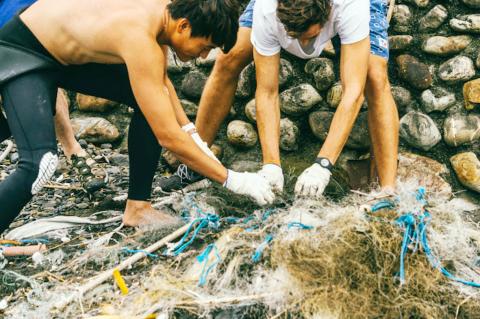
Photo Courtesy of Love Your Coast Taiwan
COLLABORATIVE EFFORT
In April, Love Your Coast Taiwan held their first clean-up in Double Lions beach in conjunction with the Waiao Seafood, Blues and Brews festival. Since then, the number of participants has been steadily increasing and they are expecting more than 50 people to take part in Sunday’s clean-up. Gibb says that the turn-up at their last two events has been a good mixture of Taiwanese plus expats hailing from many different countries.
Utilizing the resources provided by Love Your Coast — a project initially launched by a couple of New Zealand-based non-profits to help people around the world look after their beaches — Love Your Coast Taiwan aims to raise public awareness of environmental pollution through data collection and analysis.
Photos Courtesy of Love Your Coast Taiwan
Gibb says that while it’s still too soon to provide substantive results from the data they’ve gathered, it’s evident that plastic bags, bottles and food packaging is washing up on beaches around Taiwan. This is worrisome because plastics can be full of toxins which will end up in our food chain.
“Taiwan has a truly amazing coastline and some of the world’s most beautiful beaches, and many beaches are already carefully looked after by local communities,” Gibb says.
The problem is not so much caused by littering at the beach, he adds, but rather, “rubbish that is dropped in cities and towns, for example, makes its way via drains, streams and rivers into the sea and then some washes back up on the shore.”
So far, the clean-ups have generated positive media coverage. This in part is due to the efforts of well-known public figure and outspoken environmental activist Hsieh Hsin-hsuan (謝昕璇), who has been creating artistic photographs to draw attention to the cause. In addition, Love Your Coast Taiwan is working on producing video content to further highlight the issue.
Finally, Gibb says they are also looking to collaborate with other events in the future — something which he believes would help generate more interest in the cause.

What was the population of Taiwan when the first Negritos arrived? In 500BC? The 1st century? The 18th? These questions are important, because they can contextualize the number of babies born last month, 6,523, to all the people on Taiwan, indigenous and colonial alike. That figure represents a year on year drop of 3,884 babies, prefiguring total births under 90,000 for the year. It also represents the 26th straight month of deaths exceeding births. Why isn’t this a bigger crisis? Because we don’t experience it. Instead, what we experience is a growing and more diverse population. POPULATION What is Taiwan’s actual population?

For the past five years, Sammy Jou (周祥敏) has climbed Kinmen’s highest peak, Taiwu Mountain (太武山) at 6am before heading to work. In the winter, it’s dark when he sets out but even at this hour, other climbers are already coming down the mountain. All of this is a big change from Jou’s childhood during the Martial Law period, when the military requisitioned the mountain for strategic purposes and most of it was off-limits. Back then, only two mountain trails were open, and they were open only during special occasions, such as for prayers to one’s ancestors during Lunar New Year.

After Jurassic Park premiered in 1993, people began to ask if scientists could really bring long-lost species back from extinction, just like in the hit movie. The idea has triggered “de-extinction” debates in several countries, including Taiwan, where the focus has been on the Formosan clouded leopard (designated after 1917 as Neofelis nebulosa brachyura). National Taiwan Museum’s (NTM) Web site describes the Formosan clouded leopard as “a subspecies endemic to Taiwan…it reaches a body length of 0.6m to 1.2m and tail length of 0.7m to 0.9m and weighs between 15kg and 30kg. It is entirely covered with beautiful cloud-like spots

A key feature of Taiwan’s environmental impact assessments (EIA) is that they seldom stop projects, especially once the project has passed its second stage EIA review (the original Suhua Highway proposal, killed after passing the second stage review, seems to be the lone exception). Mingjian Township (名間鄉) in Nantou County has been the site of rising public anger over the proposed construction of a waste incinerator in an important agricultural area. The township is a key producer of tea (over 40 percent of the island’s production), ginger and turmeric. The incinerator project is currently in its second stage EIA. The incinerator


 RSS
RSS