


As the name suggests, Whinos, too is the sequel to a culinary hit. A spin-off of the popular bistro Whinos Bar & Kitchen, Whinos, too boasts exuberant food and wine, and a space that is felicitously ample, incorporating a cozy, hip design. My dinning companions and I were delighted with our visit on a recent Saturday night — although a mishap that occurred at the end of the meal put a slight damper on the visit.
When we arrived early in the evening for our reservation — almost an imperative if you dine there on the weekend — the place was already filled with young diners clinking wine glasses and enjoying hearty food. With subdued lighting, a warm, wood entrance and wrought iron signage, it gives a hip impression to passersby. Inside, vintage furniture blends harmoniously with brick walls painted white and paintings to create a relaxing ambience which is accentuated by jazz music. A finely stocked glass cellar and a cabinet filled with cheeses heralded a delightful evening.
For those looking for something to nibble while indulging in a few bottles of wine, the bistro’s menu, stylishly made out of cardboard wine boxes, contains a solid collection of cold cuts and hard, semi-hard, soft and blue cheese from Holland, Italy, Switzerland, France, Spain and the UK, as well as a variety of finger food, such as homemade chili cheese nachos (NT$250) and herb roasted chicken drumettes (NT$280).
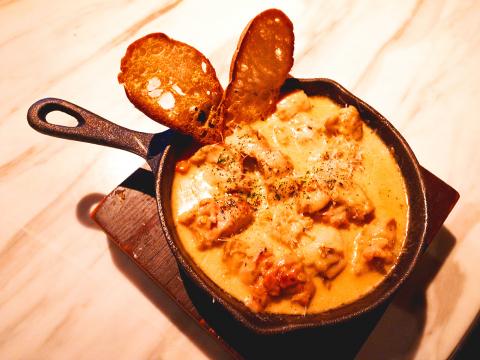
Photo: Ho Yi, Taipei Times
Serious diners have plenty to choose from. The mini foie gras cheeseburgers (NT$650) were regretfully sold out.
The four of us started our meal with the Westland old Amsterdam (NT$200) and prosciutto (NT$280). For big groups, the ham and cheese platter (NT$780) is a popular choice that comes with a selection of three cheeses and two cold cuts with fresh fruit, honey, jam, nuts, pickles and bread.
The mussels in white wine and garlic sauce (NT$320) was surprisingly spicy, while the fried pocket stuffed with chorizo, spinach and egg (NT$260) was satisfying.
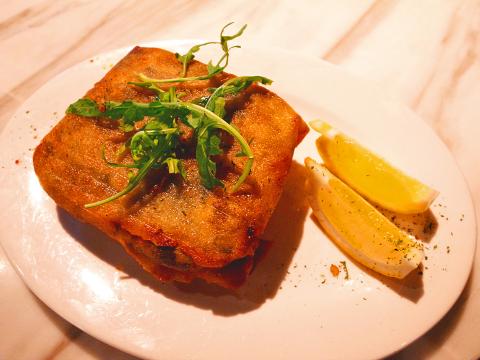
Photo: Ho Yi, Taipei Times
Touted as a must-try delicacy by food bloggers, the baked uni sandwich (NT$650) didn’t disappoint. The spread of the rich, orange gonads of sea urchins melted in the mouth, leaving a lingering briny taste.
For our main courses, while the pan-seared pork chop with cabbage and mushrooms (NT$450) was adequate but didn’t impress, the tequila lemon cream chicken (NT$380) was so luscious that we ordered two baskets of assorted bread (NT$90) to mop up all the creamy sauce from the plate.
The bistro’s cellar is stocked with white, red and sparkling wine and champagne from France, Italy, Germany, Spain, New Zealand, Argentina and the US (NT$1,300 to NT$4,800). There is also a selection of beer, grappa, sherry, whisky and other spirits (NT$220 to NT$500 by glass, NT$2,500 to NT$7,000 by bottle).
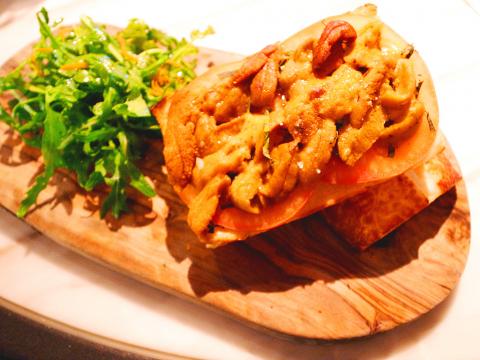
Photo: Ho Yi, Taipei Times
But wine aficionados might want to stay sober when asking for the check — a careless young waiter had put a bottle of wine we didn’t order on our bill.
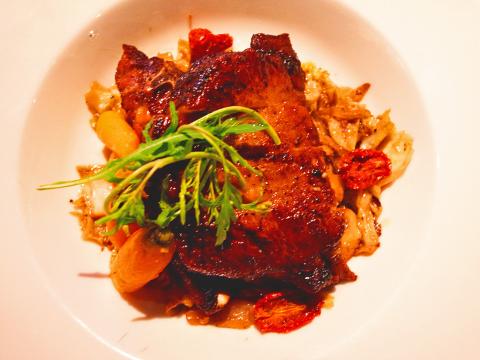
Photo: Ho Yi, Taipei Times
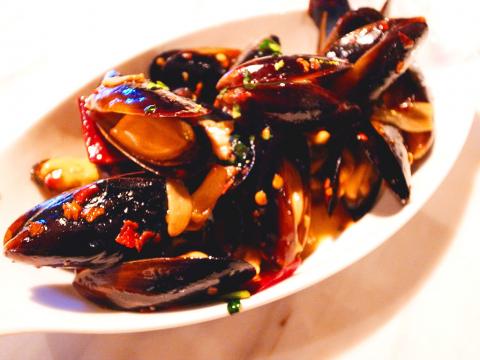
Photo: Ho Yi, Taipei Times
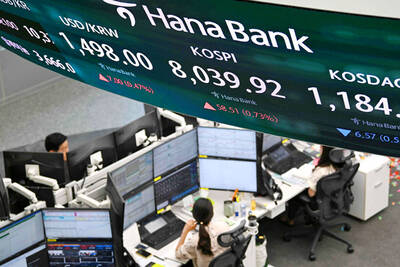
Taiwan’s overtaking of South Korea in GDP per capita is not a temporary anomaly, but the result of deeper structural problems in the South Korean economy says Chang Young-chul, the former CEO of Korea Asset Management Corp. Chang says that while it reflects Taiwan’s own gains, it also highlights weakening growth momentum in South Korea. As design and foundry capabilities become more important in the AI era, Seoul risks losing competitiveness if it relies too heavily on memory chips. IMF forecasts showing Taiwan widening its lead over South Korea have fueled debate in Seoul over memory chip dependence, industrial policy and

And so, in the wake of US President Donald Trump’s trip to the People’s Republic of China (PRC), all the experts on the Strait of Hormuz suddenly became experts on US-China-Taiwan relations. The Internet has certainly expanded human knowledge. Lots of these sudden experts made noise this week about Trump’s words after the meeting with PRC dictator Xi Jin-ping (習近平). Trump is going to sell out Taiwan! Longtime Taiwan commentator J. Michael Cole summed the situation up neatly in the Guardian: “We need to keep in mind that he has a tendency to say many things — sometimes contradicting himself within

There is considerable frustration and confusion among many, both in Taiwan and abroad — including in Washington — as to why the Chinese Nationalist Party (KMT) seems so dead set on using their legislative leverage to slash defense spending and disrupt the ability of the ruling Democratic Progressive Party (DPP) administration to function. Are they pawns of the Chinese Communist Party (CCP)? Are they traitors? In reality, there are multiple reasons. In the first column in this series on this subject, “Donovan’s Deep Dives: How and why the TPP and KMT help Beijing” (Sat May 16, page 12), we examined three

It took 12 years and months of standing in the same mountain location for director Liang Chieh-te (梁皆得) to capture a few seconds of footage: Taiwan’s largest resident raptor locking talons with its mate and spinning through the air in a courtship ritual. With only about 1,000 left in the wild and very short flight windows, the mountain hawk-eagle remains among Taiwan’s most elusive birds. The species generally produces only one offspring per year. Using forest cameras, the film crew and research teams document the arduous process the monogamous pairs go through for the chick to hatch and grow up, weathering


 RSS
RSS