


On the evening of March 18, Taiwanese politics experienced a tremendous shock as 300 students and demonstrators stormed the Legislative Yuan and took over its chamber for 24 days.
The Sunflower movement, as it has come to be known, eventually succeeded in stalling the implementation of a controversial economic trade agreement with China, and revealed not only the public’s increasing resentment toward the current political system, but its desire for reform.
Building on this wave of enthusiasm, a new generation of politicians has emerged to contest the Nov. 29 nine-in-one elections.
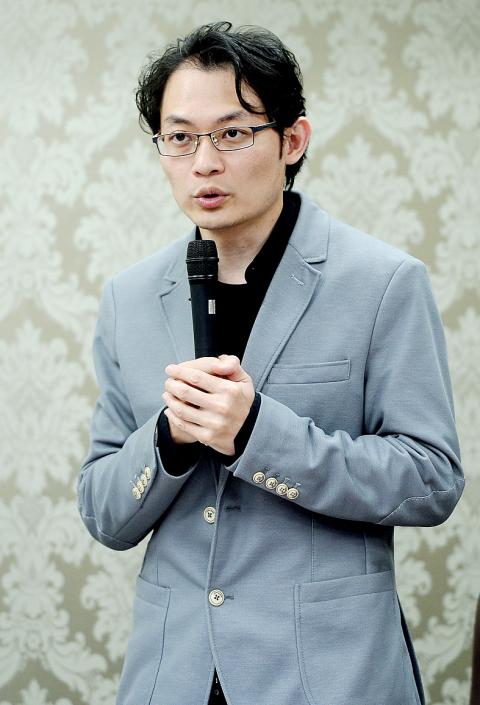
Photo: Lin Cheng-kung, TT
“The Democratic Progressive Party (DPP) has let down its supporters. The Chinese Nationalist Party (KMT) is rotten to the core. But then the Sunflowers come along. People now have high expectations of the young generation,” says Sunflower activist Yoshi Liu (劉敬文), who is better known by his nickname Yoshi (妖西).
Faced with an overtly pro-Beijing, pro-business ruling KMT and a disappointing DPP as the main opposition party, Liu is among a growing number of activists and protesters disillusioned with the current political climate in Taiwan, and who want to change the system from within. They say the year-end local elections, in which voters will elect over 11,000 officials nationwide, presents an opportunity to make changes at the grassroots level, from influencing everyday life in boroughs and villages to policy-making in city councils.
Among them, the Wing of Radical Politics (基進側翼), a pro-independence group headquartered in Greater Kaohsiung, has put forth five 20-something candidates for the offices of city councilor in Hsinchu and Greater Kaohsiung. Teaming up with the Taiwan Solidarity Union (TSU), Formoshock (福爾摩鯊會社), a group formed by people who met during the occupation of the legislature, has nominated 13 candidates to run for borough warden positions across the country.

Photo: Liberty Times
Composed of Sunflower activists with an average age of 20, the Youth Occupy Politics (YOP, 青年佔領政治) has so far reached out to 19 candidates for the offices of township mayor, borough warden and city councilor who have signed the pledge issued by the group, agreeing to observe its common platforms, including its anti-nuclear policy, government transparency, animal rights and sustainable development.
“This is one of those rare moments when the public’s demand for reform is so strong that it cannot be ignored. We need to transform this social momentum into political action,” says 22-year-old Shan Yi-che (冼義哲), YOP co-founder.
The Sunflower movement also marks a shift in the willingness of the DPP and TSU to bring a younger generation of politicians into the fold, without the caveat that they become members.
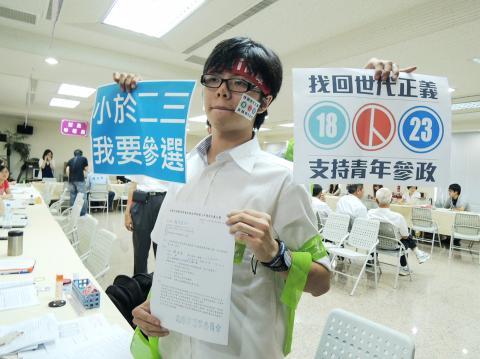
Photo: Wang Jung-hsiung
“The Sunflower movement was definitely a turning point. Before it, nobody gave a damn about us. Before it, none of us could have ever taken on important positions within the DPP,” Liu says, referring to the DPP’s recruitment of student movement leaders such as 25-year-old Fu Wei-che (傅偉哲), who was brought in as the director of the party’s Department of Youth Development following the Sunflower movement.
WILD STRAWBERRIES GROW INTO SUNFLOWERS
The emerging political force spawned by the Sunflower movement is, in fact, a continuation of earlier protest movements, most specifically the Wild Strawberry movement initiated in 2008 by college students and professors to protest excessive police force against demonstrators who opposed the visit to Taiwan of Chen Yunlin (陳雲林), the then chairman of China’s Association for Relations Across the Taiwan Strait.
It is commonly agreed that the Wild Strawberries failed to organize themselves into a mass movement due to a lack of existing networks and organizational experience, which resulted in distrust and internal discord among participants. Afterwards, former Wild Strawberries such as Lin Fei-fan (林飛帆) set up student clubs and groups at various universities to facilitate inter-campus communication and effectively laying the foundation for the organized protests that followed, including the nation-wide campaign against media monopolization in 2012.
“The Sunflower movement is a convergence of forces emerging from the Wild Strawberry movement and the anti-media monopolization campaign.... Though the Sunflower movement is huge, there are only about 100 to 200 core members, who come from the same network and are very experienced — whether it is setting the agenda, dealing with the press or creating confrontation,” says Liu, the founder of Formoshock who has been involved in the Wild Strawberry and Sunflower campaigns.
GRASSROOTS MOVEMENT
In response to the new political force, the DPP initiated Youth Power (民主小草), a program started in July that encourages those between aged 23 and 40 to contest the November elections for borough and village wardens. The DPP offers candidates a subsidy of NT$30,000 as well as advice in campaign strategy. Forty-six candidates were selected, and joining the party was not a requirement.
Meanwhile, the TSU approached Liu to carry out a similar project together with Formoshock, the aim of which is to nurture a team of young political operators and future politicians.
Open to both TSU and non-TSU members, the party sponsors 20 candidates to run in the election as borough wardens. Each candidate receives NT$50,000, the sum required as a security deposit to run in the election. A one-day workshop was also held by an incumbent borough warden and city councilor to coach the young hopefuls on pragmatic matters such as campaign strategy, voters’ expectations and grassroots political culture.
Unlike the KMT, which has long maintained its influence through borough wardens who are mostly KMT members or KMT-affiliated, neither the DPP or TSU have ever gained a firm foothold at the grassroots level. Around election time, borough wardens double up as vote captains. This year, more than 7,800 borough and village wardens will be elected.
For the opposition parties and young political hopefuls, working as a borough wardens is, therefore, an important way to weaken the KMT’s grip on power. Indeed, Taiwan’s grassroots politics has become a hotly contested field — even targeted by the Chinese Communist Party. During the controversial four day visit by Zhang Zhijun (張志軍), director of China’s Taiwan Affairs Office, the Chinese official organized meetings with locals through his grassroots contacts, which reportedly included Kuo Yun-hui (郭雲輝), chairman of the Taiwan Borough and Village Warden Association (台灣村里長聯誼會).
ESTABLISHED PARTIES
Activists and political groups say that the DPP’s comparatively liberal platform makes the party a natural ally with whom they can push for political reform.
“The DPP has always relied on all sorts of opposition forces to stay in office…. Though it has become more conservative, progressive elements remain,” Liu says.
“The KMT still doesn’t give a damn about us. It doesn’t need to absorb progressive forces. It has money, vote captains and its government-employed supporters from the military, schools and government agencies,” he adds.
In the KMT’s defense, the party has made an attempt, albeit somewhat feeble, to address the concerns of younger voters. On President Ma Ying-jeou’s (馬英九) instruction, the Executive Yuan established a youth council consisting of 27 members who hold regular meetings to offer their thoughts on public issues.
In June, however, Ma, in his capacity as KMT party chairman, publicly declared opposition to the legislative proposal to lower the minimum voting age from 20 to 18 during a KMT Central Standing Committee meeting.
In Taiwan, the minimum candidate age is 23. The minimum age threshold for the position of township mayor is 26, 30 for county and city mayors, and 40 for president.
YOP says the minimum age threshold is an obstacle to political participation. Having maintained the threshold for the past 67 years, Taiwan has become one of the globe’s remaining democratic countries to deny young people under 20 the right to vote, says Shan, a political-science major at the Tunghai University.
In order to raise public awareness of the issue, several underage YOP members, including Shan, attempted to register as candidates in the year-end elections at local election commissions last month. All were rejected.
OBSTACLES
Liu says that contrary to popular belief, the election for borough warden is more challenging than that of city councilor, as the former relies on forming tight networks with local residents and social groups. Additionally, the activists-turned-politicians often have to moderate their views to make them palatable to the electorate.
“Being too committed to activism, one can lose contact with ordinary people. Progressive ideas alone can’t change Taiwan,” Liu says. “I myself have been away from the people. It is a problem that [any activist] needs to address.”
Both Shan and Liu say that a lack of family and peer support have forced many candidates to quit. Threats made by local gangsters representing vested interests have been an additional obstacle. Of the 20 candidates selected, seven have dropped out of the TSU-Formoshock collaborated program, mainly due to family pressure.
“Because of what happened in the past, most notably the 228 Massacre and the White Terror, Taiwan’s older generation has developed a genuine sense of fear toward politics. Most of our candidates’ parents are opposed to their decision [to run for public office],” Liu says.
Even if a novice candidate manages to gather enough financial support, an election team and a sufficient amount of courage, the actual campaign is a long, trial-and-error process through which he or she learns to translate ideas into pragmatic action and adopt a political rhetoric that can be understood and accepted by voters.
Though hurdles remain, there is one thing that these young political players are certain of: the year-end elections are only the beginning of their endeavors to obtain political resources and effect change. Liu believes, given enough time, the DPP will open up more city councilor positions in the next local elections in 2018, and that more activists formed by the Sunflower movement will be recruited to work in the legislature and city councils over the next few years.
Chen I-chi (陳奕齊) of the pro-independence Wing of Radical Politics says the work of his is now more urgent than before as the countdown starts ticking for the 2016 presidential election.
“We must rekindle the passion for politics among Taiwanese. The enemy [China] is already at the gate. What will happen if we lose in 2016?” he says.

What was the population of Taiwan when the first Negritos arrived? In 500BC? The 1st century? The 18th? These questions are important, because they can contextualize the number of babies born last month, 6,523, to all the people on Taiwan, indigenous and colonial alike. That figure represents a year on year drop of 3,884 babies, prefiguring total births under 90,000 for the year. It also represents the 26th straight month of deaths exceeding births. Why isn’t this a bigger crisis? Because we don’t experience it. Instead, what we experience is a growing and more diverse population. POPULATION What is Taiwan’s actual population?

For the past five years, Sammy Jou (周祥敏) has climbed Kinmen’s highest peak, Taiwu Mountain (太武山) at 6am before heading to work. In the winter, it’s dark when he sets out but even at this hour, other climbers are already coming down the mountain. All of this is a big change from Jou’s childhood during the Martial Law period, when the military requisitioned the mountain for strategic purposes and most of it was off-limits. Back then, only two mountain trails were open, and they were open only during special occasions, such as for prayers to one’s ancestors during Lunar New Year.

You would never believe Yancheng District (鹽埕) used to be a salt field. Today, it is a bustling, artsy, Kowloon-ish “old town” of Kaohsiung — full of neon lights, small shops, scooters and street food. Two hundred years ago, before Japanese occupiers developed a shipping powerhouse around it, Yancheng was a flat triangle where seawater was captured and dried to collect salt. This is what local art galleries are revealing during the first edition of the Yancheng Arts Festival. Shen Yu-rung (沈裕融), the main curator, says: “We chose the connection with salt as a theme. The ocean is still very near, just a
A key feature of Taiwan’s environmental impact assessments (EIA) is that they seldom stop projects, especially once the project has passed its second stage EIA review (the original Suhua Highway proposal, killed after passing the second stage review, seems to be the lone exception). Mingjian Township (名間鄉) in Nantou County has been the site of rising public anger over the proposed construction of a waste incinerator in an important agricultural area. The township is a key producer of tea (over 40 percent of the island’s production), ginger and turmeric. The incinerator project is currently in its second stage EIA. The incinerator


 RSS
RSS