


Barbie and Ken, live and in the flesh. Well, almost. Last week Chelsea Bernier and Randy Dierkes were in Taipei to promote the musical Barbie Live!, a touring show that brings the Mattel character to the stage for the first time. The show, which is currently touring in Indonesia, will come to Taiwan in January to play 15 shows in Taipei, Hsinchu and Greater Kaohsiung, opening at the Taipei International Convention Center (台北國際會議中心) on Jan. 3.
The Barbie doll was launched in 1959 and as one of the world’s best-selling dolls, has been part of many children’s childhood. Barbie’s animated movies have been a major aspect of building the brand, linking Barbie with contemporary music and literary classics, and Barbie Live! will draw on some aspects of the most popular movies, particularly Swan Lake and Barbie: The Princess and the Pop Star (loosely based on Mark Twain’s The Prince and the Pauper). These will be known by fans of the copious Barbie animation output (a total of 25 feature films, a minor role in Toy Story 2 and 3 and numerous other celebrity appearances).
POSITIVE MESSAGE
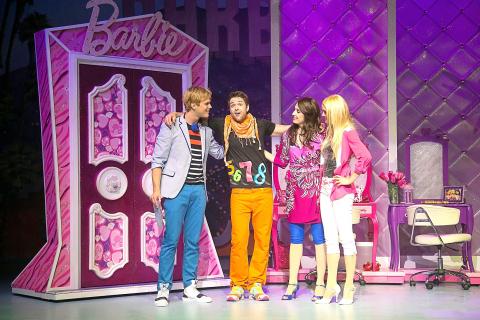
Photo courtesy of Kham
Speaking with Bernier and Dierkes last week, it was hard not to think that I had not already fallen into Barbie World, so committed to the show were the two stars.
Bernier, slim, blond and blue-eyed could easily have been Barbie even out of costume, and her enthusiasm for the positive message about “being strong, being yourself and embracing the power of friendship” was infectious.
The power of the Barbie brand has at various times received the ultimate marketing accolade of both generating controversy and being lampooned. Bernier said that performing around Asia since the Singapore premiere in September, the response to the show had been very positive. “We haven’t had any negativity, and I think that is because we do speak a positive message in the show, and that is really where the emphasis is.”
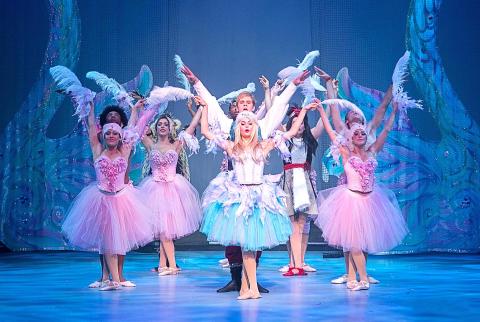
Photo courtesy of Kham
Dierkes added that producers had emphasized the personalities of the cast to make sure the show was not “just about our appearance, but our inner beauty as well.”
Those familiar with the Barbie animated movies will have a pretty good idea about the tone of the show, which is very different from that of child-oriented shows created by many Taiwan’s theater companies. Bernier said that while it was a show for children, it “wasn’t a children’s show,” and its overall staging puts it much closer to being a fully-fledged musical than purely children’s entertainment.
Stage manager and resident director Pip Loth said that Barbie Live! was to some extent drawing on the resurgence of musicals for teens and tweens that has been spearheaded by the success of shows such as Glee. This is a subgenre that takes its inspiration from pop culture, differentiating it from the more operatic tone of musicals by Andrew Lloyd Webber and others.
Among the musical numbers, there is a mix of material taken from the Barbie movies and original music by Robbie Roth, the composer for the Flashdance soundtrack, which incorporates a wide range of musical styles.
“The story takes place on a Hollywood soundstage where Barbie and her best friend Teresa are filming a brand-new movie musical and Teresa is not feeling so confident in her theatrical abilities so Barbie takes her through a journey through Swan Lake, Mariposa and the Fairy Princess and Princess and the Pop Star. These are some of the movies Barbie has starred in and it has female characters who go through a journey and learn about themselves. And through hearing about their stories, Barbie teaches Teresa to be brave and be confident and be herself,” Bernier said, summarizing the show.
Drifting from the main story into recognizable elements of the movies is one of the highlights of Barbie Live!.
“The stage design by Stanley Meyer (who has created stage designs for the likes of Alice Cooper and Cyndi Lauper) allows the story to flow from a Hollywood soundstage into these dream sequences (that play out elements from the DVDs),” Bernier said.
Dialogue for the stage show will be dubbed in Mandarin, but songs will be sung directly by the cast. There are sections when the cast interact with the audience, and Bernier said that with each new country she learns a small number of lines in the local language so that she can interact with the audience. So far her greatest challenge has been with Thai.
Barbie Live! will perform seven shows between Jan. 3 and Jan. 5 at the Taipei International Convention Center, followed by two shows (Jan. 8 and Jan. 9) at the Performance Hall of Hsinchu City’s Bureau of Cultural Affairs (新竹市文化局演藝廳) and six shows at the Kaohsiung Cultural Center (Jan. 11 and Jan. 12). Tickets are NT$500 to NT$2,000 and are available through at www.kham.com.tw or through 7-Eleven, Hi-Life and OK-Mart convenience store ticketing systems.

Google unveiled an artificial intelligence tool Wednesday that its scientists said would help unravel the mysteries of the human genome — and could one day lead to new treatments for diseases. The deep learning model AlphaGenome was hailed by outside researchers as a “breakthrough” that would let scientists study and even simulate the roots of difficult-to-treat genetic diseases. While the first complete map of the human genome in 2003 “gave us the book of life, reading it remained a challenge,” Pushmeet Kohli, vice president of research at Google DeepMind, told journalists. “We have the text,” he said, which is a sequence of

On a harsh winter afternoon last month, 2,000 protesters marched and chanted slogans such as “CCP out” and “Korea for Koreans” in Seoul’s popular Gangnam District. Participants — mostly students — wore caps printed with the Chinese characters for “exterminate communism” (滅共) and held banners reading “Heaven will destroy the Chinese Communist Party” (天滅中共). During the march, Park Jun-young, the leader of the protest organizer “Free University,” a conservative youth movement, who was on a hunger strike, collapsed after delivering a speech in sub-zero temperatures and was later hospitalized. Several protesters shaved their heads at the end of the demonstration. A

Every now and then, even hardcore hikers like to sleep in, leave the heavy gear at home and just enjoy a relaxed half-day stroll in the mountains: no cold, no steep uphills, no pressure to walk a certain distance in a day. In the winter, the mild climate and lower elevations of the forests in Taiwan’s far south offer a number of easy escapes like this. A prime example is the river above Mudan Reservoir (牡丹水庫): with shallow water, gentle current, abundant wildlife and a complete lack of tourists, this walk is accessible to nearly everyone but still feels quite remote.

In August of 1949 American journalist Darrell Berrigan toured occupied Formosa and on Aug. 13 published “Should We Grab Formosa?” in the Saturday Evening Post. Berrigan, cataloguing the numerous horrors of corruption and looting the occupying Republic of China (ROC) was inflicting on the locals, advocated outright annexation of Taiwan by the US. He contended the islanders would welcome that. Berrigan also observed that the islanders were planning another revolt, and wrote of their “island nationalism.” The US position on Taiwan was well known there, and islanders, he said, had told him of US official statements that Taiwan had not


 RSS
RSS