


When I first saw Jerome F. Keating’s The Mapping of Taiwan: Desire Economies, Coveted Geographies displayed at Bookman Books, a bookstore in Taipei’s Gongguan (公館) area located across the street from National Taiwan University, I was immediately attracted to its title and appealing layout. After I sat down and flipped through the large-sized work lavishly illustrated with maps dating back to the sixteenth century, it became immediately apparent that here was a volume that was going to fill a gaping hole on my bookshelf.
Keating is an old Taiwan hand. A prolific political commentator who has written a number of books about the country’s politics and history — all with a pro-Taiwan bent — he could have easily made The Mapping of Taiwan a screed against the myopic cultural and economic Sinification policies of the current administration, which views Taiwan as an indelible part of China. He doesn’t. Instead, we get a fairly balanced and vivid account of a country that is a conglomeration of the disparate peoples that have lived here.
His thesis is straightforward: As Taiwan became a “desired economy” in the great game of international trade, its “coveted geography” was mapped in ever increasing detail. Underlying this premise is the notion that Taiwan has for most of its history been mapped by those who have colonized it.
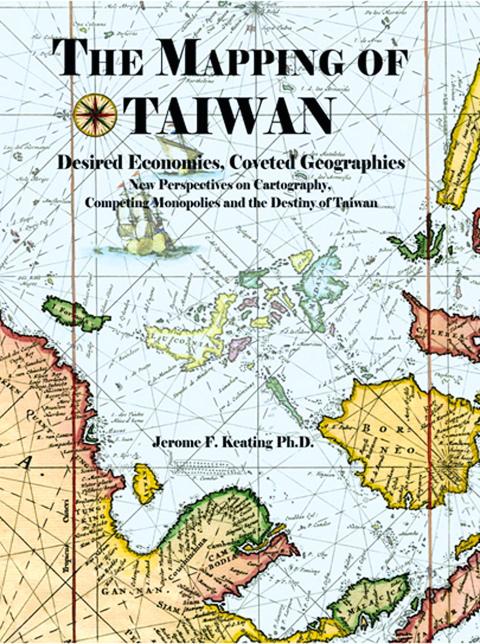
The story as told by Keating begins (and ends) with the nation’s important position as a hub for trade — even before Chinese and Europeans began cartographic depictions of the country. Drawing on recent research by scholars at Australian National University, he shows how Taiwan’s sea-faring indigenous tribes traded Fengtian jade, which can only be found here, as early as 7,000 years ago in a network that extended to the Philippines, Thailand, Malaysia and Vietnam.
“This is one of the many differences in the separate existence that Taiwan has had from life on the other side of the Straight. The history and early culture of Taiwan is a history that is connected more to the Pacific island world around it,” he writes. It’s a web of outward trade that would remain largely intact until foreign powers began populating the island and in the process marginalizing and decimating the autochthonous population.
The 15th century kicked off the great age of European exploration and discovery. Keating appropriately spends considerable space revisiting the era, providing detail to show how the growing European demand for silk and spices led Spain, Portugal and the Dutch, among others, to map Asia in ever increasing detail. Spain, for example, having established a base in Manila so as to bring silver from Mexico to trade for silk with China, sought a port in its trade lanes between the Philippines and Japan. As Keating puts it in his easygoing style, “Taiwan would fit that bill.”
As other countries became aware of the Taiwan’s strategic importance, a vague outline of it gradually emerged. A 1570 map by Abraham Ortelius shows “Fermosa” as a series of islets. A 1626 map by John Speed depicts the island as three separate sections. It’s only with a 1635 map by the Dutch mapmaking family of Willem Janszoon Blaeu, however, that the leaf-like contours of Taiwan emerge with any accuracy.
Keating’s several asides on religion, diplomacy and espionage make the chapters on European exploration especially interesting. Much like satellite technology today, he emphasizes that the possession of maps symbolized imperial power. They provided the location of buried treasure and secret passages, keys to navigation routes and dangers to avoid, the best ports to take shelter in during a storm and where to find currents to bring sailors home.
When powers clashed at sea, the victors would steal the maps of the defeated. On land, skullduggery was the order of the day. Spies sought out maps for their imperial masters at home. The Dutchman Jan Huygen van Linschoten, for example, stole several secret maps from the Portuguese, thus breaking their 100-year monopoly on the Spice Islands after he published them in a book.
But it was only in the 19th century, when Taiwan’s natural resources (tea, camphor, gold and coal) made it attractive in its own right that the nation’s internal features were mapped with any sophistication. Over the 50 years of Japanese rule, the first time a country took control of Taiwan in its entirety, the imperial power made maps of the country’s different ethnic groups — Aboriginal, Hakka and Hoklo — as well as mountains, rivers and roads.
Following Japan’s defeat in World War II, the Republic of China government, under the Chinese Nationalist Party (KMT), took control of the island. A map from the 1950s shows Taiwan as part of China — one of the few in the book that does so — and points to an ideological position that remains to this day.
But it’s the maps from the past decade that reveals the most momentous changes in Taiwan as an open, democratic and technologically advanced society. One satellite map shows population distribution throughout the island; another shows voting patterns for the 2008 Legislative Yuan elections. A third, and this is where the book comes full circle, is a map designating the ancestral lands of 10 of Taiwan’s indigenous tribes (today 14 are currently recognized by the government).
Interestingly, in a book that justifiably expends considerable space to show how foreign powers coveted and depicted Taiwan, and ends with a question mark about the nation’s future status, there are no contemporary maps of how China depicts it; nor are there any from the UN. A 2011 political map of the world (www.lib.utexas.edu/maps/world.html) from the library of the University of Texas at Austin color-codes Taiwan as part of China. It would have been illuminating to see how Taiwan is positioned within Asia’s current geo-political power struggles.
Yet perhaps this is beside the point because China’s claim to Taiwan is simply one that could be made by the many countries that have colonized it. For Keating, the crucial question is whether or not the people of Taiwan can incorporate “such diverse past narratives and write its own narrative.”
“Taiwan is at an important juncture,” he writes. “Taiwan’s future and its economy are for the first time in its history in the hands of its citizens; it can continue to create and control a clearly Taiwanese imagined community. It can map its own future.”
The Mapping of Taiwan is available at Bookman Books, 2F, 88, Xinsheng S Rd Sec 3, Taipei City (台北市新生南路三段88號2樓) and SMC Publishing Inc (南天書局), 14, Alley 14, Ln 283, Roosevelt Rd Sec 3, Taipei City (羅斯福路三段283巷14弄14號).
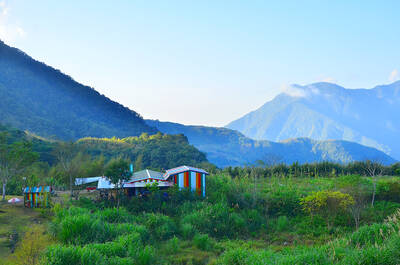
If one asks Taiwanese why house prices are so high or why the nation is so built up or why certain policies cannot be carried out, one common answer is that “Taiwan is too small.” This is actually true, though not in the way people think. The National Property Administration (NPA), responsible for tracking and managing the government’s real estate assets, maintains statistics on how much land the government owns. As of the end of last year, land for official use constituted 293,655 hectares, for public use 1,732,513 hectares, for non-public use 216,972 hectares and for state enterprises 34 hectares, yielding
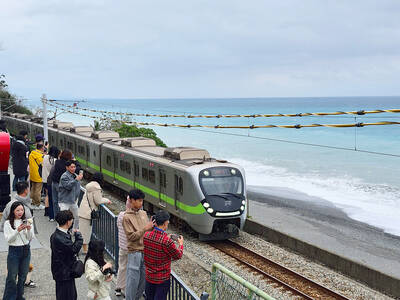
The small platform at Duoliang Train Station in Taitung County’s Taimali Township (太麻里) served villagers from 1992 to 2006, but was eventually shut down due to lack of use. Just 10 years later, the abandoned train station had become widely known as the most beautiful station in Taiwan, and visitors were so frequent that the village had to start restricting traffic. Nowadays, Duoliang Village (多良) is known as a bit of a tourist trap, with a mandatory, albeit modest, admission fee of NT$10 giving access to a crowded lane of vendors with a mediocre view of the ocean and the trains
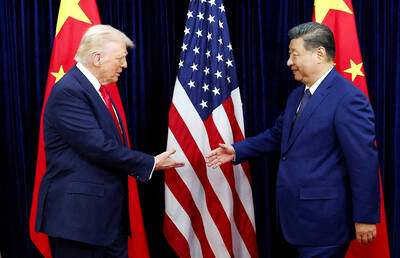
The March/April volume of Foreign Affairs, long a purveyor of pro-China pablum, offered up another irksome Beijing-speak on the issues and solutions for the problems vexing the People’s Republic of China (PRC) and the US: “America and China at the Edge of Ruin: A Last Chance to Step Back From the Brink” rang the provocative title, by David M. Lampton and Wang Jisi (王緝思). If one ever wants to describe what went wrong with US-PRC relations, the career of Wang Jisi is a good place to start. Wang has extensive experience in the US and the West. He was a visiting

One of the challenges with the sheer availability of food in today’s world is that lots of us end up spending many of our waking hours eating. Whether it’s full meals, snacks or desserts, scientists have found that it’s not uncommon for us to be mindlessly grazing at some point during all of our 16 or so waking hours. The problem? As soon as this food hits the bloodstream in the form of glucose, it initiates the release of the hormone insulin. This in turn activates a switch present in every one of our cells, which is responsible for driving cell


 RSS
RSS