


Daisy Liu epitomizes China’s obsession with luxury brands: her shoes are Guiseppe Zanotti, her brooch Chanel, a floral Hermes scarf is stylishly knotted over one shoulder. She won’t, however, tote a monogrammed Louis Vuitton handbag ever again.
Wealthy shoppers like Liu are increasingly turning up their noses at labels they believe have been tainted by the common touch, seeking out understated, and exclusive, merchandise from the likes of Chanel or Hermes instead. That is becoming a big challenge for designers hoping to cash in on the world’s fastest growing luxury market.
“I have two Louis Vuitton handbags but I no longer carry them although they are still in fashion,” said Liu, a 31-year-old employee at a multinational cosmetics firm. “I don’t think the brand fits me any more.”
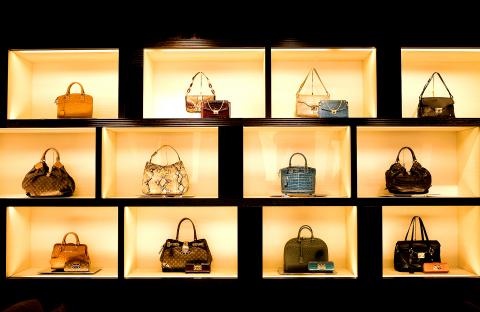
Photo: Bloomberg
More than a decade of strong economic growth has helped swell the disposable incomes of millions of Chinese, creating legions of men and women with a voracious appetite for status symbols regardless of the cost.
China’s importance for firms such as Louis Vuitton’s parent LVMH and Gucci’s PPR SA is indisputable: last year, as Europe was mired in financial crisis and the US economy faltered, Chinese shoppers spent an estimated US$18 billion on luxury goods, according to consultants Bain & Co.
China is the world’s third biggest market for personal luxury goods, worth at least US$25 billion. In the next three years, it is expected to leapfrog over Japan and the US to take the top spot, with the luxury segment expanding to US$28 billion.
As it grows, the market is also maturing, moving from so-called aspirational luxury, where bling is king, to what experts call absolute luxury: the desire to be seen as both wealthy and discerning.
“In the past, it was just a checklist. If you were one of the top five brands out of some magazine, you found that people in China just checked the checklist and bought according to the list,” said Vincent Liu, partner at Boston Consulting Group. “Going forward, people will be more selective. They know what and where and when to use what brands and products.”
For sophisticated consumers like Liu, that means purchases such as a US$2,000 Chanel mini bag and a Prada clutch. She’s also eyeing a coral lambskin bag from Bottega Veneta, the Italian fashion house renowned for its signature woven leather goods.
“The truly wealthy, the real millionaires, they will not want to buy LV Louis Vuitton or Gucci because they are too commonplace,” said Shaun Rein, managing director, China Market Research Group. “Rich people are getting richer and they want exclusiveness and more self-indulgence.”
OVER EXPOSED
China’s luxury market is poised to grow 18 to 20 percent this year, steeply outperforming the single-digit forecasts for Europe, the Americas and Japan, according to Bain, explaining the rapid expansion of larger luxury firms such as LVMH.
For years, LV’s Monogram “Speedy” tote, a dome-shaped classic favored by Audrey Hepburn, was one of the most desirable bags for Chinese women because it was a clear signal of having made it: the handbag costs double the US$400 an average Chinese worker earns a month.
The brand is LVMH’s cash cow and revenues are almost double those of Gucci, widely considered its closest competitor.
But as LVMH grew in China — there are currently about 38 Louis Vuitton stores there, including in remote areas such as the southern Guangxi autonomous region, compared to the 57 or so in Japan — it lost some of its cachet.
“In China, Louis Vuitton is seen as the brand that even your aiyi, or domestic helper, can afford,” said a retail consultant who declined to be named in order to be candid.
When asked to comment, LVMH told said it expected to “gain a brand new lead on the market” via a new store set to open next month in Shanghai’s swanky Plaza 66 mall. “The Plaza 66 will confirm Vuitton as the trendsetting brand in China,” the statement said.
Gucci did not immediately respond to requests for comment.
LV remains one of China’s most popular labels — a recent survey by strategists Digital Luxury Group put it at the top of web searches by consumers.
But brands such as Chanel and Hermes are catching up fast.
A recent study by consultants Bain shows twice as many Chinese now covet Hermes, creators of the iconic Birkin and Kelly handbags, and the brand is the third most likely to be purchased after Gucci and Louis Vuitton.
“Some prefer Hermes because our products are more subtle and not over exposed,” the brand’s China president, Leo Liu, said.
To attract shoppers, LVMH and other larger luxury brands are trying to strike the difficult balance between exclusivity and popularity to remain profitable.
LVMH is offering customers increasingly expensive and bespoke services to try to retain a mystique around the Louis Vuitton brand, whose creations are seen as being both too common and easily copied.
The company is also careful about rolling out new stores, aware that the brand would suffer from too much visibility.
Whether these strategies will convince savvy Chinese shoppers to carry their LV bags is unclear.

Yesterday, the Democratic Progressive Party (DPP) nominated legislator Puma Shen (沈伯洋) as their Taipei mayoral candidate, the Chinese Nationalist Party (KMT) put their stamp of approval on Wei Ping-cheng (魏平政) as their candidate for Changhua County commissioner and former legislator Tsai Pi-ru (蔡壁如) of the Taiwan People’s Party (TPP) has begun the process to also run in Changhua, though she has not yet been formally nominated. All three news items are bizarre. The DPP has struggled with settling on a Taipei nominee. The only candidate who declared interest was Enoch Wu (吳怡農), but the party seemed determined to nominate anyone
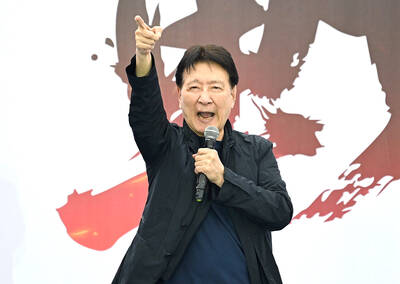
In a sudden move last week, opposition lawmakers of the Chinese Nationalist Party (KMT) and Taiwan People’s Party (TPP) passed a NT$780 billion special defense budget as a preemptive measure to stop either Chinese leader Xi Jinping (習近平) or US President Donald Trump from blocking US arms sales to Taiwan at their summit in Beijing, said KMT heavyweight Jaw Shaw-kong (趙少康), speaking to the Taipei Foreign Correspondents Club on Wednesday night in Taipei. The 76-year-old Jaw, a political talk show host who ran as the KMT’s vice presidential candidate in 2024, says that he personally brokered the deal to resolve
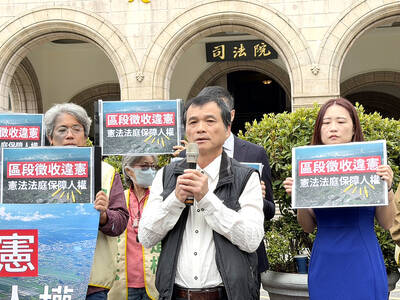
What government project has expropriated the most land in Taiwan? According to local media reports, it is the Taoyuan Aerotropolis, eating 2,500 hectares of land in its first phase, with more to come. Forty thousand people are expected to be displaced by the project. Naturally that enormous land grab is generating powerful pushback. Last week Chen Chien-ho (陳健和), a local resident of Jhuwei Borough (竹圍) in Taoyuan City’s Dayuan District (大園) filed a petition for constitutional review of the project after losing his case at the Taipei Administrative Court. The Administrative Court found in favor of nine other local landowners, but

The Chinese Nationalist Party (KMT) and its sock puppet, the Taiwan People’s Party (TPP), passed their version of the government’s proposed supplementary defense spending bill last week, engendering much commentary. While all eyes were on the defense budget, the PRC’s assault on Taiwan was advancing on other fronts. The removal of domestic drone production and other technologies critical to the nation’s asymmetrical defenses from the list of items purchased in the “compromise” bill shows how the KMT-TPP alliance appears to be serving the People’s Republic of China (PRC). Ironically, the cuts will impact industries heavily represented by tech firms in areas run


 RSS
RSS