


French hip-hop choreographer Mourad Merzouki said on Wednesday that he was nervous about how Taipei audiences would react to his newest work, YogeeTi.
He needn’t have worried, at least judging by the audience members at Sunday’s matinee at the National Theater in Taipei. He had them with the opening movement, when the 10 dancers, clad in gray or black long-sleeved unitards, moved in floorwork that was as pointed and sharp as knitting needles. The performers lined up horizontally with their legs moving in unison over and under, or scuttled back and forth like shuttles in a weaving machine.
That was the whole idea, of course, since YogeeTi was a collaboration with Taiwanese fashion designer Johan Ku (古又文) who has made his name with spectacularly clunky, yet often delicate, knits.
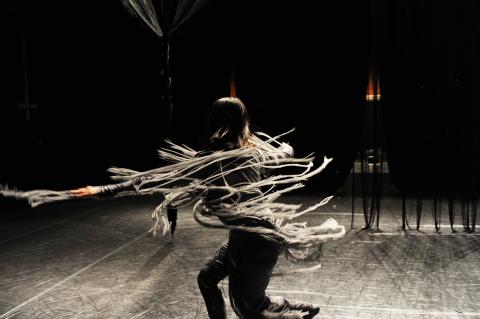
Photo Courtesy of National Theater Concert Hall
YogeeTi moved seamlessly back and forth between duets and group work, a male/female pairing or male/male, sometimes playful, sometimes challenging. The pops, hops and articulation of hip-hop were fused with modern dance, neither overpowering the other. Merzouki has taken the energy from the streets and polished it until it gleams appropriately for the stage.
The dancers not only wore knits, they interacted and created them, from braiding plaits in string curtains to sliding around on the floor on knit cushions.
Kudos must go to Benjamin Lebreton for a set design utilizing Ku’s giant knotted creations and curtains of string and to Yoann Tivoli for a great lighting design.
It is a testament to National Taipei University of the Arts that the five Taiwanese dancers in the piece — Chen Hong-ling (陳宏菱), Hsieh Yi-chun (謝宜君), Wu Chien-wei (吳建緯), Kan Han-hsin (甘翰馨) and Kao Hsin-yu (高辛毓) — all graduates of its dance school, fitted so seamlessly in with the five French hip-hop artists. It was especially nice to see Wu again; he’s a lovely dancer who obviously had put on some muscle to keep up with his French counterparts.
YogeeTi will be performed in Greater Kaohiung’s Cultural Center’s Chihteh Hall on Saturday at 7:30pm.
A quieter, but no less frenetic program, also part of the Taiwan International Festival of the Arts, was put on by Laurie Anderson at Taipei’s National Concert Hall on Saturday night. Anderson may have mellowed a bit over the years, but she remains a fascinating and challenging performer.
The flood of words, images and sounds that washed over the Concert Hall in her Delusion sometimes came so fast that it was hard for the mind to process everything, even for a native English speaker. Luckily, there were Chinese subtitles for her text.
While playing the violin and a synthesizer, Anderson told tales and asked questions — about the death of her mother, the last thing you say before you turn into dirt, who owns the moon, plus a disturbing dream about her rat terrier Lolabelle. Sometimes she used her own voice, sometimes she lowered it electronically to a male alter ego, and other times she just let the music speak.
The programers for the annual Taiwan International Festival of the Arts deserve a big round of applause too for bringing such terrific shows to Taiwan.
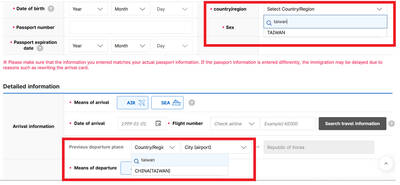
Jason Han says that the e-arrival card spat between South Korea and Taiwan shows that Seoul is signaling adherence to its “one-China” policy, while Taiwan’s response reflects a reciprocal approach. “Attempts to alter the diplomatic status quo often lead to tit-for-tat responses,” the analyst on international affairs tells the Taipei Times, adding that Taiwan may become more cautious in its dealings with South Korea going forward. Taipei has called on Seoul to correct its electronic entry system, which currently lists Taiwan as “China (Taiwan),” warning that reciprocal measures may follow if the wording is not changed before March 31. As of yesterday,
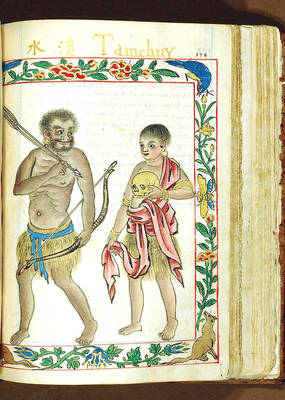
The Portuguese never established a presence on Taiwan, but they must have traded with the indigenous people because later traders reported that the locals referred to parts of deer using Portuguese words. What goods might the Portuguese have offered their indigenous trade partners? Among them must have been slaves, for the Portuguese dealt slaves across Asia. Though we often speak of “Portuguese” ships, imagining them as picturesque vessels manned by pointy-bearded Iberians, in Asia Portuguese shipping between local destinations was crewed by Asian seamen, with a handful of white or Eurasian officers. “Even the great carracks of 1,000-2,000 tons which plied
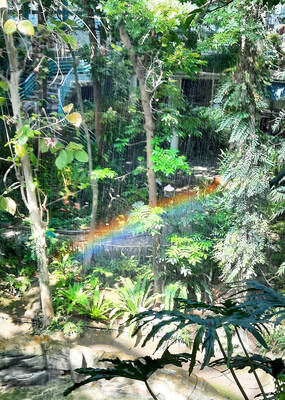
It’s only half the size of its more famous counterpart in Taipei, but the Botanical Garden of the National Museum of Nature Science (NMNS, 國立自然科學博物館植物園) is surely one of urban Taiwan’s most inviting green spaces. Covering 4.5 hectares immediately northeast of the government-run museum in Taichung’s North District (北區), the garden features more than 700 plant species, many of which are labeled in Chinese but not in English. Since its establishment in 1999, the site’s managers have done their best to replicate a number of native ecosystems, dividing the site into eight areas. The name of the Coral Atoll Zone might
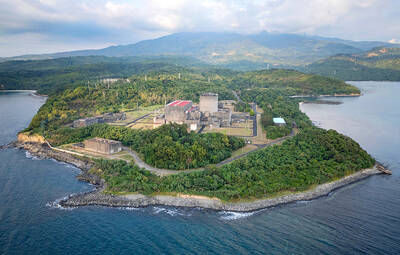
Nuclear power is getting a second look in Southeast Asia as countries prepare to meet surging energy demand as they vie for artificial intelligence-focused data centers. Several Southeast Asian nations are reviving mothballed nuclear plans and setting ambitious targets and nearly half of the region could, if they pursue those goals, have nuclear energy in the 2030s. Even countries without current plans have signaled their interest. Southeast Asia has never produced a single watt of nuclear energy, despite long-held atomic ambitions. But that may soon change as pressure mounts to reduce emissions that contribute to climate change, while meeting growing power needs. The


 RSS
RSS