


Wimbledon’s over and the FIFA qualifiers are slogging along, so why not concentrate on something that really matters? The Taiwan preliminaries for Braun Battle of the Year (BOTY), an annual international competition for break dancing crews, take place in Taipei this weekend.
BOTY was founded in 1990 by Thomas Hergenrother of the Hannover, Germany-based crew Burning Moves. The relatively small contest with around 500 spectators has grown into a widely anticipated event with preliminary competitions worldwide. (The first competition in Taiwan was in 2006.) This year’s BOTY World Final will take place in Montepelier, France, at a venue that seats more than 10,000.
“It’s like the Olympics … The world’s best [break] dancers are gathered together and you see the newest, craziest things,” says Win Chou (周允斌), who manages The Best Crew (TBC) Dance Studio (TBC舞蹈休閒館), the official organizer and host for BOTY Taiwan.
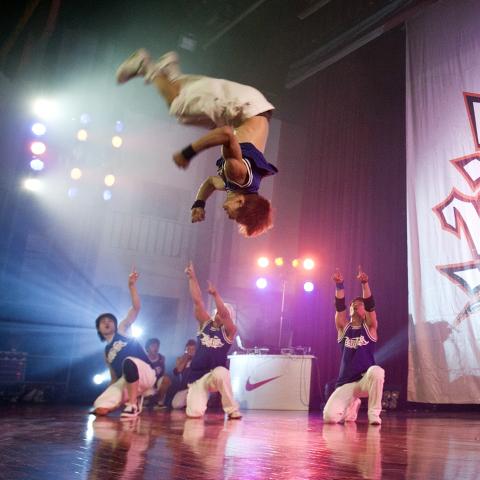
Photo courtesy of BOTY Taiwan
A warm-up match (熱身賽) tomorrow at the new TBC studio in Taipei will feature popping, locking and breaking battles. The BOTY Taiwan main event (主賽事) will be held on Sunday in the Sun Yat-sen Auditorium (逸仙堂) at the Taipei Campus of Ming Chuan University (銘傳大學台北校區). Sunday’s events include a crew “show round,” in which break-dancing groups of at least eight members perform choreographed pieces.
The judges for the main event, American B-boys Ken Swift and Abstrak and Japanese B-boy Katsu, will select four crews for the semifinals. These crews will compete through battles — exchanges of improvised moves — and the winner will represent Taiwan at BOTY Asia against crews from Japan, South Korea, the Philippines, Malaysia and China, among others. The top three crews from BOTY Asia will advance to the BOTY World Final.
Unlike the final, which only has B-boy crew battles, BOTY Taiwan has solo battles for lockers, poppers, and B-boy soloists. The winners in these categories will not go to BOTY Asia, which is a competition for break-dancing crews only.
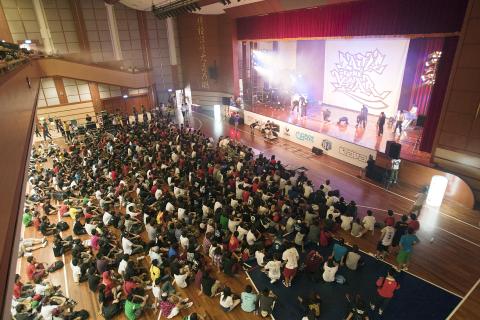
Photo courtesy of BOTY
“Taiwan’s dancing population is pretty large and it needed a landmark competition, so we included ... a warm-up match with locking, popping and B-boy one-on-one,” Chou says.
Through this additional event, TBC hopes to expose more Taiwanese street dancers to the scale of an international competition.
To simulate the atmosphere of an international competition, TBC is meticulous when it comes to selecting judges. “We choose international judges who are more original, more helpful to Taiwan,” says Chou, who is one of the Taiwanese judges for locking. “If we pick a judge who ... carelessly chooses a winner, when these champions go overseas to Germany or France, they’ll be eliminated immediately.”
Taiwan’s B-boys haven’t been letting their country down. In 2004, before Taiwan had its own preliminary, TBC won the Southeast Asia BOTY regional competition, earning it a ticket to the World Final in Germany. In 2008, Formosa Crew battled its way to the world semifinals and finished with a bronze. “In Asia, the pioneers in street dance culture are Japan and [South] Korea,” says Chou. “They’ve been connected with the European and American dance communities for a long time now. It’s like a miniature United Nations ... Taiwan didn’t become included until around 2004 to 2006, so to these countries we’re pretty new.”
Taiwanese crews are now aiming for second place in BOTY Asia, he says, with presumably Japan or South Korea in first.
The two days of competition in Taipei are open to the public. “We would love to have people who don’t necessarily know dance to come watch,” Chou says. “But it takes a lot of advertising to get the word out there and as of now, we have mostly small sponsors. Also, we’re waiting for the average standard of Taiwanese dancers to get to a certain level to make it even more interesting for viewers.”
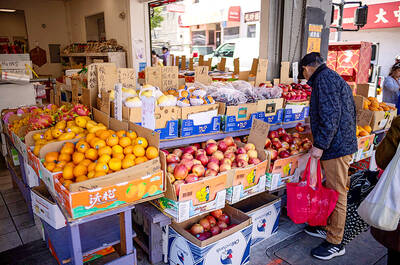
Ajay Verma, a consultant gastroenterologist at Kettering general hospital in Northamptonshire, says our gut is a “complex machine.” “It is constantly providing us with the nutrition we need, initially to grow and develop, and then for us to survive, thrive and repair from injury and illness.” How can we keep it functioning well? Put simply: “Make sure what you put into it is balanced, and that you clear out its waste products adequately,” Verma says. “In a general gastroenterology clinic, the most common conditions we see are irritable bowel syndrome (IBS), gastroesophageal reflux disease, inflammatory bowel disease and constipation,” says Nisha
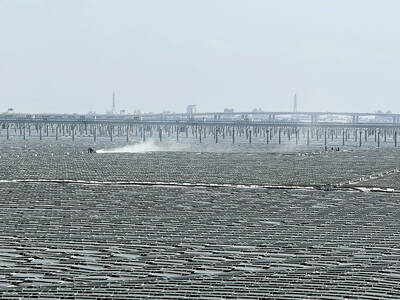
The arithmetic is straightforward and uncomfortable. By the end of 2025, Taiwan had committed itself to a 50-30-20 electricity mix — half natural gas, 30 per cent coal, 20 per cent renewables. The Ministry of Economic Affairs’s (MOEA) own monthly energy reports tell a different story. Natural gas reached 47.8 per cent of generation last year. Coal stood at 35.4 per cent, comfortably above its target ceiling. Renewables came in at 13.1 per cent, well short of the 20 per cent Taipei had pledged a decade earlier. Installed renewable capacity reached roughly half of the 12 gigawatts (GW) the government
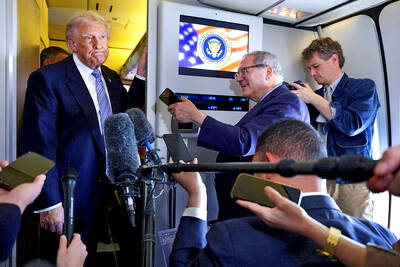
Last week US President Donald Trump was asked by a reporter whether he would speak on the phone to the President of Taiwan. “l’ll speak to him. I speak to everybody. We have that situation very well in hand,” Trump said. This marked the second time in a couple of weeks he had said he would talk to the President of Taiwan. In 2016 he famously took a call from then-president Tsai Ing-wen (蔡英文), when he was president-elect. Despite warnings that the apocalypse was nigh because of a phone call, the world quickly forgot about the conversation between two democratically-elected presidents.
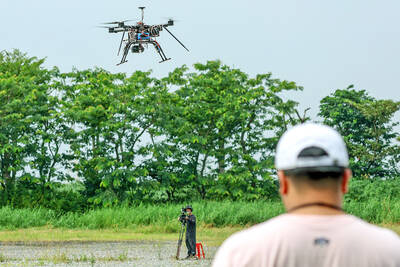
Taiwan’s drone exports are taking off, fuelled by the war in Ukraine, as Taiwanese companies seek a stake in the fast-growing global market for unmanned aerial vehicles (UAV). Low-cost drones used for reconnaissance and strikes are in high demand as governments around the world boost defense spending in the face of intensifying conflicts. A relative new player in the increasingly competitive industry, Taiwan’s pitch is to be an “Asian hub” for the production of UAVs and components free of Chinese materials, or “non-red.” That means its UAVs can be up to three times more expensive than their Chinese competitors, like the world’s biggest


 RSS
RSS