


Last month, the US media group PBS ran a strange story on its Web site. “Prominent rapper Tupac has been found alive and well in a small resort in New Zealand,” it reported. “The small town — unnamed due to security risks — allegedly housed Tupac and Biggie Smalls [another rapper] for several years.”
For two reasons, this was a surprising piece of journalism. First, Tupac died in 1996. Second, the piece wasn’t written by PBS. It had been planted on their site by a group called Lulz Security, a loose collective of anonymous hackers who wanted revenge for a recent PBS program that criticized WikiLeaks. “Greetings, Internets,” Lulz wrote on their own Web site, by way of explanation. “We just finished watching WikiSecrets and were less than impressed. We decided to sail our Lulz Boat over to the PBS servers for further ... perusing.” Above the message read the tagline: “Set sail for fail!”
It was an extraordinary episode, but by no means isolated. In March, hackers stole a database of e-mail addresses from the marketing group Epsilon, in what one commentator called the largest e-mail address heist in history. Then computer security firm RSA had their servers breached, an attack that may have led to the hacking of defense giant Lockheed Martin, an RSA client. In April, person unknown cracked Sony’s PlayStation network, and stole 77 million users’ data. And in the past month, the IMF, CitiBank, the Spanish police, Google, the Turkish and Malaysian governments, the US Senate, and, just two nights ago, the CIA have all been hacked in one form or other.
GRAPHIC: TT
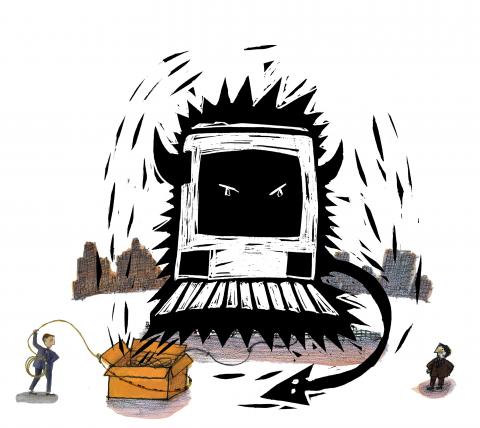
It is tempting to consider this a kind of hackers’ high noon. But, says Richard Clayton, a prominent computer scientist at Cambridge University, conflating these different attacks is a “bit like treating knife crime as the same as burglary.” In simple terms, there are three kinds of attack taking place. Hacktivism is the most prominent: Raids by amateur groups such as Lulz (who took down sites belonging to the CIA, the Senate, and the Spanish police) or Anonymous (PayPal, PlayStation, MasterCard, and Visa), either for fun, “for the lulz” — or, increasingly, as an act of political protest. Then there’s the criminal kind — professionals hunting for credit card details, or e-mail address directories, with the aim of selling them on for profit. While the PlayStation systems were first hacked by hactivists, a second breach was made by cyber criminals who had more commercial ends. And finally, there’s state-sponsored espionage, or even cyber-warfare. “Google, RSA, Lockheed Martin, IMF — the strong suspicion is that all those were state-sponsored, or state-approved,” says Dave Clemente, a cyber security expert at Chatham House, the international affairs think tank. “Whether it’s Chinese, or Russian, or eastern European, a lot of these hacks seem to have been given a wink and a nod of tacit approval from states.”
Are all three categories really on the rise? Well, possibly. “It’s difficult to substantiate whether there’s more going on or not,” says Rik Ferguson, director of security research at computer protection firm, TrendMicro. “What’s certainly true to say is that more attacks are being publicly disclosed. Victims are more willing to come forward and say ‘something bad happened to us.’” Disclosure laws obliging companies to come clean about data breaches have been in place in many parts of the US for several years. But the real turning point, says Ferguson, came only a year ago, when Google went public with the news that it had been hacked by Chinese sources. “That got the ball rolling,” Clemente says. “It suddenly seemed more permissible to report a hack. Getting hacked doesn’t seem to have the stigma that it did several years ago, and there’s not a feeling now that you’re on your own if you get hit.”
But even if increased openness is in part to thank for the apparent hike in hacking, there has still been an exponential rise in the number of cyber threats. In 2008, security giant Symantec counted 120 million malware variants; last year, that figure had risen to 286 million. Symantec security strategist Sian John has also noted a large increase in what are known as “targeted attacks.” A decade ago, a hacker would usually have intended a single virus to reach millions of people. Today, the average number of computers infected by an individual malware is just 15, and that is because hackers are using a new tackle called spear-fishing, which enables them to be more specific about who they target. “In the past, if you got a phish attack, it would be from a Nigerian offering you lots of money,” John says. “Now it’ll be from someone saying: ‘Oh, we saw you at that conference last week. Here’s some minutes of that conference.’” And contained within those minutes will be a virus.
This kind of targeted attack has become so dangerous because of the amount of information we divulge on the Internet. “One of the first places a hacker will visit is LinkedIn,” Ferguson says. “What do we do on there? We make our entire CV available for the world to see. You can see everywhere I’ve worked in the past. You can see all my connections, see everyone I’ve worked with, everyone I know. So a hacker can assume one of those people’s identities and reference things that have happened in my professional life. And I’m far more likely to open an attachment from your e-mail, because it’s far more credible.” Unsurprisingly, then, Ferguson’s job involves not just infiltrating black-hat hacking communities online, but training office workers to be more aware of social engineering ruses such as these. (Security experts have also been known to test a company’s defenses by leaving infected USB sticks lying around and seeing whether anyone picks them up out of curiosity. In 2008, US military computers were breached in this way, according to rumor, after hackers scattered USBs across a car park at a US base in the Middle East.)
Targeted attacks are also popular because they enable cyber-criminals to go after individuals with access to large banks of information. “Criminals,” says Ferguson, “have realized they can get more bang for their buck if they can penetrate a large aggregation of data in one single successful attack, rather than trying to compromise multiple individual PCs.” Hence the hacking of Epsilon, which at a single stroke may have given hackers access to millions of e-mail addresses.
The most audacious example of a targeted attack is thought to be an act of espionage rather than criminal activity. Last year’s Stuxnet worm supposedly worked its way through the Iranian military computer system with a single goal: to damage the centrifuges that controlled the country’s uranium enrichment program. But while, according to John, “Stuxnet is the most sophisticated piece of malware we’ve ever seen,” most hacking techniques have not necessarily changed much in recent years.
“They sound rather complicated,” says David Whitelegg, who blogs at ITSecurityExpert.co.uk, “but really they are often no more sophisticated than they’ve ever been.” The malware that led to the hacking of security giant RSA may have been a “zero-day attack” — ie, it had never been seen before — but the method of infection was nothing new. “At the end of the day, a user within that company opened an e-mail. It went into his spam box, he opened it, and that launched the attack. And that’s the way it’s always been.”
Direct denial of service attacks (DDoS) — the method employed by Anonymous to take out PayPal, Mastercard and Visa by overloading them with hits — are also nothing new. “DDoS has been around for years,” Whitelegg says. “There’s nothing you can do about it.”
But even if their methods are old, the arrival of groups such as Anonymous and its offshoot Lulz Sec does mark a changing of the guard. “Hactivism is definitely on the rise,” Ferguson says. “Anonymous were previously quite a cliquey underground community. But as the WikiLeaks thing unfolded, and they gave their support to Julian Assange, and they began to attack organizations they felt were treating WikiLeaks unfairly, they have garnered a lot of coverage. They’ve associated themselves very cleverly to V for Vendetta, a popular film with a popular image and well-known taglines such as ‘We are Legion.’” New members have also realized how simple it is to join the group. “If they want to participate, it’s very easy for them to download a tool that hands over your computer to Anonymous” — and which then allows them to take part in DDoS attacks.
Yet if their rise is partly down to greater exposure and clever associations, it is also undeniably linked to a growing political consciousness throughout the cyberspace community. The anarchist collective Deterritorial Support Group recently posted an essay entitled “Twenty Reasons Why it’s Kicking Off in Cyberspace,” which aimed to explain the recent rise of Anonymous and Lulz. “Make no mistake,” they wrote, “this is not a minor struggle between state nerds and rogue geeks — this is the battlefield of the 21st century, with the terms and conditions of war being configured before our very eyes ... At the heart of it is a newly politicised generation of hackers who have moved from a lulz-based psychic-economy to an engaged, socially aware and politically active attitude towards world events, primarily as a reaction to the way governments and multinationals dealt with the fallout of WikiLeaks.”
Such political development engagement raises new moral questions. A Lulz attack on, say, the CIA, is primarily an act of protest — a Web-based sit-in, if you like. “And if the police are wary of arresting people for taking part in a real-life sit-in,” Ferguson asks, “then why are they so willing to arrest people for the digital equivalent?” In other circles, however, such actions are considered less protest, and more acts of war. “Cyberspace,” read a Chatham House cyber security report from last year, “should be viewed as the ‘fifth battlespace,’ alongside the more traditional arenas of land, air, sea and space.” Significantly, the report also noted that “in cyberspace the boundaries are blurred between the military and the civilian, and between the physical and the virtual; and power can be exerted by states or non-state actors, or by proxy.”
It is tempting to think of this kind of debate as irrelevant to our everyday lives. Symantec says mobile phone technologies will be hacking’s next target, and perhaps it is physical problems such as this that we should be more concerned about. But as we increasingly live more of our lives online, and as that boundary “between the physical and the virtual” is increasingly blurred, perhaps it is the conceptual questions posed by hacking that will ultimately prove more significant.
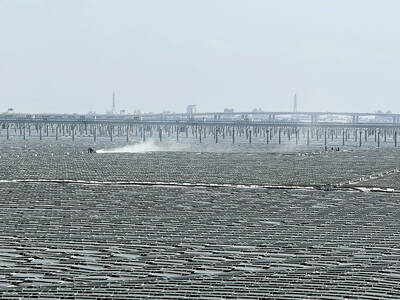
The arithmetic is straightforward and uncomfortable. By the end of 2025, Taiwan had committed itself to a 50-30-20 electricity mix — half natural gas, 30 per cent coal, 20 per cent renewables. The Ministry of Economic Affairs’s (MOEA) own monthly energy reports tell a different story. Natural gas reached 47.8 per cent of generation last year. Coal stood at 35.4 per cent, comfortably above its target ceiling. Renewables came in at 13.1 per cent, well short of the 20 per cent Taipei had pledged a decade earlier. Installed renewable capacity reached roughly half of the 12 gigawatts (GW) the government

There are shadowy cabals plotting to sell out Taiwan to be annexed by China, by invasion if necessary. Fortunately, they are buffoons. In 2019, former Bamboo Union gangster and founder of the China Unification Promotion Party (CUPP), Chang An-le (張安樂, colorfully known as “White Wolf”), led a protest at the Legislative Yuan against comments made by then-premier Su Tseng-chang (蘇貞昌) that in the event of an attack by China, he would never surrender, but would protect the nation by fighting to the end, even if he only had a broom. Chang had party members bring a wooden casket that they
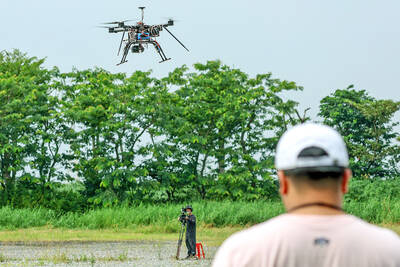
Taiwan’s drone exports are taking off, fuelled by the war in Ukraine, as Taiwanese companies seek a stake in the fast-growing global market for unmanned aerial vehicles (UAV). Low-cost drones used for reconnaissance and strikes are in high demand as governments around the world boost defense spending in the face of intensifying conflicts. A relative new player in the increasingly competitive industry, Taiwan’s pitch is to be an “Asian hub” for the production of UAVs and components free of Chinese materials, or “non-red.” That means its UAVs can be up to three times more expensive than their Chinese competitors, like the world’s biggest

It seems every few days one bumps into one of those “real man” comments in which Taiwan is urged to “face reality” or similar, and “make a deal,” with the speaker implying that soon it will be too late. “Deal” advocates always present themselves as having a superior grip on reality, and the manly ability to make the “hard choice.” Their testosterone-laden language often echoes that of Taiwan sellout advocates. Note that such commentary always specifies a process (“make a deal, work with, make progress”), never the end state of what occupation by a violent authoritarian colonialist state will entail. In


 RSS
RSS