


T he Wedding Banquet (喜宴) meets Lan Yu (藍宇) in Creative Society Theatre Company’s (創作社劇團) He Is My Wife, He Is My Mother (少年金釵男孟母), a comedic costume drama that explores sexuality against the backdrop of the Republic of China’s early years and the 1940s.
The gay-themed play about lust, romance, family and friendship spanning two generations premiered in May last year and was proclaimed by the United Daily News as one of 2009’s top theatrical productions.
He Is My Wife, He Is My Mother was adapted from the sixth chapter of Qing Dynasty writer Li Yu’s (李漁) novel Silent Operas (無聲戲). The book was banned because of its risque subject matter, only to resurface during the second half of the 20th century.
Director and playwright Katherine Hui-ling Chou (周慧玲) discovered Silent Operas in a library at Columbia University while she was pursuing a PhD in drama at New York University.
“I was intrigued by how this writer obviously revels in his explicit description of homosexual love and sex but details them in a sardonic tone,” said Chou during rehearsal on Wednesday. “He portrays homosexual love in the first half of the story and decides to finish it with a virtuous mother raising a son in the second half.”
Though the novel is set in the early Qing Dynasty, Chou has adapted the story to a modern setting.
Her play tells the tale of a love triangle between three homosexual men.
Xu Jifang (�?�) (played by Hsu Hua-chien, 徐華謙), a widowed father, falls in love with the youthful You Ruilang (尤瑞郎) (played by actress Hsu Yen-ling, 徐堰鈴). The two become lovers and move in together.
Chen Dalong (陳大龍) (played by Lee Yi-hsiu, 李易修), Xu’s former lover, is so angered by his ex’s betrayal that he orchestrates You’s arrest, which, without giving too much away, leads to Xu’s death.
The bereaved You moves to a distant city with his late lover’s young son, where he impersonates the boy’s mother in order to raise him.
“This story is about communication both ways,” said Chou. “We usually think about children coming out of the closet to their parents, but parents sometimes need to come out to their children.”
During rehearsal on Wednesday, Xu and You’s first night of torrid sex was handled tastefully by the two actors with symbolic body gestures while Lee played nanguan (南管) music in the foreground.
The play neither sells itself as overblown comedic relief nor insults audiences’ intelligence with jazzed up sex scenes.
“There have been too many gay plays that try to peddle political agendas or rely on steamy sex scenes,” said Chou. “I just want to touch people’s hearts.”


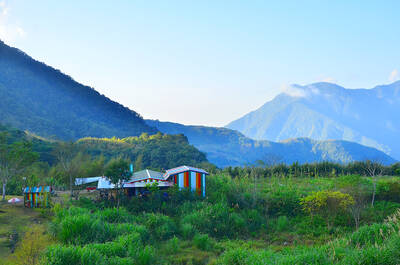
If one asks Taiwanese why house prices are so high or why the nation is so built up or why certain policies cannot be carried out, one common answer is that “Taiwan is too small.” This is actually true, though not in the way people think. The National Property Administration (NPA), responsible for tracking and managing the government’s real estate assets, maintains statistics on how much land the government owns. As of the end of last year, land for official use constituted 293,655 hectares, for public use 1,732,513 hectares, for non-public use 216,972 hectares and for state enterprises 34 hectares, yielding
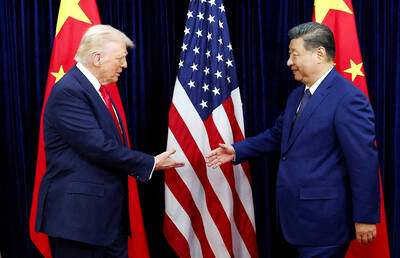
The March/April volume of Foreign Affairs, long a purveyor of pro-China pablum, offered up another irksome Beijing-speak on the issues and solutions for the problems vexing the People’s Republic of China (PRC) and the US: “America and China at the Edge of Ruin: A Last Chance to Step Back From the Brink” rang the provocative title, by David M. Lampton and Wang Jisi (王緝思). If one ever wants to describe what went wrong with US-PRC relations, the career of Wang Jisi is a good place to start. Wang has extensive experience in the US and the West. He was a visiting
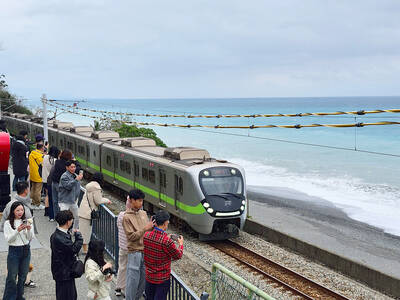
The small platform at Duoliang Train Station in Taitung County’s Taimali Township (太麻里) served villagers from 1992 to 2006, but was eventually shut down due to lack of use. Just 10 years later, the abandoned train station had become widely known as the most beautiful station in Taiwan, and visitors were so frequent that the village had to start restricting traffic. Nowadays, Duoliang Village (多良) is known as a bit of a tourist trap, with a mandatory, albeit modest, admission fee of NT$10 giving access to a crowded lane of vendors with a mediocre view of the ocean and the trains

One of the challenges with the sheer availability of food in today’s world is that lots of us end up spending many of our waking hours eating. Whether it’s full meals, snacks or desserts, scientists have found that it’s not uncommon for us to be mindlessly grazing at some point during all of our 16 or so waking hours. The problem? As soon as this food hits the bloodstream in the form of glucose, it initiates the release of the hormone insulin. This in turn activates a switch present in every one of our cells, which is responsible for driving cell


 RSS
RSS