


“Don Winslow is an author currently living in the US, most recognized for his crime and mystery novels.” That’s the one-sentence entirety of the biographical notice Winslow has attracted on Wikipedia, though he has a dozen novels, a couple of movie deals, a slew of ardent reviews, a whip-cracking way with words and a whole lot of Southern California surfer baditude to his credit.
Those earlier books (11 published in the US, one available in the UK with no set American publication date) have much sparkle to recommend them. But they aren’t Savages, the one that will jolt Winslow into a different league. Savages is his 13th and most boisterously stylish crime book, his gutsiest and most startling bid for attention.
It’s clear that Savages has no dearth of nerve from the snow-white, one-page opening chapter, which consists of exactly two words. The first one isn’t “thank.” The second one is “you.” As opening gambits go, this one is pure kamikaze, and it could have backfired accordingly. But Winslow has written the killer book to back it up.
Savages is full of wild-card moves. And it’s not afraid to risk missing its mark. But its wisecracks are so sharp, its characters so mega-cool and its storytelling so ferocious that the risks pay off, thanks especially to Winslow’s no-prisoners sense of humor. About a Latino neighborhood: “You hear English here it’s the mailman talking to himself.” About skewering the bourgeoisie: “Every great wine-tasting should end with arsenic.” About an Iraq war veteran who feels overlooked in Orange County’s smug atmosphere: “Without men like me, the clubhouse whores would be wearing burqas, my friend.”
The Iraq vet, a former member of the Navy Seals, is the ostensible reason for that note of hostility on the book’s first page. He calls himself Chon (though his given name is John), and he’s half of a pragmatic new-wave drug-dealing partnership in Laguna Beach. Chon and his partner, Ben, aren’t tired old Scarface types. They represent a more creative kind of illicit entrepreneurship. Chon’s case of what this acronym-filled book calls “PTLOSD” (“Post-Traumatic Lack of Stress Disorder”) has empowered him to sign on as a private-security mercenary in Afghanistan and to come home carrying the most potent marijuana seeds he could find.
When Chon entrusted these seeds to the wonkier Ben, the book says, it was “like giving Michelangelo some paintbrushes and a blank ceiling and saying — ‘Go for it, dude.’”
(The occasional free-verse layout is another of Winslow’s potentially dangerous tricks.)
Ben bred the seeds until they were even stronger. He created “a plant that could almost get up, walk around, find a lighter, and fire itself up.” But Ben and Chon have grown this crop too successfully for their own good, attracting the extreme interest of a Mexican cartel in Baja, a group not friendly to competition.
Now Ben wants out of the drug business. He’s become interested in philanthropy in third world nations. He certainly doesn’t want to grow crops for the Mexican cartel.
“He appreciates the irony, though, that the Mexicans basically want to turn them into field workers,” Winslow writes. And: “He digs the reverse colonialism of it, but it just isn’t his thing.”
So Savages is a battle of wills. And that battle, for all the book’s throwaway humor, turns as vicious as the title implies. As the story begins, Chon is with Ophelia. Ophelia is called O for short, and nicknamed Multiple O. She enjoys her life in Laguna Beach as a part-time dysfunctional daughter (her mother is known as PAQU, for “Passive Aggressive Queen of the Universe”) and full-time slacker.
When Ophelia sees Chon staring intensely at his computer screen, she thinks he’s looking at pornography. He is. But it’s not the type she imagines. It’s a monstrous snuff scene sent by the Baja cartel as a warning, showing what can happen to rogue dealers. And it strikes not just fear but also curiosity into Chon. He’s just enough of an etymologist to notice that “beheading” is both a noun and a verb.
“You want my advice, boys? And girl?” asks the DEA agent whom Ben, Chon and O regularly bribe. “I’ll miss you, I’ll miss your money, but run.” Chon is old-school enough to think that if you start running you can never stop. (Ben insists irrelevantly that running is fun and good for the cardiovascular system.) The point is they’re ready to fight the cartel in a war of nerves.
Since the video wasn’t enough to scare Ben and Chon, the cartel has a second idea: Kidnap O. So she becomes a hostage, a role that allows her to fulfill a dream. (“I’m actually forced at gunpoint to lie around my room and do nothing but watch bad TV.”) While in captivity she starts demanding her rights, like the rights to Internet access and salad. Soon she is half-trying to fool PAQU about her whereabouts with bogus messages. As in: “It’s very nice here, with the Eiffel Tower and all that.” And: “Okay, it’s off to Trafalgar Square and later to the West End to see a play. I might even give Shakespeare a try! Who’d a thunk, huh?”
As the peril in Savages escalates, Chon finds himself forced back into military mode. Ben finds himself prodded toward behavior that he can justify but not condone. And what began in the tone of Elmore Leonard moves into the darker realm of Oliver Stone, who plans to film Savages but will have to walk a tightrope when he takes it on.
The Winslow effect is to fuse the grave and the playful, the body blow and the joke, the nightmare and the pipe dream. It’s flippant and dead serious simultaneously. “Whatever happened to morality?” somebody asks in Savages. Winslow answer: “Replaced by a newer, faster, easier technology.”



On a harsh winter afternoon last month, 2,000 protesters marched and chanted slogans such as “CCP out” and “Korea for Koreans” in Seoul’s popular Gangnam District. Participants — mostly students — wore caps printed with the Chinese characters for “exterminate communism” (滅共) and held banners reading “Heaven will destroy the Chinese Communist Party” (天滅中共). During the march, Park Jun-young, the leader of the protest organizer “Free University,” a conservative youth movement, who was on a hunger strike, collapsed after delivering a speech in sub-zero temperatures and was later hospitalized. Several protesters shaved their heads at the end of the demonstration. A
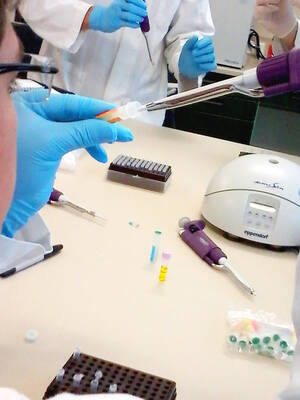
Google unveiled an artificial intelligence tool Wednesday that its scientists said would help unravel the mysteries of the human genome — and could one day lead to new treatments for diseases. The deep learning model AlphaGenome was hailed by outside researchers as a “breakthrough” that would let scientists study and even simulate the roots of difficult-to-treat genetic diseases. While the first complete map of the human genome in 2003 “gave us the book of life, reading it remained a challenge,” Pushmeet Kohli, vice president of research at Google DeepMind, told journalists. “We have the text,” he said, which is a sequence of
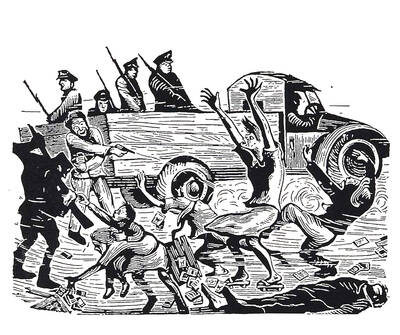
In August of 1949 American journalist Darrell Berrigan toured occupied Formosa and on Aug. 13 published “Should We Grab Formosa?” in the Saturday Evening Post. Berrigan, cataloguing the numerous horrors of corruption and looting the occupying Republic of China (ROC) was inflicting on the locals, advocated outright annexation of Taiwan by the US. He contended the islanders would welcome that. Berrigan also observed that the islanders were planning another revolt, and wrote of their “island nationalism.” The US position on Taiwan was well known there, and islanders, he said, had told him of US official statements that Taiwan had not
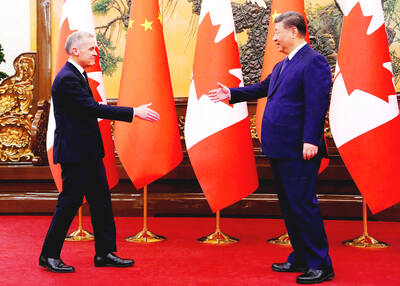
Britain’s Keir Starmer is the latest Western leader to thaw trade ties with China in a shift analysts say is driven by US tariff pressure and unease over US President Donald Trump’s volatile policy playbook. The prime minister’s Beijing visit this week to promote “pragmatic” co-operation comes on the heels of advances from the leaders of Canada, Ireland, France and Finland. Most were making the trip for the first time in years to refresh their partnership with the world’s second-largest economy. “There is a veritable race among European heads of government to meet with (Chinese leader) Xi Jinping (習近平),” said Hosuk Lee-Makiyama, director


 RSS
RSS