


We all know that Jay Chou (周杰倫) fancies himself something chronic, but his most recent automotive acquisition really takes the cake. Not content with his already considerable collection of luxury sports cars, the Chairman (周董) has recently taken delivery of his very own Batmobile.
According to a report in the United Daily News, the custom-made auto is based on the one used in Tim Burton’s 1989 Batman. The car, which takes up to three parking spaces and cost NT$5 million, is not just a collector’s item. Chou said he might have the chance to take it on the road one day. “We’ll see if the paparazzi will be able to keep up with me then,” he said.
Chou’s new toy is an innocent diversion compared to what other celebs have been getting up to, most notably Ethan Ruan (阮經天), who has been caught, once again, with his pants down.
Pop Stop reported last week that Ruan’s girlfriend Tiffany Hsu (許瑋甯) had changed her Facebook status from “In a relationship” to “It’s complicated” after the star was spotted at a hotel in Taichung with an unidentified woman.
Since then, additional details have been pouring in of his louche behavior.
At the time of the alleged indiscretion, Ruan was supposed to be on leave from the publicity tour for hit film Monga (艋舺), in which he starred, to attend his grandfather’s funeral.
Photos submitted by a member of the public to Next Magazine suggest that he might have had a date with a “long-haired hottie” (長髮辣妹) whose going price, according to the rag, is NT$30,000. There is still plenty of controversy as to exactly what might, or might not, have happened, as the dates and locations of the photos are disputed.
Rather less controversial, though equally eye-catching, is Stanley Huang’s (黃立行) most recent romantic involvement. Huang, who is no stranger to speculative gossip, has generally managed to keep a fairly tight lid on the details of his private life.
There has, nevertheless, been intense speculation about a possible new courtship following the breakup of his three-year involvement with singer Dominique Tsai (蔡詩蕓). According to Next Magazine, his new inamorata is model Hu Jia-ai (胡嘉愛). Up to now, Hu has been very much in the minor league, but perhaps now she’ll have a chance to move up from the D list.
Someone else who’s going places is Wang Ying (王瀅), niece of singer Harlem Yu (庾澄慶).
Wang is getting hitched to Jimmy Yang (楊立傑), scion of the Nankuo Construction (南國建設) family.
Suggestions that the whirlwind romance, which is leading to marriage after only six months, is being driven by a pregnancy are providing a rich vein for the gossip rags to mine.
From romance to finance: Chang Chen-yue (張震嶽) is romancing a “long-haired hottie” of his own. The singer is riding a wave, and apart from having nothing to hide (when asked who she was, he simply replied that he had plenty of women friends), his participation in Super Band (縱貫線), together with veteran rockers Lo Ta-yu (羅大佑), Emil Chou (周華健), Jonathan Lee (李宗盛), has proven a huge success.
The Liberty Times (the Taipei Times’ sister paper) estimates the band’s 52-show concert tour (six gigs were added on to meet demand), grossed NT$4.3 billion, with each of the performers pulling in NT$100 million.


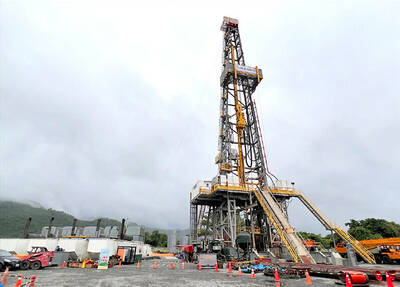
Taiwan’s renewable shortfall is a problem of execution, not resources. Japan’s long-cycle, joined-up energy planning is the model worth studying — but what Taiwan can borrow is the institutional machinery, not the politics. When Nvidia CEO Jensen Huang (黃仁勳) used his visit to Taipei last month to warn that the country needs far more electricity, he was naming a constraint its own planners already know well: Taiwan Power Co (Taipower, 台電) expects demand from the semiconductor and artificial intelligence (AI) sector alone to exceed 5 gigawatts (GW) by 2030. The harder question is not whether to build more capacity but which
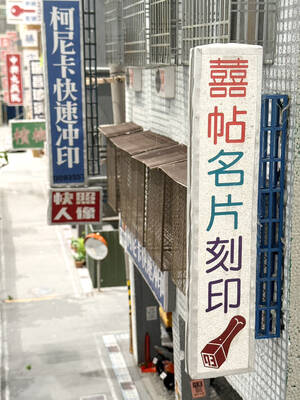
In a projection room, visitors at the Re: Battle City exhibition at Kaohsiung’s Neiwei Arts Center are invited to sit and watch a 20-minute animated movie. Artist Chang Li-ren (張立人) created the movie with dolls he made by molding paper into crude, painted figurines. The dolls interact in a detailed and realistic Taiwanese cityscape. Outside the projection room, visitors can wander around a massive model of the city. A sizeable crowd happily takes pictures of what looks like the best dollhouse in Taiwan: the same props that were used to tell the story of the country’s descent into techno-dictatorship in the movie. The
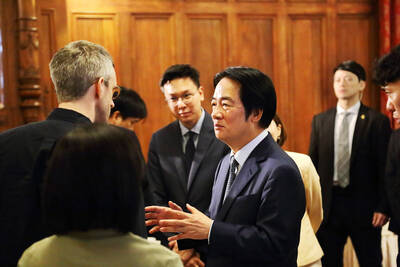
The last time Taiwan’s foreign correspondents were invited to a special briefing with a sitting president was in 2015. That was two presidents ago under Ma Ying-jeou (馬英九). But Thursday morning, President William Lai (賴清德) welcomed the nation’s international press corps warmly, speaking specifically to the theme of press freedom. Lai addressed Taiwan’s foreign press corps saying, “You live, work and report in Taiwan.” “Thank you for your professionalism and upholding the spirit of press freedom,” he continued. “As you engage in your work of journalism, you let the world see Taiwan.” The timing of this event, hosted by the Taiwan Foreign
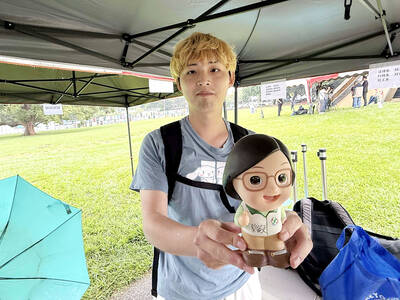
Chinese Nationalist Party (KMT) Chairwoman Cheng Li-wun’s (鄭麗文) recent trip to the US highlighted her party’s anti-Taiwan defense policies. Disapproval of their policies was strong among those who met with her. Republican Senator Dan Sullivan, said that the KMT was “playing with fire.” Democratic Representative Tom Suozzi reportedly said that Cheng’s party was “weakening deterrence.” Foreign policy maven David Sacks observed in Asia Nikkei that “many Americans struggle to see the logic behind the KMT’s refusal to fund the portion of the special defense budget pertaining to indigenous defense production.” The logic of the KMT’s decision to purchase only US


 RSS
RSS